Is it really time to talk about putting away the boat for winter? Sadly, for many boaters, the end of the season is just around the corner. If you’re in an area where winter will eventually show its face, you may be staring down the prospect of leaving your boat unattended for a stretch of four to six months. A lot can happen during that time, potentially damaging your boat, its engines or one of its systems. Fortunately, there are options to assist in keeping an eye on your pride and joy.
Boat monitoring systems have been available for more than a decade. If you’re familiar with the category, there is an excellent chance you were first introduced to it by Siren Marine (now a division of Yamaha Marine). Monitors from Siren and numerous other manufacturers have long focused on ensuring your boat is safe and ready for your next use. During the boating season, that is just what most boaters want to know.
Although most monitoring products are sold based on their use during the boating season, there are numerous reasons to also monitor your boat during a layup period. “Many boat owners assume that once their boat is hauled or winterized, the risks are behind them,” says Austin Bliss, CEO of remote monitoring company Sensar Marine. “In reality, the off-season presents an entirely different set of threats, and because no one is checking on the boat regularly, problems can go unnoticed until significant damage has already occurred. During the off-season, batteries slowly discharge, water can find its way into the boat, temperatures can reach damaging extremes, and boats remain vulnerable to theft, unauthorized movement or accidental impact.”
Before we dive too far into off-season boat monitoring, let’s talk for a minute about how a monitoring system helps during your boating season, no matter how long or short. Boat monitors are, conceptually, relatively simple devices. They monitor a number of sensors on your boat and report if any of the measured values are outside of expected ranges. Typically, they connect to the world through a cellular network and send information to a dedicated app on your phone along with email and text messaging.
Sensar
These monitors watch things such as boat location, battery voltage, bilge pump activations, temperatures, door and security sensors, motion alerts and more. Increasingly, the monitors connect to your boat’s NMEA 2000 network and monitor values including engine information, tank levels, digital switching and other data.
If your boat is hours from your home, getting an alert that the starting battery’s voltage is low beats making the trip and arriving at a boat you can’t start. If you anchor or tie up to a mooring ball regularly, knowing the boat is where you left it greatly enhances peace of mind. And regardless of how you use or store your boat, knowing when your bilge pump is running and for how long allows boat owners to catch issues before they become catastrophes.
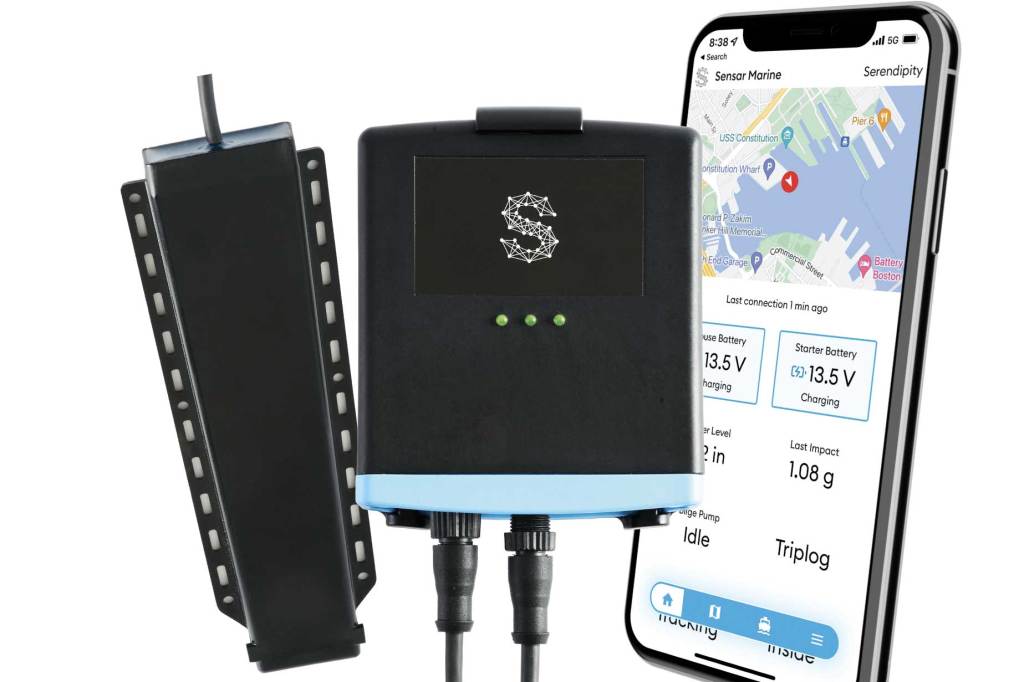
Boat monitoring systems start around $500 and can, depending on the sophistication of the system, scale well into the thousands of dollars. The simplest of systems monitor and alert on a relatively small number of sensors. For example, Sensar Marine’s base system monitors two batteries’ voltage, bilge pump activations, bilge water level and temperature, impacts and location.

In contrast, Siren’s $1,500 Long-Distance Cruiser Bundle includes monitoring of location, batteries, high water, shore power, an entry sensor, temperature and NMEA 2000 data, including engine parameters and digital switching. Other satellite monitoring products, including more security-focused options from companies like Global Ocean Security Technologies (GOST), pick up about where Siren tops out.
Focusing back on remote, off-season monitoring, it is important that a system enhances your awareness of what’s happening on the boat without contributing to any troubles. A boat monitor is a great tool to keep tabs on things through the winter layup, but not if that same monitor also consumes power from and places strain on the boat’s batteries. Fortunately, there’s a new crop of monitors with internal batteries designed to run a long time without drawing power from the boat they are monitoring.
Some boat monitoring systems are better suited to off-season use than others. Sensar Marine’s monitor includes an internal, rechargeable battery that can power the system with no external power for up to four months. If your boat is outfitted with lithium-iron-phosphate batteries, it is important to ensure they aren’t overdischarged, as that can destroy them.
“Sensar Marine is ideally suited for boats in layup, providing reliable 24/7 monitoring of the fundamentals of boat health, including location, battery voltages, bilge pump activity, impact sensing, ambient temperature and more,” Bliss says. “Our unique engineering allows our devices to operate year-round, in temperatures down to minus-40 Fahrenheit, without any parasitic load on the boat’s batteries. And because Sensar Marine is hardwired, our owners never need to worry about maintaining wireless sensors or replacing disposable batteries in the middle of winter.”
Another player, Skyhawk Oversea, takes the power independence concept a step further. While Sensar draws no power from the boat’s batteries unless they are actively charging, Oversea never draws power from the boat’s batteries. Instead, the system relies on non-rechargeable batteries that last for multiple years. Skyhawk’s all-wireless system uses long-range wireless technology that allows the hub and sensors to be located hundreds of feet apart. That range allows a single Oversea hub to potentially monitor multiple boats, especially in storage.
“Skyhawk Oversea was designed to be easily deployed using wireless technology, economical and uniquely suitable for off-season monitoring,” founder and CEO Rich Shevelow says. “The Oversea hub creates no drain on a battery in storage. One hub enables the monitoring of hundreds of sensors. It permits the long-term monitoring of batteries, bilge pumps and various environmental conditions with an extensive array of available sensors.”
While it is easy to select that system based solely on your in-season use, it behooves you to consider all 12 months of the year and select a system that works with both your active time using the boat and those times when the boat is stored.
Regardless of the system selected, a monitoring system ensures your boat is safe, secure and ready for your next adventure. During the off-season, a boat monitor helps ensure the assumptions you’ve made are true. If you left a trickle charger connected, you expect the batteries are being maintained. Additionally, you expect your boat isn’t filling with water. A boat monitoring system verifies those assumptions and dramatically increases the odds your boat will be ready for your next season of enjoyment.
This article was originally published in the October 2026 issue.