Billy Black
At The Anchorage, a small boatyard on the Warren River in Rhode Island, the Rolling Stones come first. Gimme Shelter plays from a dusty boombox tuned to The Wolf 106.3. The sound bounces off the rafters of the shop, guitars echoing across fiberglass hulls in various states of repair and construction. In one, Chico, the shop foreman, leans into a sander, working along the curve of the hull until a pale cloud rises and hangs in the light. He sings along without quite meaning to.
The building absorbs the noise and gives it back, softened against the whine of tools, the scrape of sandpaper, the low murmur of conversation. The work never quite ends. It just pauses and then resumes.
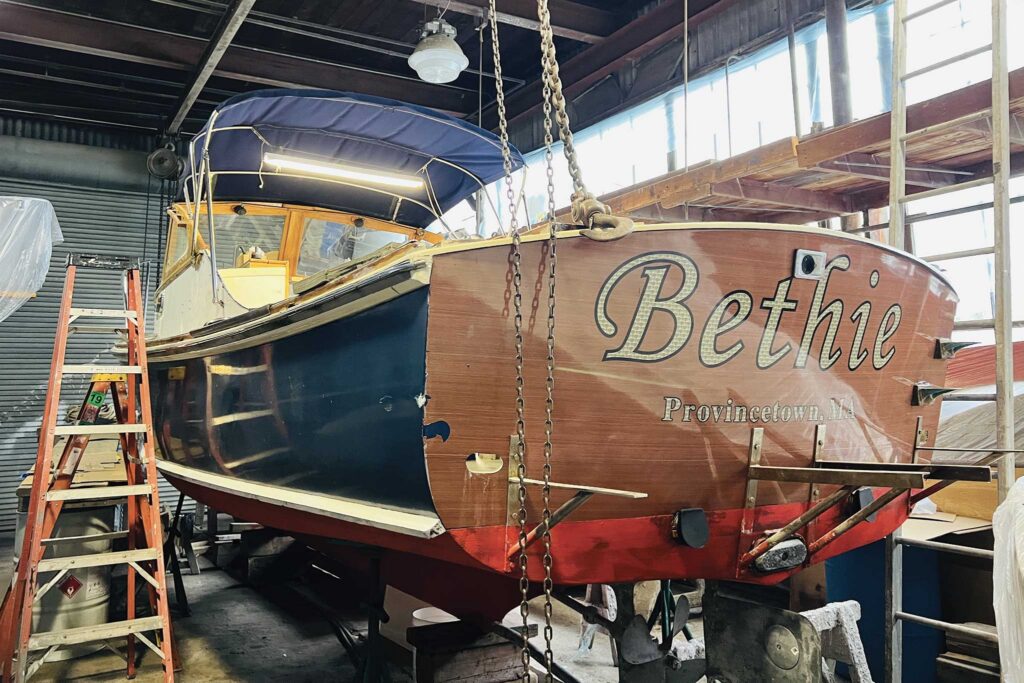
I’ve come to The Anchorage because I bought a boat, with the confidence that comes from not yet knowing enough. It is a 43-year-old fiberglass model with classic Downeast lines that’s well regarded among fishermen and priced to reflect how much work it needs. The shape suggests usefulness over glamour; something built for early departures and long runs offshore. I bought it from a private seller nearby in Rhode Island, someone thinning out a life on the water.
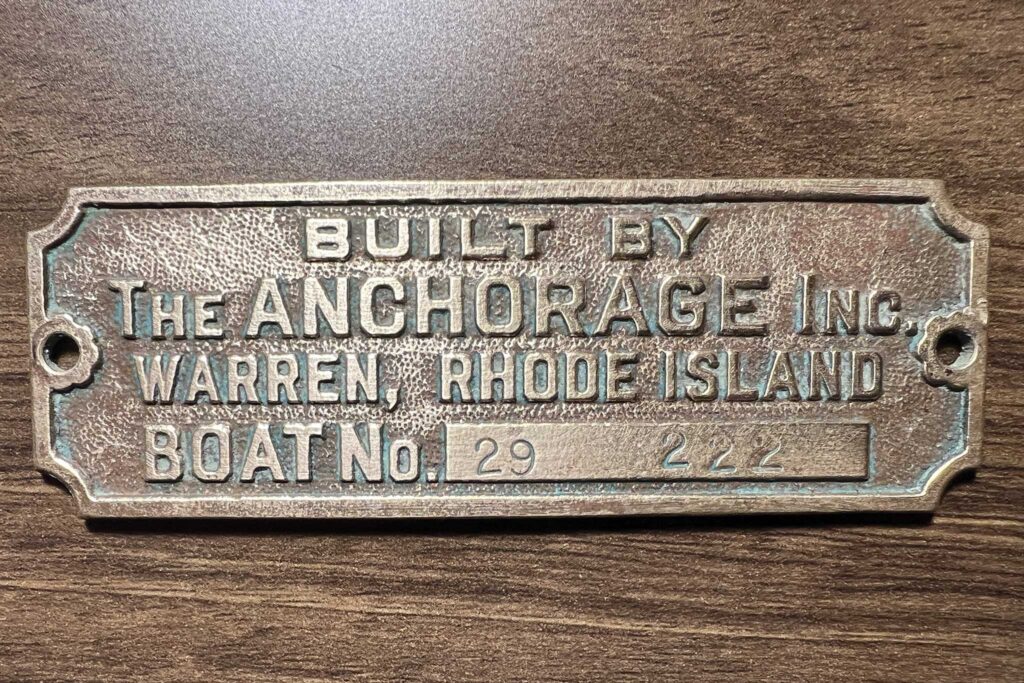
When I went looking for restoration advice, I learned the boat had begun its life here.
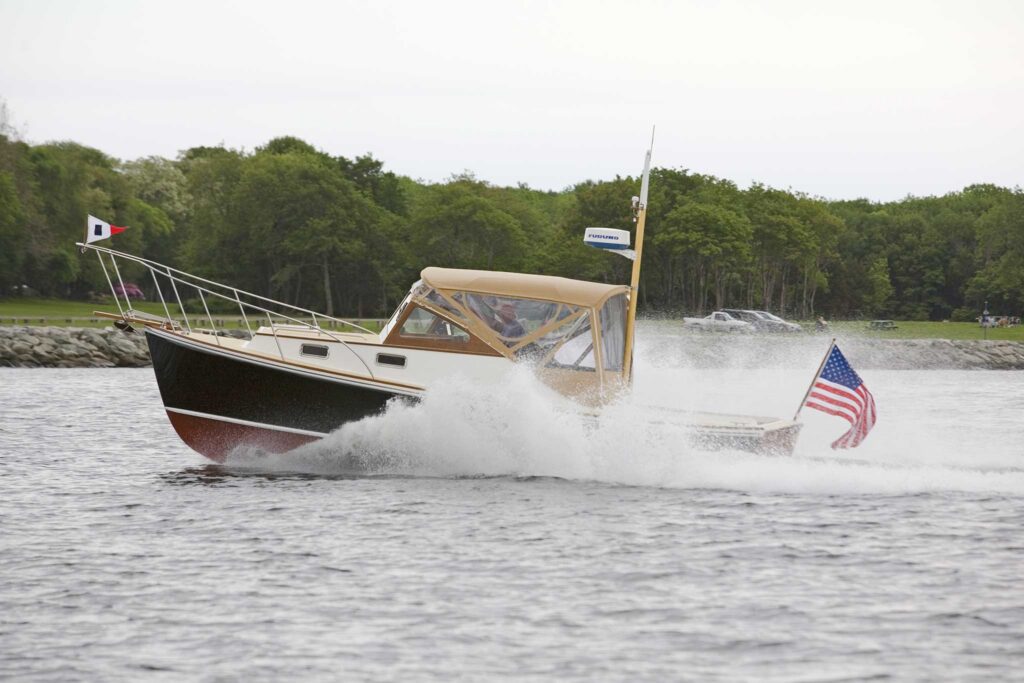
The boat was a Dyer 29, a design built continuously since the mid-1950s, widely believed to be the longest production run in fiberglass boatbuilding history. It comes from The Anchorage, a family-run yard founded in 1930 that has endured nearly a century of New England boatbuilding, surviving the Hurricane of 1938 and a devastating fire a generation later.
The yard has also outlasted the industry’s own upheavals: the rise and collapse of wooden yards, the postwar turn to fiberglass, and the consolidations that followed. Along the Northeast coast, the Dyer earned a reputation as a simple, seaworthy boat—steady enough for striper fishing, capable offshore for tuna, and versatile enough that many owners kept them for decades.
Today, The Anchorage remains one of the few places where boats are still built and repaired largely the way they always were, by craftsmen cutting and sanding wood, and shaping and mixing resins in careful proportions learned through repetition. By comparison, much of the marine industry now runs on computer models and modular components, where efficiency favors replacement over repair, and the work leaves less room for the kind of knowledge that comes from fixing things by hand.
The boatyard sits low on the river, where old industrial buildings still line this stretch of Rhode Island shoreline. From the water, The Anchorage barely announces itself—two weathered structures pressed into the bank, as if trying not to draw attention, its windows giving little hint of the work still going on within.
The scale of the buildings feels out of proportion to the
activity inside. The factory has produced some 30,000 vessels in dozens of designs. At its height, the yard would have kept up to 35 workers moving between hulls and machines. Now the work is carried out by a small, trusted crew and a reliable circle of contract hands ensuring efficiency in every task.
Walking into the two-story factory feels less like stepping back in time than entering a place where time has been allowed to accumulate. Boats sit in various stages of disassembly—some are stripped down to bare hulls, others half-reassembled, waiting patiently for their turn. Light filters down from high windows, catching on teak shavings and resin dust. The air smells faintly of wood and engine oil. Notes are taped to machines reminding whoever comes next how to mix, how to cut, how to avoid repeating an old mistake.
The Dyer 29 emerged during an optimistic moment after World War II, when fiberglass promised lightness and durability and boatbuilders along the New England coast began experimenting with materials borrowed from aviation and the military. It was a period when design still belonged largely to individuals—people working by trial and error, shaping boats according to what they learned on the water rather than what a committee or a computer suggested.
Bill Dyer, the founder of The Anchorage, was one of them. A former cotton broker who drifted into boatbuilding before the Depression, he spent the 1940s writing to other builders experimenting with plastics and traveling to see their successes and failures firsthand. He was less interested in novelty than in reliability. The boat he wanted was simple, seaworthy and repairable—something that could be used hard offshore and trusted to come home.
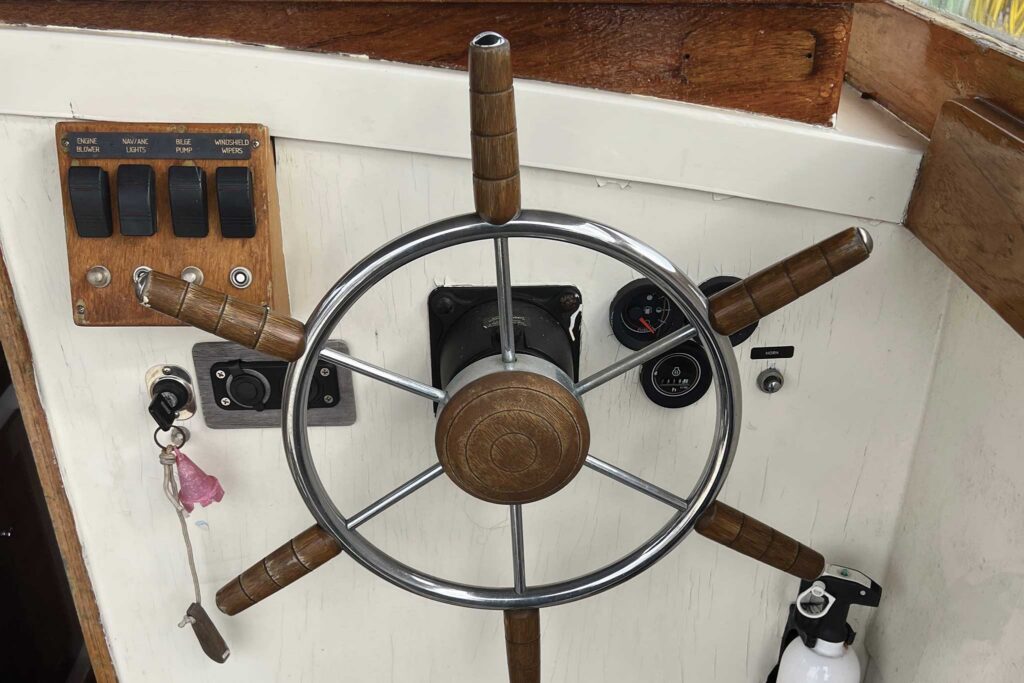
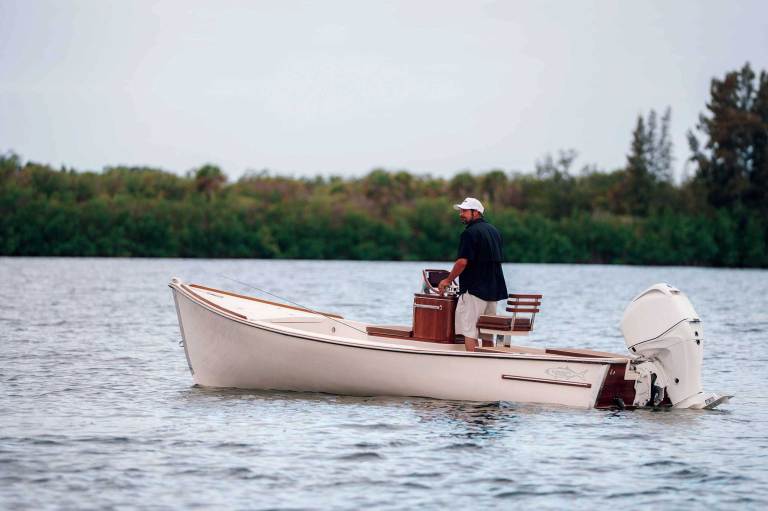
The Dyer 29 followed naturally from that approach. Its beauty lies in its low profile, spare lines and soft sheer, embodied in a solid one-piece hull. A story in the Autumn 1980 Nautical Quarterly deemed boats with this semi-displacement hull so seaworthy they seemed “designed by a fish,” an acknowledgment that the water itself, rather than software or artificial intelligence, settled the final shape. Owners valued the way the boat handled in real conditions—not fast by modern standards, but predictable, dry enough for long runs and forgiving when the weather turned. The form proved so balanced that it never needed redesigning.
Most of the yard’s output has long been its smaller boats—Dyer dinghies. From the 7-foot, 11-inch Midget to the 9-foot Dhow and 10-foot Dink—they have become quietly ubiquitous along the coast and was prized as a tender for its stability, durability and the same straightforward practicality that defined the larger boats. Online groups trade photos and restoration advice. nearly 70 years later, though output has slowed, the boats are still in production.
The company is now run by Dyer’s grandson, Tad Jones, who brings an intimate knowledge of each project while working in close coordination with Chico, a 40-year employee, and his sister, Anna, who manages the office and keeps the business on track.
Island Marine CEO Nick Kiyriakos, a mechanic/consultant who comes through occasionally to work on engines, often pauses to watch Chico, smiling at the rhythm of the shop. “This is a special place,” he says, trying to imagine what it was like 40 years ago, when boatbuilding was a bigger part of life in Rhode Island.

On the shop floor, Chico and another carpenter named John handle much of the repair work and construction. They know the boats by hull number. They remember which ones were altered, which ones came back after hard use, and which ones never quite behaved the way they should have. There are no apprentices in this shop.
At one point, while repairing the cabin roof on my boat (#222), Chico snapped the head off a screw buried deep in the fiberglass, left behind years earlier in a careless repair. He clamped one pair of pliers onto the thin edge of the screw, then locked the second over the first for leverage, turning slowly. He finally worked it free like an Old West doctor extracting a bullet, and dropped the fragment into my palm. “Merry Christmas,” he said.
It was the kind of small problem that stops work cold if you don’t know what to do next. Much of what happens inside The Anchorage exists in that space—knowledge learned slowly, rarely written down, and now carried by fewer people each year.
Working alongside them, stripping hardware, rebedding fittings and filling old screw holes in my boat, which is a gem in the rough among the other Dyer 29s here, I begin to understand why these boats inspire such loyalty among fishermen and longtime owners alike. They are not museum pieces. They are working boats, built to be repaired and meant to stay in service long enough for owners to know them well.
In recent years, the boating industry has moved in a different direction. New boats are designed on screens, built from modular systems, and engineered for comfort and predictability. Interiors increasingly resemble small apartments. Walk through most marinas now and the boats begin to look alike—similar proportions and layouts, solutions arrived at through software and market research. They are safer, faster and more efficient than the boats that came before them, but I think they leave less room for improvisation or long familiarity. The Dyer belongs to an earlier assumption: that a boat will be used hard, kept long enough to be understood, and passed along rather than traded in.
At The Anchorage, nobody talks about preservation. The work simply continues. A piece of teak is cut, fitted and sanded. Resin is mixed. A hull is repaired because it can be. Fiberglass has proven more durable than anyone expected when these boats were first built. The Anchorage builds the same boat, the same way, for the same reasons, in a world that no longer rewards such behavior.
Many of the earliest Dyer 29s are still running, and most of the ones in the shop will likely remain on the water for decades, long after the men repairing them are gone. What is less certain is whether the knowledge required to keep them that way will survive as long.
Asked about it, Jones shrugs. Skilled labor for this kind of work is hard to find, he says, especially among younger people who are more interested in finance, computing or AI.
“We just do things our way here,” he says, echoing his grandfather. “ We build ’em to last.”
Outside, the river moves past the buildings as it always has. Inside, the radio plays, a sander starts up again, and another boat waits its turn.
This article was originally published in the June 2026 issue.