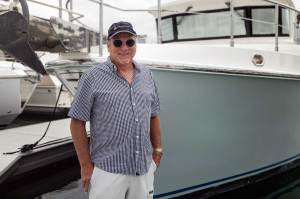
As we approached the boat tied up at the dock, he didn’t call out the confident sweep of the sheer line or the wave-piercing entry of the deep-V hull. He didn’t dwell on the square-shouldered pilothouse that’s a study in workboat-inspired gravitas. Ben Knowles steered us away from those standout features of the Targa 41 and zeroed in on something a little more granular: the side decks.
For skippers who handle boats with family crews—or no crew at all—this type of detail really matters. Knowles is keenly aware of that. This Maine native is a lifelong boater who’s raced at a high level and logged countless miles under sail and power throughout the Northeast, Caribbean and beyond. With no pinched corners or awkward transitions, a passenger can circle this boat with confidence, aided by substantial bulwarks and sturdy handholds. The trade-off for the side decks is less volume in the cabin, but Knowles says it’s worth it. “Once you understand what these can do for you, it’s hard to accept anything else,” he said.
Knowles is president of East Coast Yacht Sales (ECYS), the Targa dealer for the eastern United States. He’s a fan of Nordic boat design, particularly this brand built by Botnia Marin in Finland. “The Fins like going fast, and they like rough weather, but they’re also very practical,” he said. That realistic approach to design has garnered Targa the respect of offshore cruisers who value its overbuilt quality and its capacity to keep crew comfortable for long periods of time. Knowles himself plans to run the 41 to Newfoundland for a couple of weeks this summer with his wife and three young children.
The float plan on this day was less ambitious but still promising. Knowles and his colleague Bryan Roach would run the boat about 40 miles south from the ECYS location in Mystic, Connecticut, to Montauk, New York, and back again. Fortunately, conditions were dreary, with steady rain, low visibility and temps in the cool 50s. They were just right for a model billed as an all-weather cruiser that leaves the dock when other boats won’t go.
Knowles was at the helm as we left the slip. The pilothouse door to starboard (one of two) was open, and he was able to step onto the deck to assist with lines. Because the doorway is substantial, he had no issues with headroom as he moved in and out of the boat. “The flow here is easy, and if it’s easy, you’re going to use it more often,” he said.
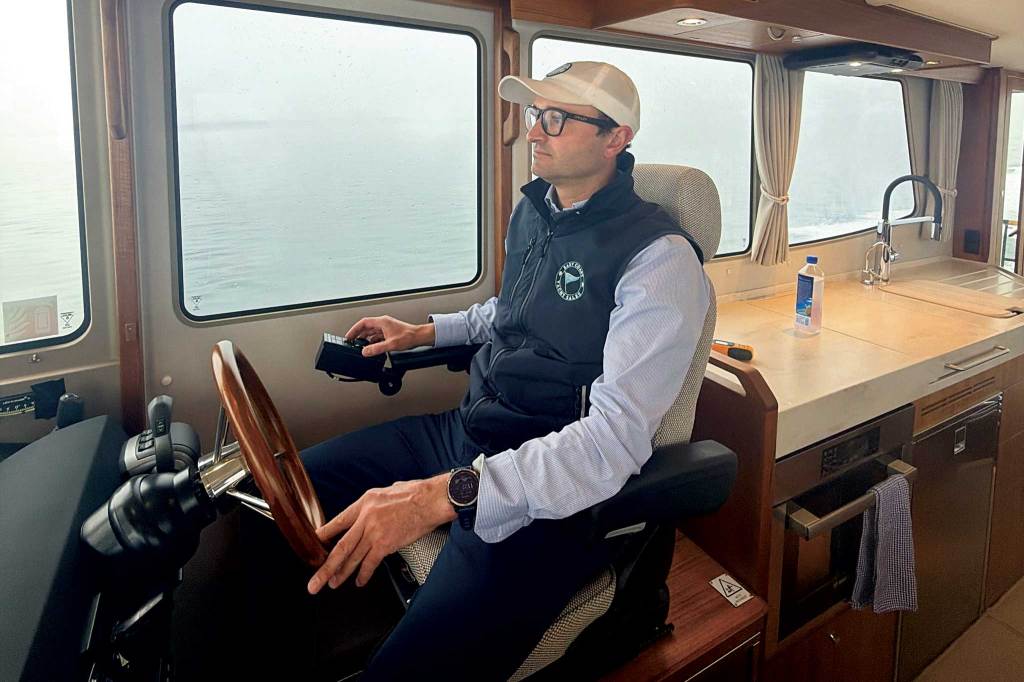
After leaving the Mystic River, we entered Fishers Island Sound, where it took no time to realize the 41 is a reliable sea companion. The defroster (not found on many boats in this size range) quickly cleared condensation and enhanced the excellent visibility through the windshield. Knowles called out its reverse rake. “It’s great when you come home in the dark,” he said. “This design offers a profound benefit when running at night, because it reduces glare. That’s why you see a lot of commercial and military ships with this type of windshield.”
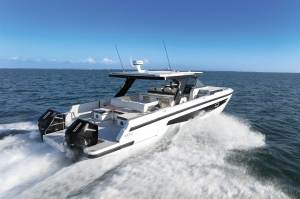
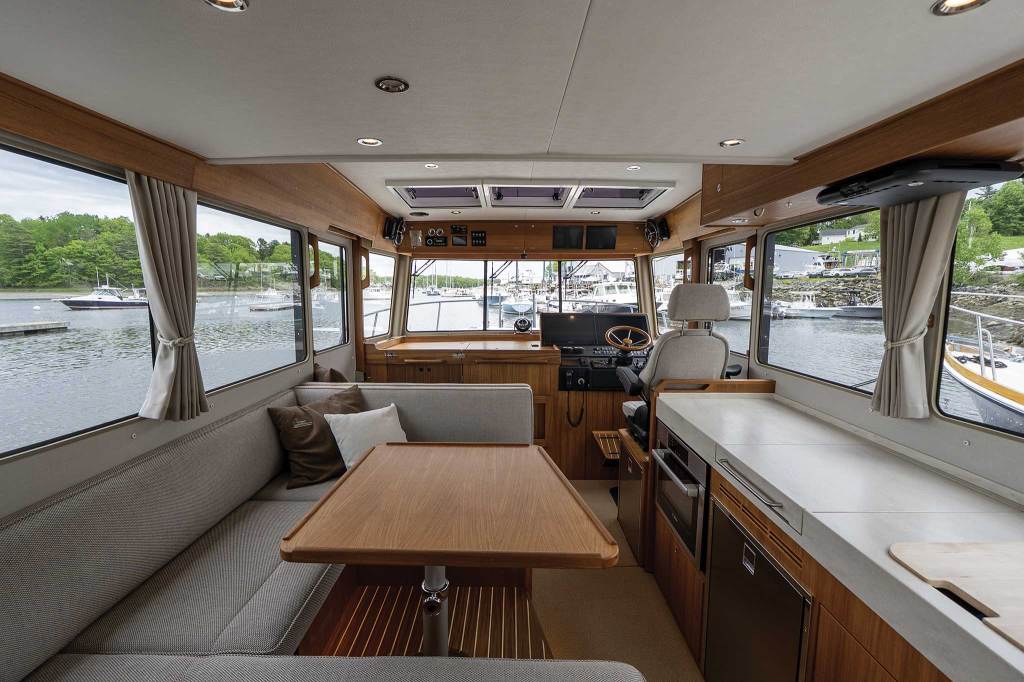
Sound levels were in the low-70-decibel range in the cabin as we ran at a good clip. “The high all-day cruising speed of the 41 at 80 percent engine load is 31 knots, burning 35 gph,” Knowles said. That gives her a range of 300-plus nautical miles. Power is a pair of 480-hp Volvo Penta D6 DPI diesel sterndrives. I sat on the long bench opposite the helm, admiring passing commercial boats on the steel-colored water, enjoying the substantial legroom and the warmth from the diesel-fired forced-air heater. Here were the benefits of cruising on the shoulder season.
The 41’s swell-cleaving stem and robust bow made for a business-like ride, even when conditions got bumpy at The Race off Montauk, where deep water, shallow shoals and swift tidal currents can stir up some chaos. At all times, the 41 felt like a substantial boat. Knowles switched off the automatic settings to demonstrate that the Targa is easy to trim and finesse. The ride was playful, too, heeling and carving when put into hard turns, then charging ahead with the vigor of a sportboat, achieving 38 knots at wide-open throttle.
At the dash, Targa favors a traditional electrical architecture with dedicated physical switches rather than digital switching. The approach reflects the builder’s emphasis on simplicity, reliability and the needs of owners who venture well beyond the nearest marina. That said, the Targa 41 is hardly short on technology. Available systems include an open-array radar, satellite compass, low-light camera, Seakeeper stabilization and lithium-ion batteries. “The boat represents a good balance,” Knowles said. “Right-sizing technology is an important consideration if you’re going farther afield.”
The Targa 41, which made its U.S. debut in 2025, is a significant model for the builder, as it represents a redesign after years of refinement and owner feedback. Some of the upgrades include hull windows that replace ports, and improved light and views through large, frameless windows in the salon.
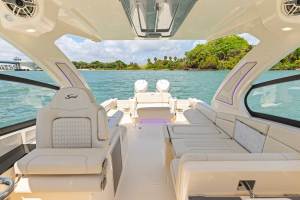
On the starboard side of the salon is a raised galley with good storage (including a clever paper towel holder) and impressive headroom (6 feet, 6 inches), despite the flybridge overhead. Opposite is a convertible dinette and a pop-up TV. Natural teak cabinetry throughout the 41 reinforces the boat’s salty character. It also brings back good memories for Knowles. “Our company was a Grand Banks dealer for over 30 years. I remember helping my father offload those boats in New Jersey and running them up to Maine,” he said. “Teak will always smell like a real boat to me.”
Below, the Targa 41 has a forward owner’s stateroom with a private head featuring a separate shower. The surprising accommodation, however, is the full-beam midcabin that’s accessed by its own staircase at the aft end of the salon and arranged with double and single berths. The day head is just a few steps away.
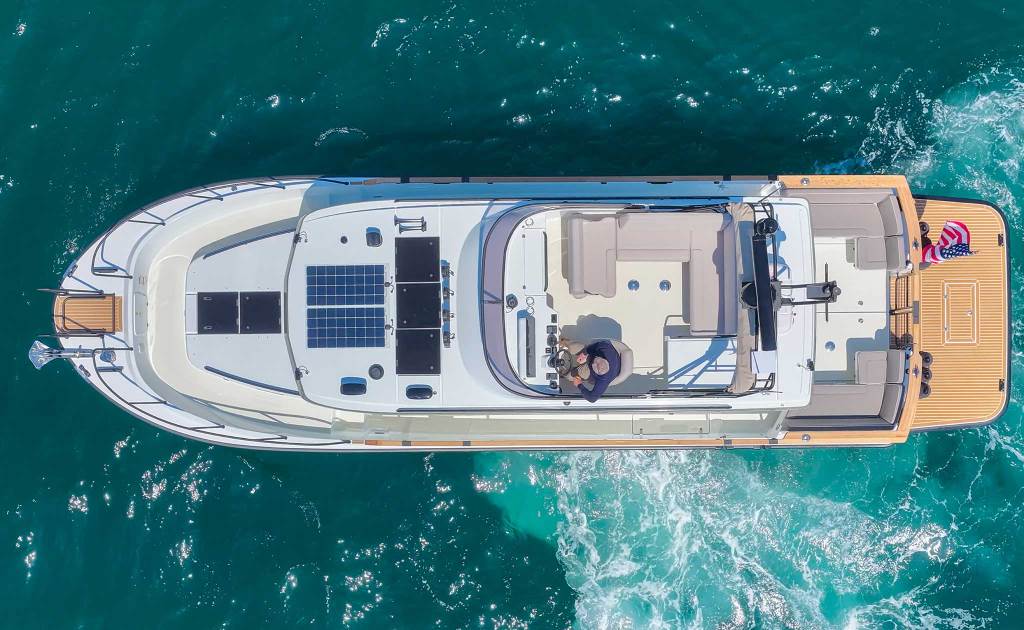
Once docked in Montauk, we checked out the cockpit. It reflects the 41’s emphasis on practicality, with twin gates that improve dockside access and create better traffic flow. Two highlights in the cockpit are the built-in staircase to the flybridge and the engine-room access. There are two hatches with hinges forward. When they’re open, there’s unobstructed access to the machinery space. Abaft the cockpit is a big swim platform with a clever hatch in the center that offers a view of the props. The platform can also accommodate a tender, which is important for adventure cruising.
After lunch at Safe Harbor Montauk Yacht Club, we boarded the 41 for the run back to Mystic. En route, Knowles shared some of the reasons ECYS took on the Targa brand. It’s a reputable family-owned company, for starters, founded by Johan and Britt-Marie Carpelan in 1976 and now run by their son, Robert, who serves as CEO, and daughter Martina, the creative director.
“They’ very modest, understated people, and they’re just great to do business with,” Knowles said. Targa is also a low-volume, high-quality brand that does a lot of engineering and construction in-house. As such, it can work with a company like ECYS to “Americanize” boats to its preferences, from the Dometic air conditioning system to the
through-hulls, sea strainers and other components specified by Knowles and his team. “We’re able to enhance the boat so it’s easily serviced in the U.S.,” he said.
By the time we tied up back in Mystic, the Targa 41 had made its case quietly and convincingly—which, it turns out, is exactly the point. On a gray, wet day that kept most boats at the dock, we logged miles in comfort and without drama. That’s a job requirement for a boat designed to go when others won’t.
This article was originally published in the August 2026 issue.