The year 1965 was brimming with future classics. Billboard’s Hot 100 music chart had two up-and-coming British Invasion acts in the top 10: The Rolling Stones and The Beatles. It was also the first full model year of the Ford Mustang, and the Stuttgart stalwart, also known as the Porsche 911, had just arrived on our shores.
Six decades later, these musicians and sports cars are still relevant. All have retained an enduring spirit and an oversized gravitational pull through constant refinement. They not only dug the foundation for goalposts, they kept moving them, and in the process exceeded expectations.
The same can be said about Grand Banks Yachts. Its future classic, the Grand Banks 36, splashed in Hong Kong Harbour in 1965. Since then, the company has continued to evolve its model line to appeal to a growing audience, a methodology embraced and advanced by CEO and chief designer Mark Richards.
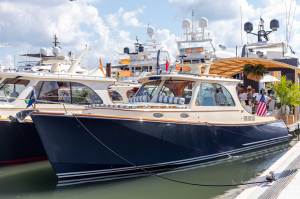
One might be challenged to see the lines of the GB 36 Classic in the builder’s latest launch, the Grand Banks 62. This thought was in my head when I was aboard the new model in June. I gathered lines and pulled fenders aboard as the boat exited Rhode Island’s Newport Harbor and hopscotched around the dozens of vessels on moorings. We passed a GB 36 just off our port side. Like the 62, it had a handsome, faux-planked hull and plenty of teak.
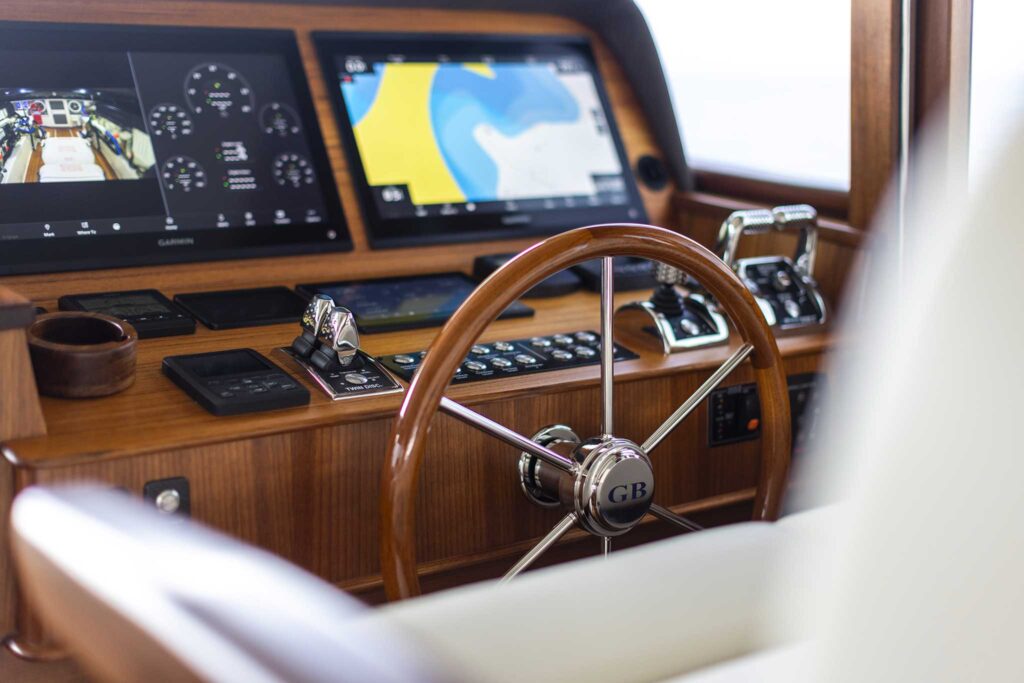
Twenty minutes later, at the flybridge helm’s destroyer wheel, I had forgotten any thoughts of comparison to the Grand Banks models of yore. I pushed the throttles, and in seconds the 62 jumped from 11 knots to just under 26 knots at 2000 rpm. Conditions were calm, so I chased the wakes of commercial boats as they returned from sea. Her hull made mincemeat of them. I made sudden, fast turns and simply could not unnerve the boat. The 62’s response was effortless, agile and confident. I firewalled the Twin Disc QuickShift transmission, and the boat topped out at 30 knots, with her power plants—twin 1,000-hp Volvo Penta D13s— hitting 2400 rpm, their max output.
The performance numbers were right on brief, an exact match to the estimates the builder gave us when the boat was under construction in Malaysia. Credit for that can be attributed to a number of factors, including perfectly tuned Veem props, Dometic hydraulic steering, Humphree interceptors and the ideal power match of Swedish iron. However, I would ascribe the lion’s share of the 62’s performance attributes to the hull.
Richards has made his slippery V-Warp running bottom the foundation of the Grand Banks model line since 2017. With a fine entry, some amidships curvature and minimal deadrise at the transom, this hull is a product of the performance-obsessed, former Sydney Hobart Yacht Race champion’s restless mind.
The 62 is light and lithe, in large part because she utilizes construction techniques that reduce weight and add strength. In addition, she’s topped with a carbon fiber superstructure. This yacht tips the scales at just over 72,000 pounds.
Not only can the 62 outrun other boats in her class, she is also a marathoner with a range of 2,531 nautical miles at 9 knots. Range is 1,728 nautical miles at 11.3 knots, and 907 at 17 knots. Even at a quick clip of 26 knots, with the engines at just under 70 percent load, the boat’s range is 637 nautical miles. For Richards, who prides himself on attention to detail and a strict adherence to performance-based results, proof is in the distances.
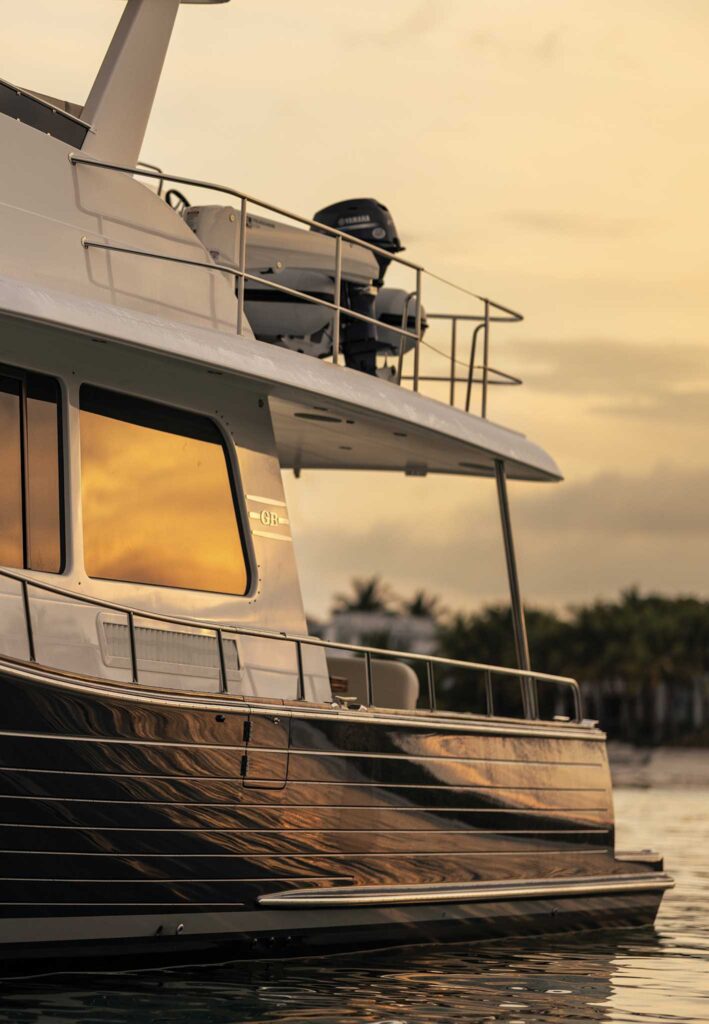
Once we returned to the dock and tied up at Casey’s Marina at Spring Wharf (the builder acquired the marina and service center earlier this year), I took in the boat’s lines. Like her sisterships, the 62 is an example of refined engineering, with a streamlined, purposeful profile and long waterline. The arc of the hardtop on the flybridge echoes the raked, forward-facing windows in the pilothouse. It gracefully curves outward as it goes aft, both to protect the sidedecks and to shade the cockpit completely.
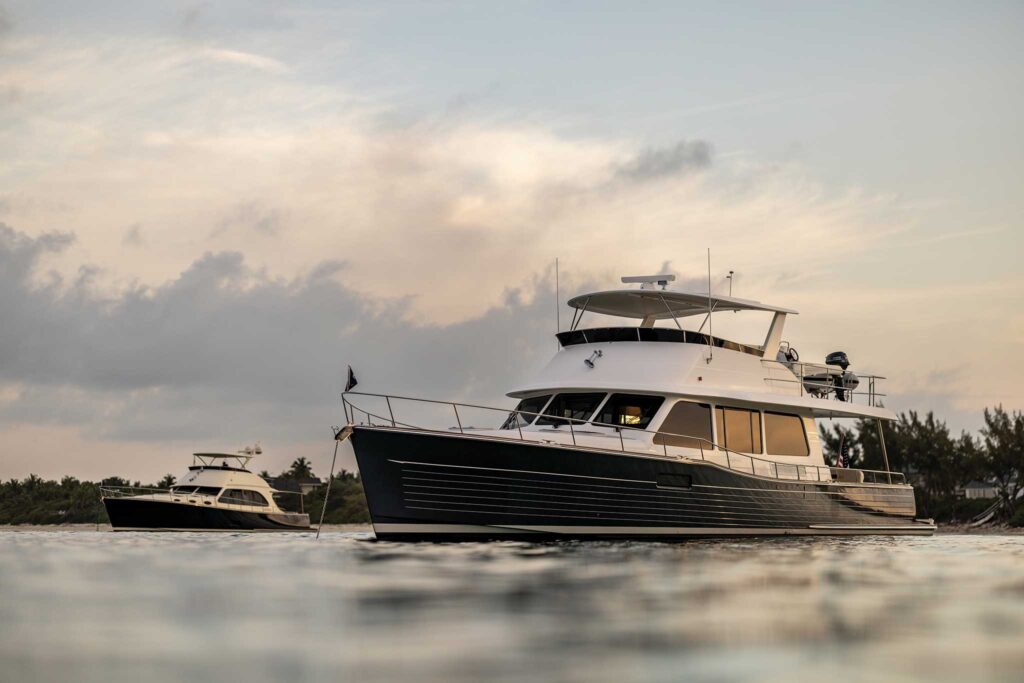
Hull No. 1 is an open flybridge model. Like many of the boats in the builder’s lineup, which ranges from 54 to 85 feet, the 62 is available with a fully enclosed skylounge.
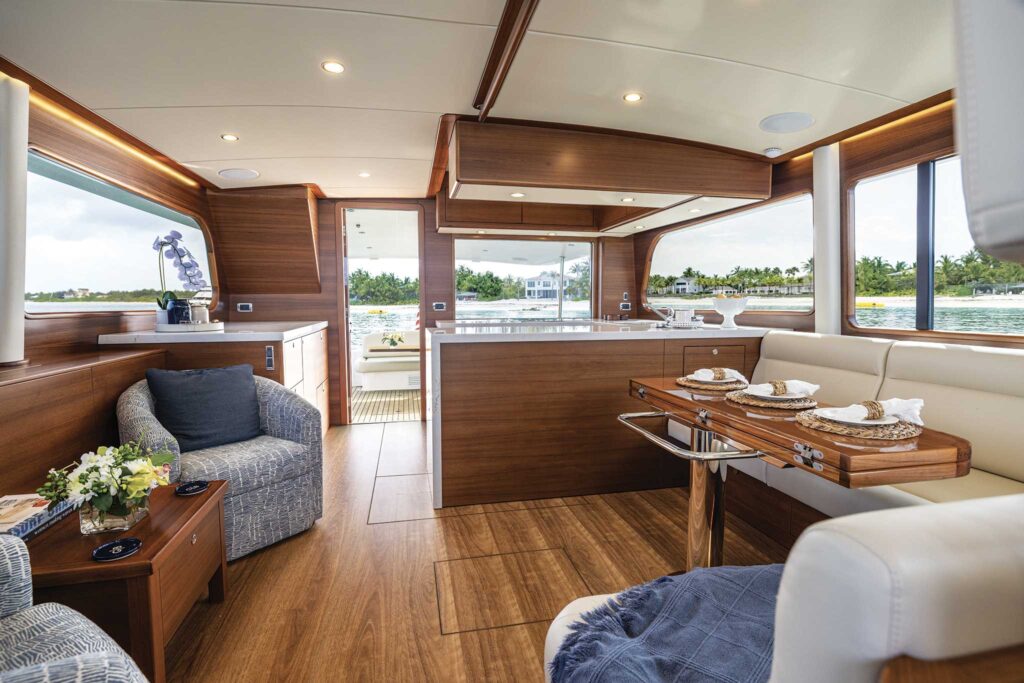
As I learned earlier in the year during a visit to the builder’s Malaysia boatbuilding facility, Grand Banks offers clients a semicustom build process, most notably in the salon and galley. Owners can choose from a number of layout options for the galley and dinette, and even forgo a lower helm station. To me, the galley aft is the Goldilocks option, since it’s located to service the cockpit (through an electric window) and the salon. The galley also has generous stowage, a Miele appliance suite, a full-size refrigerator and freezer, and additional fridge/freezer drawers.
Refinement and an understated elegance define the interior spaces. As is true on nearly all Grand Banks models, the book-matched teak is exquisite and used liberally above and belowdecks. The wide-plank soles are manufactured wood. They provide a fine contrast to the soft goods and slightly darker, satin-finished teak.
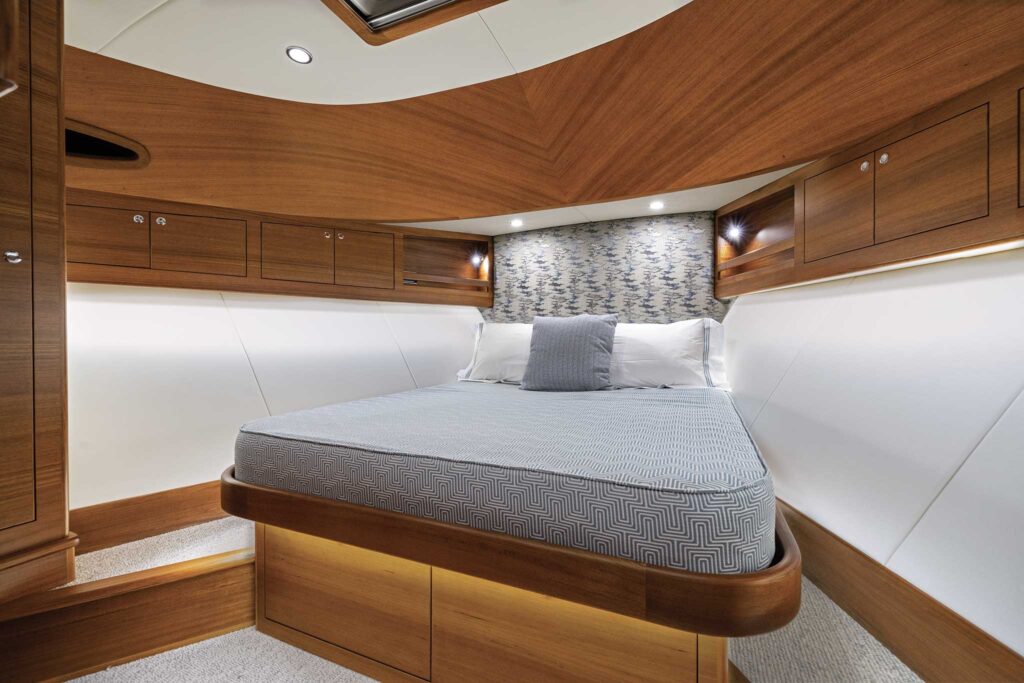
The 62 was developed from the 60 for those who want roomier accommodations. The boat retains the full-beam, amidships master with an athwartship king berth, and there’s a VIP stateroom forward with queen berth. The 62’s extra length allows the third stateroom to have two berths: a single and, two steps down, a double berth, plus an en suite head. A day head in the companionway is shared by the VIP stateroom. Mechanical spaces will serve the owner-operator well. There is significant length in the lazarette for paddleboards and kayaks. That space leads forward to the well-organized engine room, where I found crouching headroom and easy access to all service points.
For 60 years, Grand Banks Yachts has maintained its reputation for exceptional seamanship and reliability. Over the decades, the cruising cognoscenti have dubbed a number of its models true classics. More recently, under the steady hand of Richards, the brand has undergone a reinvention while retaining its place as a standard-bearer in the power-cruising market. In the new 62—a refined passagemaker that’s built to last—that exceptional attention to detail and craftsmanship are as present as they were back in 1965.
LOA: 68’10”
Beam: 19’2”
Draft: 4’7”
Displ.: 72,091 lbs.
Fuel: 1,532 gal.
Water: 317 gal.
Power: (2) 1,000-hp Volvo Penta D13s
November 2025