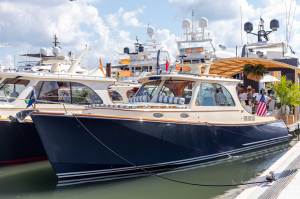
“We gave this design a valiant effort,” said Jeff Donahue, vice president of sales for MJM Yachts. He was referring to the 38RS, or Retreat Sportfish series. That’s how the company bills this sportfish/cruiser crossover, which is also family-friendly and eye-appealing, among other things. He shared this insight after I’d spent a few enjoyable hours with a fishing rod, perched on the boat’s ample bow.
I first saw the 38RS in Newport last fall, when it made its public debut. The boat brought me back to my teen years in New England. I’d eye the Downeast-style cruisers and dayboats that made up a big part of the local fleet. Yet even with their brightwork, mahogany coaming boards and teak decks, I wanted to fish those boats. Downeast design, after all, is historically tied to fishing. But over time, these vessels have lost their rod holders and fish boxes, and the open cockpits that were once organized for working lines are now more commonly set up for picnics and entertaining.
“Why would you ever want to get blood on those decks?” That’s what my father would say when I was a kid. And he had a point. The cost for the annual upkeep of those Downeast boats matched the price tag for our collective family fleet—his wee catboat and my little lapstrake dory.
A quarter century later, my adolescent prayers were answered. I was given the chance to fish from the MJM, a brand that’s celebrated for its modern interpretation of classic Downeast design. And because the boats are now built in North Carolina, MJM style is sometimes called “Carolina Downeast.”
I was invited aboard the 38RS for an early fall fishing trip, to put Hull No. 1 through her paces off Beaufort, North Carolina, where a nor’easter had created the type of conditions this boat was designed for.
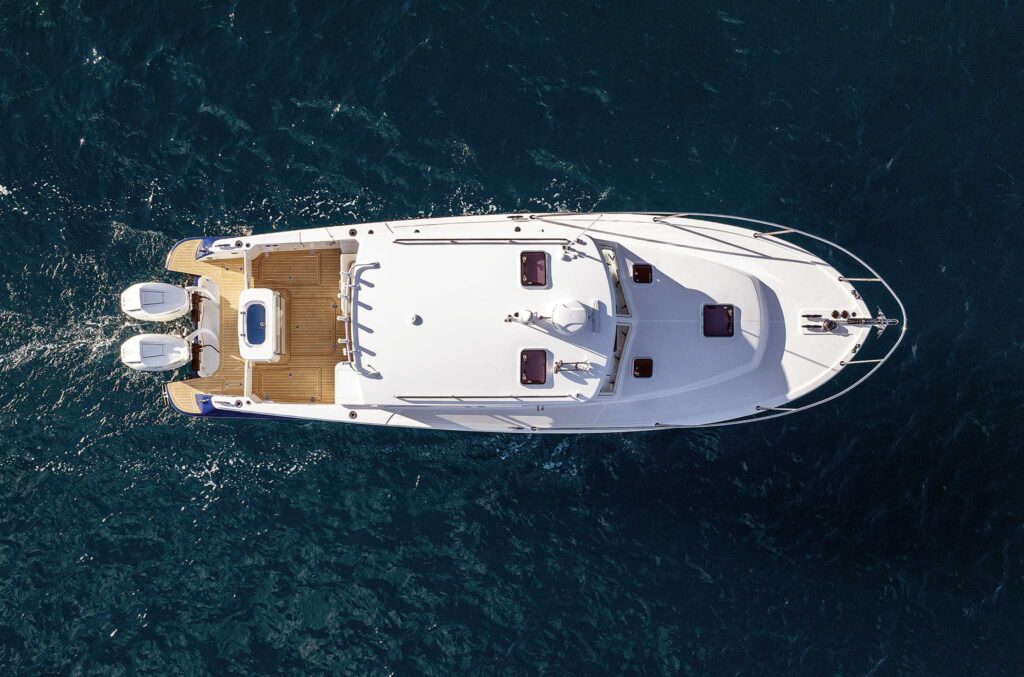
One of the first things anglers do to gauge a boat’s fishability is count rod holders. That’s what I did as soon as I boarded the 38. There were four around the cockpit rails (some were cupholder combinations) and two affixed to the aft end of the 40-gallon baitwell. A seven-rod rocket launcher was on the hardtop, to which outriggers can also be affixed. Even with all that rod stowage, there was still room in the cockpit for a tackle-storage system, a live well, a folding transom bench seat and another lounge that faced aft. A cockpit hatch revealed a storage area that could fit another half-dozen offshore rods, plus other pieces of bulky gear.
Once through the inlet, we worked our way down the beach to where the red drum bite had been on fire the previous day. We kicked on the Skyhook, which instructed the optional 400-hp Mercury V-10 Verado outboards to keep the boat stationary between a collision of wind, sea and tide. Those outboards had produced a top hop of 43 knots in chop on the way out.
“We’re the Grey Poupon of the fishing fleet,” Donahue said as we approached the fishing site. “No one’s going to fish this boat too hard.”
The 38RS is not designed to be a platform for highly competitive anglers who do the tournament circuit. To Donahue’s point, the owners of a 38RS might not enter the White Marlin Open or engage in run-and-gun offshore duty, but they will edge up to the rocks and toss plugs or set a handful of baits for a pleasant afternoon respite from the call of responsibilities on terra firma. Personally, I’d take this boat bluefin fishing near shore in summer or pack up the family for a bottom-fishing adventure.
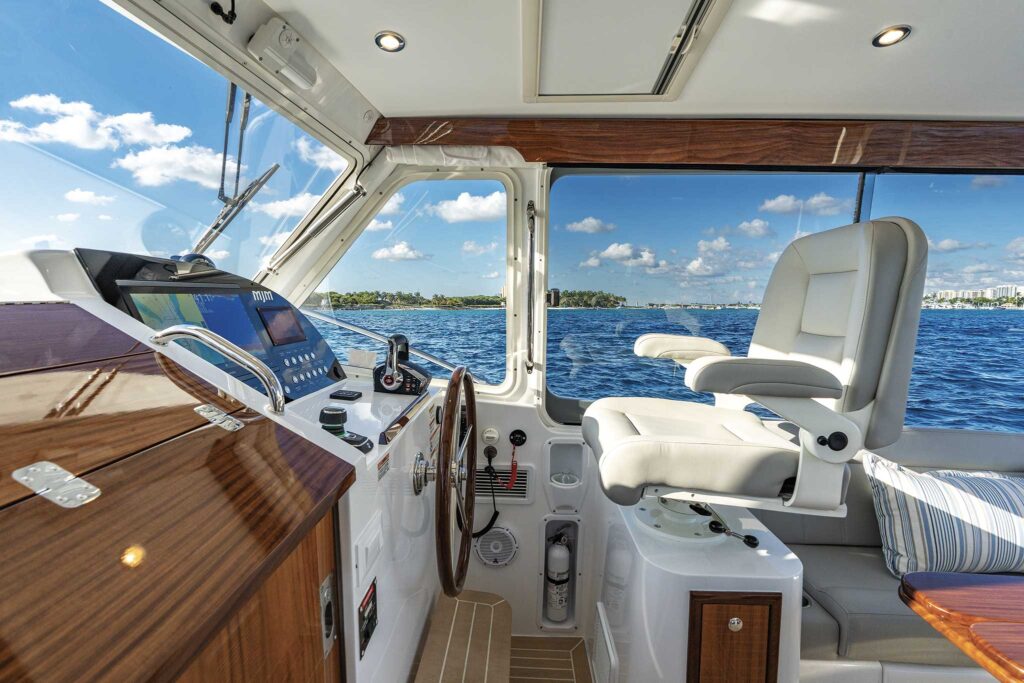
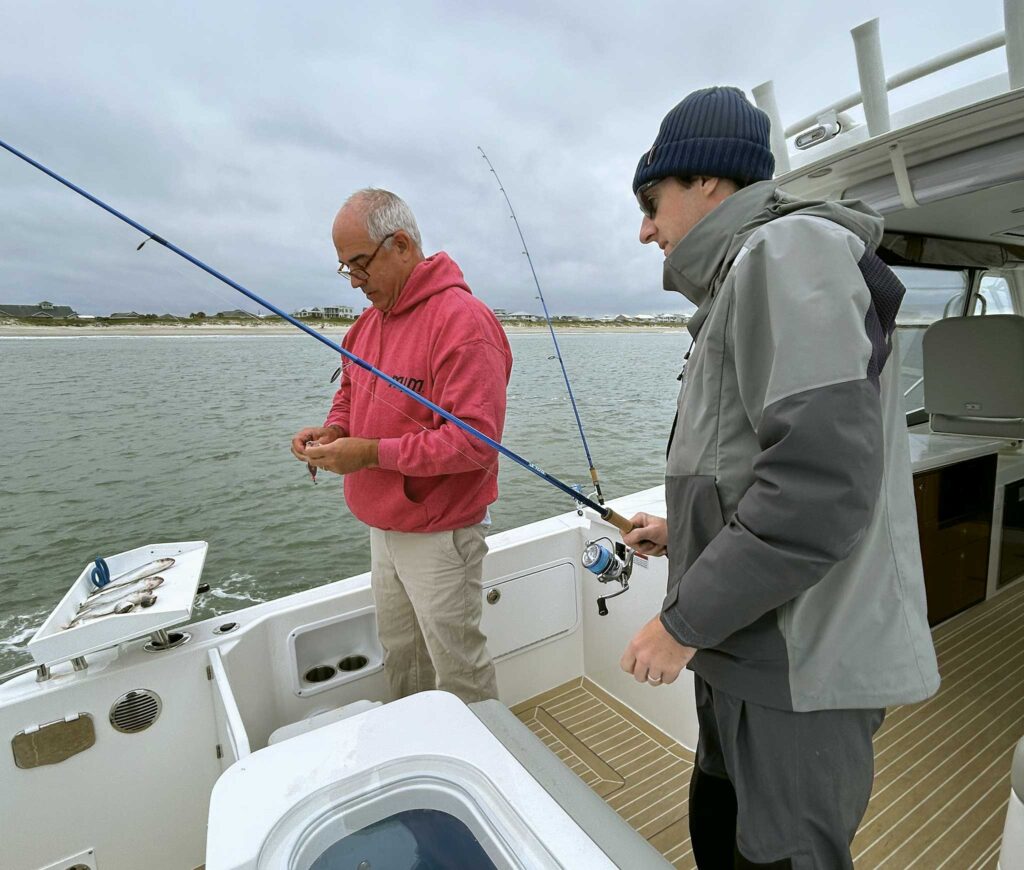
In the heated wheelhouse, MJM’s Madelyn Knobel watched the action from the L-shaped settee. Donahue and I split the cockpit, slinging bait in the shallows near the inlet and down the beach. We also did some vertical jigging on a nearshore wreck where I’m nearly certain I dropped a good grouper just before it broke the surface. That loss was not the boat’s fault.
The 38RS had touches of teak topside and in the pilothouse, but the decking was engineered wood, onto which I splattered the first bit of blood from a small bluefish. That catch was not the appropriate homage to the boat, but it made me laugh. I have a habit (or curse) of traveling from my home waters in the Northeast to fish for relative exotics like red drum and sea trout, only to hook this familiar fish time and again.
I wondered if the blood would come out of the faux teak. Six hours later those stains were baked in. I was concerned because the boat was going to be exhibited at a major show just a few weeks after this sea trial. Fortunately, Donahue only had to apply a splash of water and wipe the area with a cloth. The stain came right up.
I took a break from fishing to check out the cabin. I liked the fact that I didn’t have to hunch to step through the oiled cherry companionway. That delightfully bright finish also covered the bulkheads and defined the entire cabin. The layout included a V-berth, a dressing area with a bench, and a full-sized head with a separate shower. This cabin was not made to be a just a place to sleep when in a pinch. It was inviting and more comfortable than many other cabins in this boat’s class. There’s space for family members to spread out. One reason for that roominess: There’s no galley here. The galley is located up in the pilothouse.
We stationed ourselves in a rip during the last couple hours of a tide. My plan was to huck epoxy and metal jigs for false albacore. Donahue played run-and-gun at the helm and put me where I needed to be during the ephemeral feeds that took place. I wanted to catch a few of these fish and put the sizable counter in the galley to good use. I’d prepare them with a little soy sauce, pepper and a packet of crystallized lemon that I took from the beverage cart on my flight down. Grey Poupon, indeed. Unfortunately, the fish were not on board with this itinerary. We got no bites. My catch-and-cook prowess would have to be exhibited on another day.
I didn’t catch as many fish as I wanted to, but I did enjoy the time spent on the 38RS. While our boat was not as quick as the caravan of jaunty center consoles that left the inlet with us earlier in the day, we had no trouble pushing 30 knots almost right out of the hole. Even though those other boats were faster, their crews came back with empty fish boxes too.
More important, the seaworthy hull and enclosed pilothouse on the 38RS kept us all high and dry for the entire day, while the rest of the fleet wore doused foulies and returned to the dock looking more than a bit raw in the blustery weather. I’ll take high, dry and fishless any day.
LOA : 38’6”
Beam: 11’0”
Displ: 13,310 lbs.
Draft: 1’9”
Fuel: 250 gals.
Water: 50 gals.
Standard power: (2) 300-hp Mercury Verados
Optional power: (2) 400-hp Mercury Verados
This article was originally published in the March 2026 issue