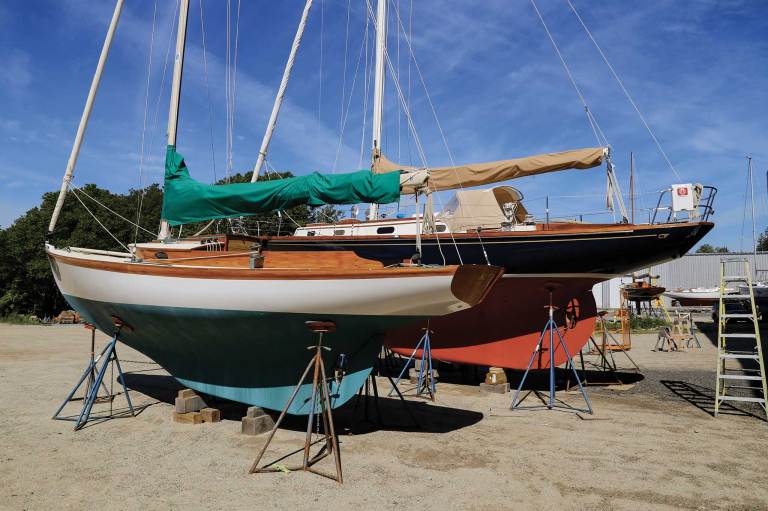
Peter Bailey sits across the salon table, deep in the bowels of Moccasin, a 1977 Cape George pilothouse cutter built for cruising and trolling salmon. The 78-year-old, while prepping the boat for a summer cruise, recites his three essential rules for sailing. “One: Don’t be stupid,” he says. “Be well prepared, well equipped, well trained and educated Two: Shit happens, especially if you violate rule number one. And three: Bring beer.”
Bailey was born in San Francisco and grew up in Laguna Beach, California. He didn’t come from wealth, but instead learned the ways of the sea during his days in the U.S. Coast Guard. He had remote postings in the Pacific during the Vietnam War, and later was one of the “body snatchers” who recovered suicide jumpers under the Golden Gate Bridge and rescued boaters who got in trouble.
After his discharge, he moved to Sausalito’s houseboat and hippie community, working as a carpenter and shipwright. He also started a family and planned to go cruising, an idea that promised adventure and escape from the high cost of living ashore. “I had two kids. I needed a place and I had no money, no property, no family wealth, nothing,” he says.
With some luck and a sympathetic landlord, he paid $35 shop rent at the Gate 3 Boat Co-op, where he laid the keel of Bertie in 1976. He built the hull of Port Orford cedar with internal ballast, and he named the 65-foot vessel after his grandmother. His design drew inspiration from Joshua Slocum’s Spray but sported a ketch rig with a fully battened Chinese lug main and a gaff mizzen.
Joined by his third wife, Heidi Snyder, whom he married after a courtship via handwritten letters, Bailey cruised Bertie from San Francisco to British Columbia to retrace the steps of Allen Farrell, who built simple and seaworthy craft on the beach using hand tools. In 2016, Bailey and Snyder set off from Port Townsend, Washington, on a voyage with stops in Mexico, the Galapagos, Panama, the Caribbean and Florida, eventually destined to cruise European canals and the Mediterranean. But first they headed to the Wooden Boat Show in Mystic, Connecticut.
They were 65 miles off the New Jersey coast on the evening of May 29, 2019, when a white squall—a microburst—hit them with full force.
“It goes oomph and it’s 90, 100 miles an hour,” he recalls. “It’s local. It’s small. It doesn’t last very long. Heidi was on watch, and I was coming up to relieve her. If I hadn’t, I might have died, because the boat went upside down so quickly and I never would have been able to get out.”
Just as he opened the companionway hatch to get outside, green water rushed in, flooding the cabin. Bertie refused to go down, kept afloat by her timbers and trapped air, so Bailey and Snyder got out and clung to the overturned hull while trying in vain to dive and activate the EPIRB that was submerged but failed to self-deploy.
As the seas calmed, Bertie rolled up on her side, letting them reach and set off the rescue beacon. Bailey, who didn’t wear foulies, was shaking as he became hypothermic. “I literally had him inside my body, like in my jacket and giving my body heat,” Snyder told a news station afterward.
The Coast Guard airlifted the couple to a medical center in Atlantic City, New Jersey, for a checkup. “Nice to see you alive,” the rescue swimmer said when visiting them with the flight crew. It was the swimmer’s first real job, and he got to save a former Coastie.
Sadly, though, Bertie was at the bottom of the Atlantic with all of the couple’s worldly possessions, including money and passports. They got back on their feet with help from hospital staff, friends, relatives, a fundraising page and an insurance policy. Soon, they bought Moccasin. “Did not have to think twice,” Bailey says.
As for his three rules: They tested numbers one and two in inverse order, but there was no beer on board at the time of the accident. “Beer helps,” he adds, “but isn’t necessary.”
September 2025