Adam Nowalsky is a licensed captain who has been chartering boats for more than 25 years. He grew up fishing with his father on a progression of boats that increased in size as he got older. Through high school and college, he worked in local tackle shops and as a mate on charter boats. He bought his first boat, a 26-foot Sea Ox with twin sterndrives, in the late 1990s. Not long after, he saw two Osmond Beal-designed Downeasters. The boats made an impression on him.
“Once you see a Downeast boat, it gets in you,” Nowalsky says. “And it stays with you the rest of your life. This boat type blends form and function in a way that speaks to me.”
He began to search for a Downeaster of his own. After many months, he located a 35-footer designed by Willis Beal. It was sitting in a yard in Steuben, Maine. He bought the boat in 2010 and brought Karen Ann II back to New Jersey, where he put her into charter.
At the time, the price of diesel fuel had spiked from $1.50 to $4 per gallon, but the efficient hull let him run his business economically. He needed a mere 15 to 20 gallons of diesel per day. “I would cruise at 13 knots and jokingly tell my clients that when the boat hit 15 knots, I got whiplash,” he says.
He sold Karen Ann II in 2017, and then bought a 21-foot BHM Downeaster with an outboard in 2020 so he could fish with his children. He continued to study Maine builders and watch brokerage listings. In time, he located Valiant II, a 29-foot Osmond Beal design built in 2004 at H&H Marine in Steuben, Maine. The fiberglass boat was in disrepair after years of hard use as a commercial lobster boat, but that didn’t deter Nowalsky.
In early 2023, he began a major refit. Taylored Boats in Addison, Maine, lengthened and enclosed the wheelhouse, added a starboard-side sliding door and rear door, gelcoated the decks, installed new spray and rub rails, and repaired the hull damage from all of those lobster traps coming over the starboard side for years.
Taylored Boats also reconfigured the cabin, adding an access box for the engine and a rope locker for the Good windlass. Multiple transducers were installed, including an in-keel transducer for a 3D mapping system. The boat received a dual-ram steering system and a Michigan Wheel DQX four-blade prop before going to Glendon Stanley Awlgrip in Bernard, Maine, for paint in January 2024. Years of old paint was removed from the bottom, then the hull was re-seared. The hull and house were painted off-white, and a vivid red boot stripe was added.
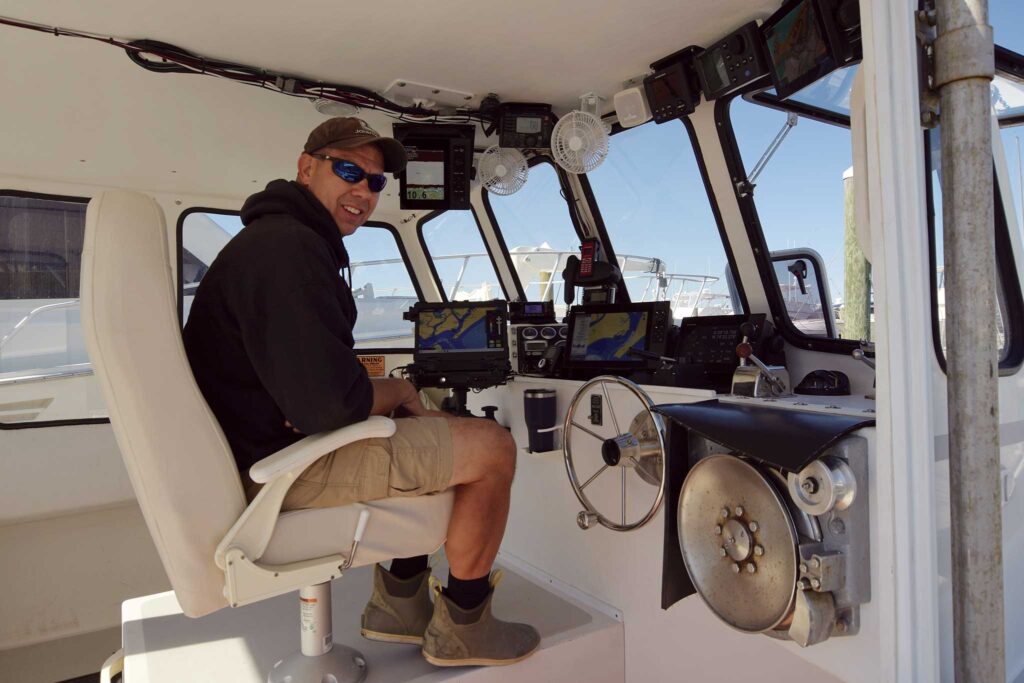
The boat was then trucked to Chestnut Neck Boat Yard in New Jersey, where Nowalsky executed a number of DIY projects. He’s an IT specialist at Stockton University in Galloway, New Jersey, so he’s handy when it comes to working on boat systems, from electronics to diesel engines. He installed a breaker system and a 24-circuit Blue Sea electrical panel. He replaced all the deck hardware, adding rod holders and a Seaview Global mast for the Furuno radar, FLIR camera and antennas. He integrated Furuno TZtouch multifunction displays with a depthsounder. He installed a computer with TimeZero software to record bottom hardness, an important consideration when bottom fishing.
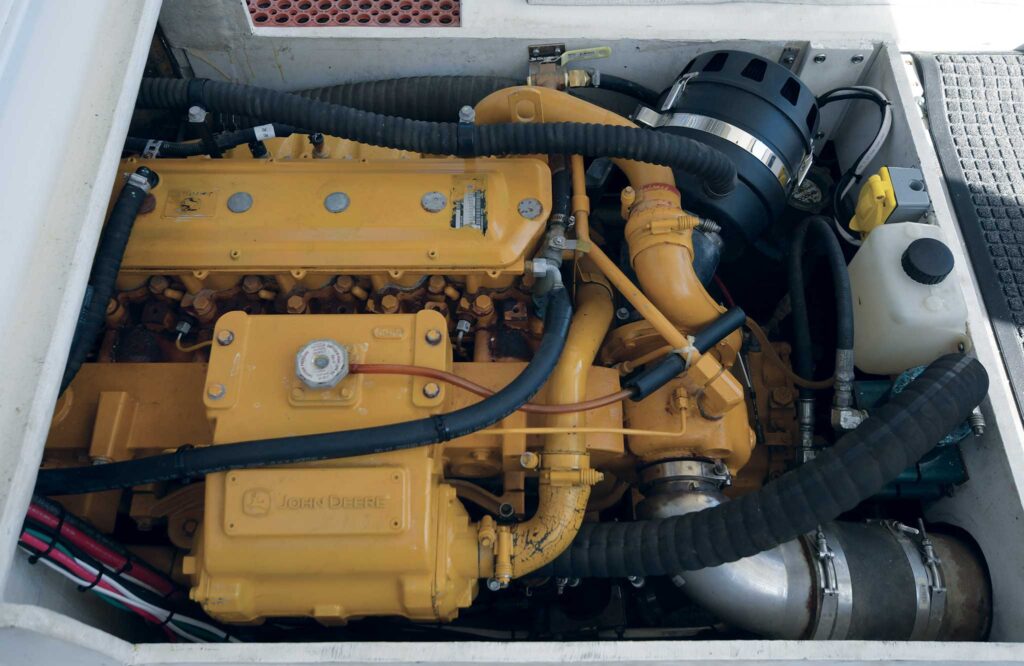
The engine—a 400-hp John Deere 6068 SFM 85 diesel—received new injectors and remote filters for easier maintenance. There’s also now a hydraulic fluid cooler, so vessel systems can operate smoothly in the warmer waters off South Jersey.
Today, Valiant II is a standout, a lobster boat rigged for inshore charter fishing that Nowalsky docks in Somers Point, New Jersey. She is 29 feet, 8 inches long with a 10-foot, 8-inch beam, and she draws 3 feet, 6 inches. Like all boats by Osmond Beal, she is a skeg-built design.
The hull is semi-planing, a form that Beals Island builders made famous more than 100 years ago. Unlike displacement hulls, this one rises on the water as it gains speed rather than plowing through it, thereby reducing the wetted surface. The substantial skeg provides stability at speed and at rest while protecting the running gear.
“The unique thing about these hulls is they can be powered up to go really fast or run with less horsepower for more economical operation,” Nowalsky says.
Valiant II is used for day charters, so she’s not fancy. She is tall in the bow with a sloping sheer that’s instantly recognizable as old-school Downeast. The house retains the hydraulic pot hauler and davey, throwbacks to the vessel’s days as a working lobster boat. Nowalsky uses the devices to set and retrieve a second anchor while bottom fishing.
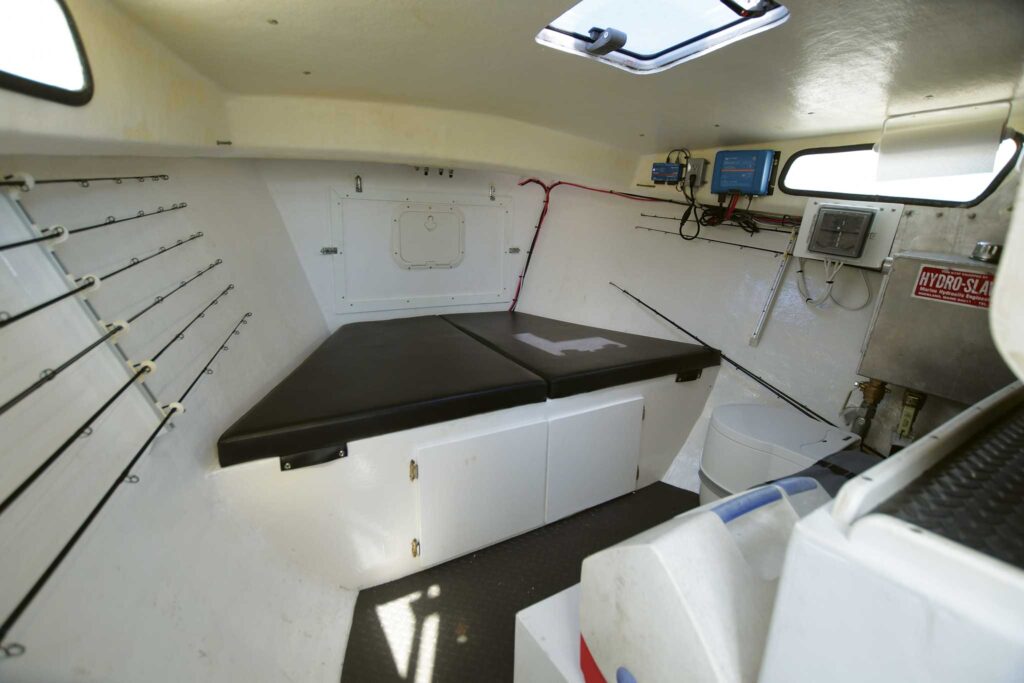
He runs the boat from a captain’s chair mounted on the engine box. The deckhouse has seating for passengers, plus a spartan cabin with a V-berth and head. The cockpit offers plenty of deck space for fishing, and there’s a large fish box.
Valiant II also has a large rudder that makes it possible to turn the boat on its axis—a characteristic feature of the Downeast design. The boat cruises at 15 knots, burning 14 gallons per hour, but she’s capable of speeds up to 22 knots at wide-open throttle.
All of these features make her a good fishing boat, but what makes her a great charter boat? Nowalsky contends it’s her looks. “Anglers see the boat and want to fish it,” he says. “Then there’s the fuel economy, which helps me keep rates reasonable. And the boat’s ride brings customers back again and again. You can’t make this boat pound. The deep keel adds stability in a beam sea, and any roll we experience when drift fishing is gentle. She’s a standout among fleets filled with lookalikes.”
November 2025