
A marine engine will run for thousands of hours with proper maintenance, but eventually the day comes when even a once-loyal engine gasps its last. Maybe there’s been a catastrophic failure—we told you to replace your exhaust manifolds—or there are just too many hours on the clock. Whatever the cause, when no mechanic has enough magic in his toolbox to coax another season from your tired iron, you’ve got to decide: Should I buy a new boat, or install a new engine in the boat I love? For many of us, the sensible answer is repowering.
Rebuild, Remanufacture or Buy New?
Some boatowners want to rebuild their old engine rather than buy a new one, thinking it’ll be easier on the checkbook. That’s not so, according to marine experts.
“It’s cheaper to replace it,” says Bob Petzold. Petzold is president of his family’s boatyard, Petzold’s Marine Center in Portland, Connecticut, a few miles south of Hartford. His mechanics are qualified on almost every brand of marine engine, and they’re happy to repair yours. But when it comes to rebuilding, explains Petzold, there’s a lot of labor involved for a skilled mechanic to do the job right once the engine is opened up. There’s so much labor, says Petzold, that a rebuild “doesn’t make sense, unless you’re going to do the work yourself.”
Instead, advises Petzold, consider buying a remanufactured engine. Petzold says he can usually get a remanufactured engine in a couple of days and often can have a customer back on the water without missing a weekend.
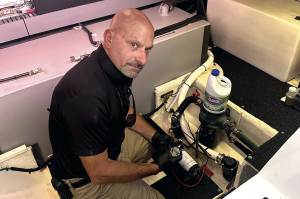
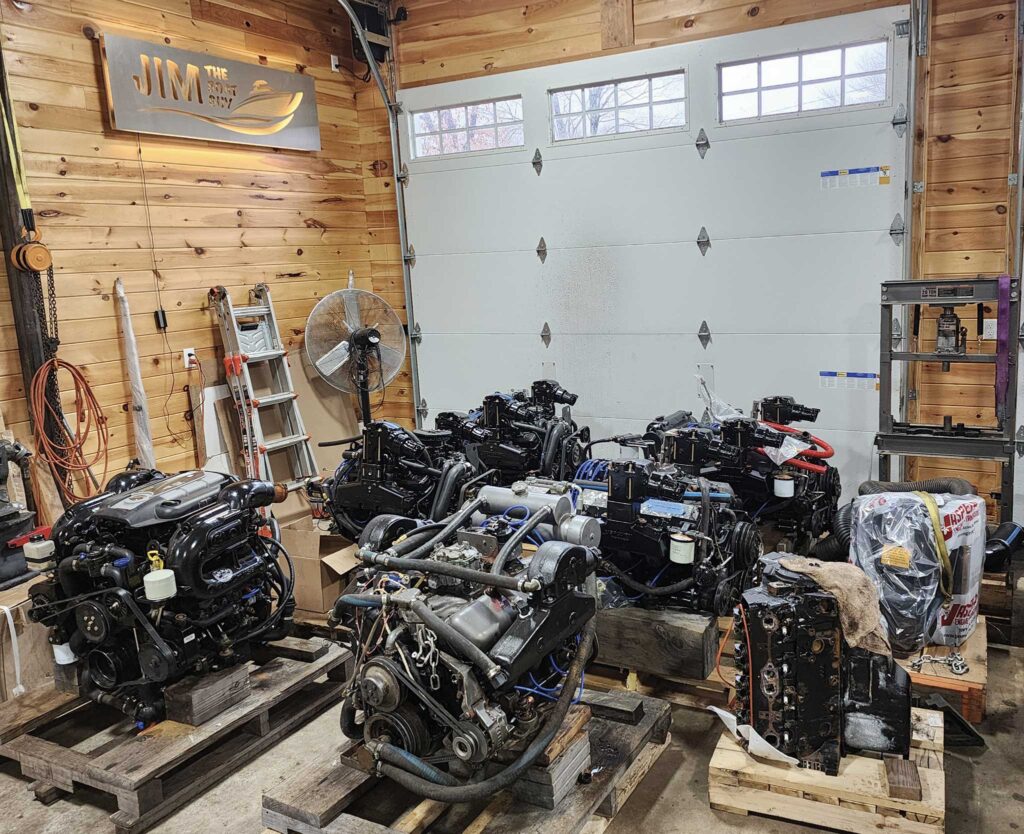
Jim Valiante agrees. Valiante, also known as Jim the Boat Guy, is a mobile marine mechanic based in South Windsor, Connecticut. When an engine fails, “there are three options,” he says. “A new, complete drop-in engine that’s very pricey; a used engine [Russian roulette], or a remanufactured long-block assembly, which is our recommendation.” A remanufactured engine is a used engine that’s been completely torn down, thoroughly cleaned and inspected, and reassembled to factory specs, using many new parts. Valiante says he installs about 15 remanufactured long-blocks for every complete drop-in engine. “A long-block swap gets you back boating for about half the price of a brand-new drop-in.”
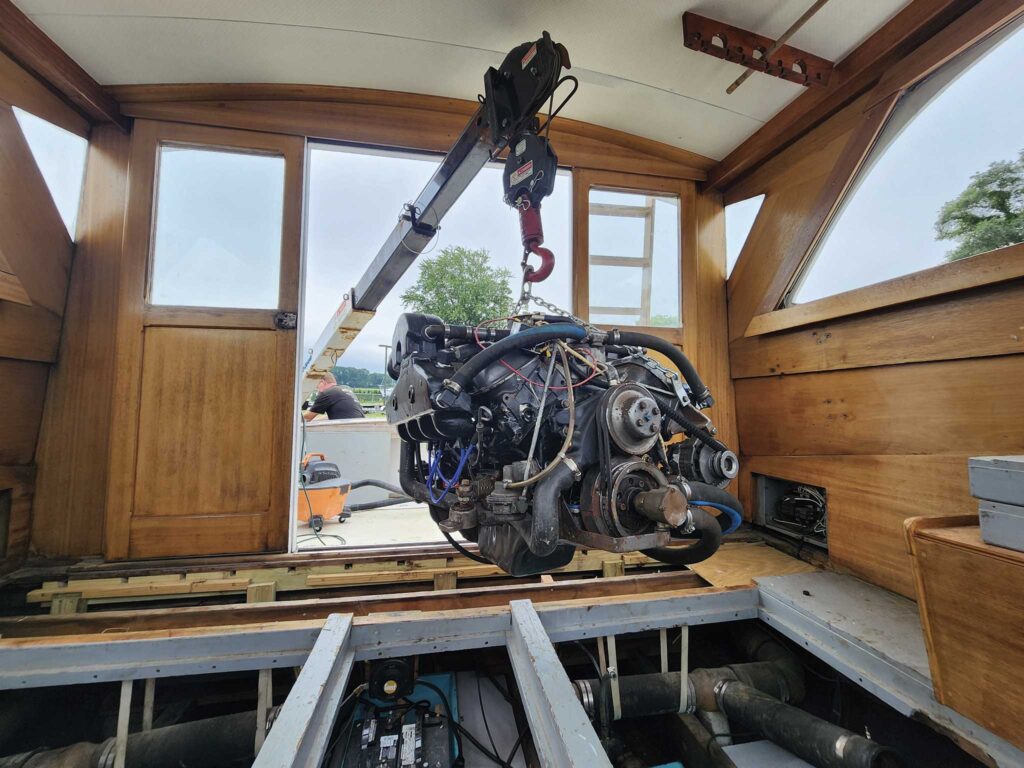
What’s a long block? When you buy a remanufactured marine engine, you don’t get a complete, ready-to-install engine, but either a long block—which consists of the engine block, crankshaft, cam, pistons, and related parts (what gearheads call the rotating assembly), plus cylinder head or heads. A short block doesn’t include the cylinder heads, but if you’re going this far, you want new ones. No exhaust or intake manifolds are included, no fuel-supply system, no cooling system, no ancillary items like the starter or alternator. Your mechanic either takes those off your old engine, or you buy them separately. Some remanufacturers offer a “tinware” package consisting, usually, of the oil pan, timing cover and valve covers.
Watch the Warranty
Petzold recommends buying remanufactured engines from Mercury Marine (mercurymarine.com), partly because of the warranty. There are Mercury dealers everywhere, he said, so if you need warranty work, chances are there’s a dealer nearby. Petzold also has a warning for those who choose to go in this direction:
“We are starting to see some quality issues with different engine rebuilders,” he says. The Chevy 305-, 351- and 454-cid engines, once the staple of the marine industry, were developed in the 1970s and ceased production in the early 2000s, he explains. “I am not sure whether the quality of the remanufactured engines results from poor workmanship, or is due to the age of the engines. Some of the engines being rebuilt could be more than 50 years old.”
So, says Petzold, when repowering, look into your options and do the research. See if the OEM offers a replacement engine for the iron you’re replacing, check online reviews of remanufacturers, and pay particular attention to the warranty. Most remanufacturers warranty their engines, but they won’t pay for the removal and reinstallation of one that needs replacement.
Valiante buys his long blocks from Jasper Engines and Transmissions, based in Lincoln Park, New Jersey. The company covers its products with a three-year parts and labor warranty, although the warranty typically doesn’t cover water intrusion. “So, it’s very important,” stresses Valiante, “to replace the manifolds and risers with new ones when building a long block. Check the exhaust flappers in the exhaust Y pipe at this time too.” He also says to use the old manifolds and risers only if they’ve been replaced very recently. A bad riser can ruin a new engine just as easily as it can an old one.
When repowering, Valiante recommends examining anything on the engine that has a service interval or is tough to replace in the boat. “On twin engine boats the port starter is typically very difficult to change, so we have a good look at it and make a recommendation.
It’s the perfect time to check your hard-to-reach bilge pump/float switch and your bilge blower; both have very serious safety ramifications so should not be overlooked. And it goes without saying that spark plugs, wires and the distributor cap get replaced too.” Valiante also suggests degreasing and cleaning the bilge while the engine is out. That is also the perfect time to repaint with an epoxy paint to make the area like new and “a much nicer place to work.”
Gas to Diesel
Maybe you’re tired of gasoline engines. Today you can find a diesel to replace almost any gas engine. Electronic common-rail diesels offer compact size, excellent power output, great fuel economy, almost totally smoke-free operation, built-in diagnostics, fly-by-wire controls and so forth. In most cases, gas engines can be replaced by diesels of less horsepower and still maintain the same, or faster, cruising speed, since diesels can be run continuously at 90 percent or more of max rpm, compared with 60 to 70 percent for gas. Converting from gas to diesel can add complications to the project, but most people think the extra effort is worth it.
Repowering from gas to diesel doesn’t happen by simply pulling out the gas engine and dropping in the diesel. The reduction gear might need to be changed to handle the added torque of the diesel; maybe the propeller shaft needs to be bigger, too. The fuel system has to be altered to incorporate the diesel’s fuel return. Usually a diesel of similar horsepower to the gas engine will require somewhat larger exhausts too. Swapping gas for diesel isn’t a do-it-yourself job: Special training and special tools are often required. Find a factory-authorized, factory-trained service dealer to do the job.
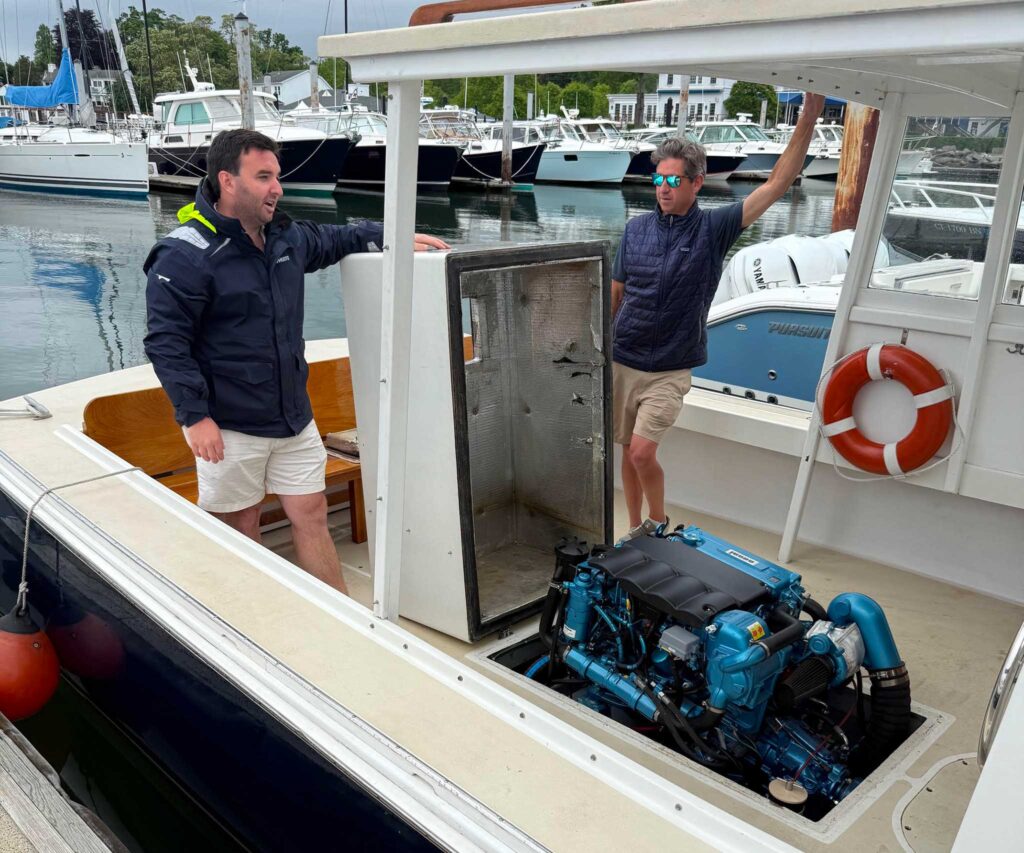
One service dealer experienced in repowering with diesels is Jesse Boschetto, owner of Bosch Marine in Plymouth, Massachusetts. Bosch Marine is a mobile shop servicing the South Shore, Cape Cod and Islands of Massachusetts. At press time Boschetto had just completed sea trials of a Holland 30 lobster boat powered by a new Nanni T4.270 diesel. Owned by Richard M. Benincasa, Sr., of Old Greenwich, Connecticut, Belle was launched in 1980 with a single gas engine and repowered in 2013 with a 375-hp Crusader Captain’s Choice 6.0. In 2024, with 1,200 hours on the Crusader, Benincasa decided to upgrade to diesel. He chose the Nanni because of its reputation, heritage (it’s based on a long-wearing Toyota block), extensive dealer network and a significant cost savings as compared with similar diesels.
Boschetto completed the repowering over the winter. He had to redesign the exhaust system, add a fuel return line, and upgrade the V-drive to handle the added torque of the diesel. He kept the existing transmission after rebuilding it in his shop. The existing propeller shaft was usable, with a new prop to match the Nanni. Boschetto kept Belle’s Morse cable controls, but the Nanni can be fitted with electronic controls in the future. He also installed hydraulic steering, replaced the wooden shoe on the skeg with stainless, and made a number of improvements to the electrical system and the electronics.
The Nanni is rated at 265 hp at 3600 rpm. But when it comes to marine engines, horsepower doesn’t always tell the whole story, according to Boschetto.
“The Nanni has more torque, which is what pushes the boat through the water,” he says. The sea trial data backs up that statement. Belle runs at a cruise speed of 20 knots burning 9 gph, with a top speed of 25 knots and 14 gph. Benincasa says the numbers for the old Crusader were 18/19 knots at cruise, 22 knots at top speed. He didn’t have fuel consumption figures, but published boat tests suggest the Crusader burns about 25 gph at 5200 rpm, 14 gph at 4000 rpm, the maximum recommended cruising speed. So, Benincasa got higher speed, lower fuel burn, more reliability and an engine that should run for thousands of hours.
Boschetto recently replaced a pair of 210-hp Cummins diesels in a classic Bertram 31 with a pair of the same Nanni engines as in Belle. The result was similar: A boost in cruise speed from 14 to 26.5 knots, and in top end from 22 to 31 knots, with lower fuel consumption. “I’ve never had a single owner who’s been unhappy with the Nanni diesels,” he says, “and they’re priced competitively.”
So maybe it’s time to say goodbye to the rusty, smelly, leaky iron in your engine compartment and drop in some new power. With a new engine, your boat will act like a kid again, you’ll get better performance and burn less fuel. Once the pain of paying for the project is over, you may wonder why you waited so long.
August 2025