Nicole Jacques
When Cape Cod, Massachusetts, resident Chris Corey and his father decided to buy a 15-year-old Grand Banks Eastbay, they were already drafting a list of repairs and upgrades before the sales contract was signed. Corey organized their ideas into three columns: “must have,” “would be nice” and “defer to next year.” At the top of the first column, written in ink, was a non-negotiable item: new paint.
Corey doesn’t make decisions lightly, and by the time the boat left the broker’s dock in Portland, Maine, he felt confident in his choice of paint color and product. But that certainty didn’t last long. As soon as discussions with technicians began at Safe Harbor Front Street in Belfast, Maine, where he contracted for the refit, Corey had new questions. “When it came to choosing the color and brand of paint, I don’t think my father and I were prepared for how hard those decisions would be,” he says.
A boat’s paint isn’t just cosmetic; it’s a protective system with long-term implications. Most marine topcoat paints are urethane-based and fall into two categories: acrylic or polyester. They’re formulated using either toners or tints, then mixed with an activator and sometimes a reducer before application. Each ingredient influences how the paint applies, how it looks, how long it lasts and how easily it can be repaired years later. Because many trusted manufacturers offer systems built on different combinations of these variables, it’s not always easy to decide which product and color makes sense for a specific boat.

Chris Cory
Bill Robishaw, paint department manager at Safe Harbor Front Street, knows that customers select paint based on priorities like cost, appearance and personal experience. His hull or deck preparation and application procedures are then dictated entirely by those decisions. Comfortable working with any major system, he guides customers not toward his own preferences but toward products that align with their expectations and how they plan to use the boat, since he’s fully aware he’ll likely see the same vessel again when it’s time for the inevitable touch-ups.
“The most important thing to me is repairability,” Robishaw says. “There’s a 100 percent chance you’re going to have to repair a paint job at some point.”
For years, that belief made acrylic paints a popular choice. Acrylic finishes are traditionally softer than polyesters, making them easier to apply, blend and repair. Polyester paints cure to a harder, more durable surface with deeper gloss and a distinctive “wet paint” look. That same hardness, however, makes repairs more difficult when a boat lands hard against a dock or piling.
In recent years, Robishaw has noticed changes in paint formulations, particularly during the pandemic when supply-chain disruptions affected the availability of raw materials for manufacturers. In his experience, some modern acrylic paints are less repairable than versions from just five years ago, eroding what was once their primary advantage.
More concerning, some manufacturers now caution against polishing acrylics altogether due to the risk of fading or discoloration. That can be a tough sell for owners who want to preserve the shine of a new finish. As a result,
Robishaw sees more customers choosing polyester systems for a more reliable, high-gloss result.
For a methodical owner like Corey, another critical decision was getting the shade of white exactly right. When he first began talking with the yard, he was convinced he wanted Grand Banks’ factory white, but the service manager suggested exploring alternatives. Four samples were applied in small test patches along the boat’s brow to show how each shade read across the deck’s curves. Corey ultimately chose StarkWhite, which he felt best complemented the shape of the boat. Additional test areas were applied in the cockpit and on louvered doors, allowing him to see how the color performed across different textures and in changing light.
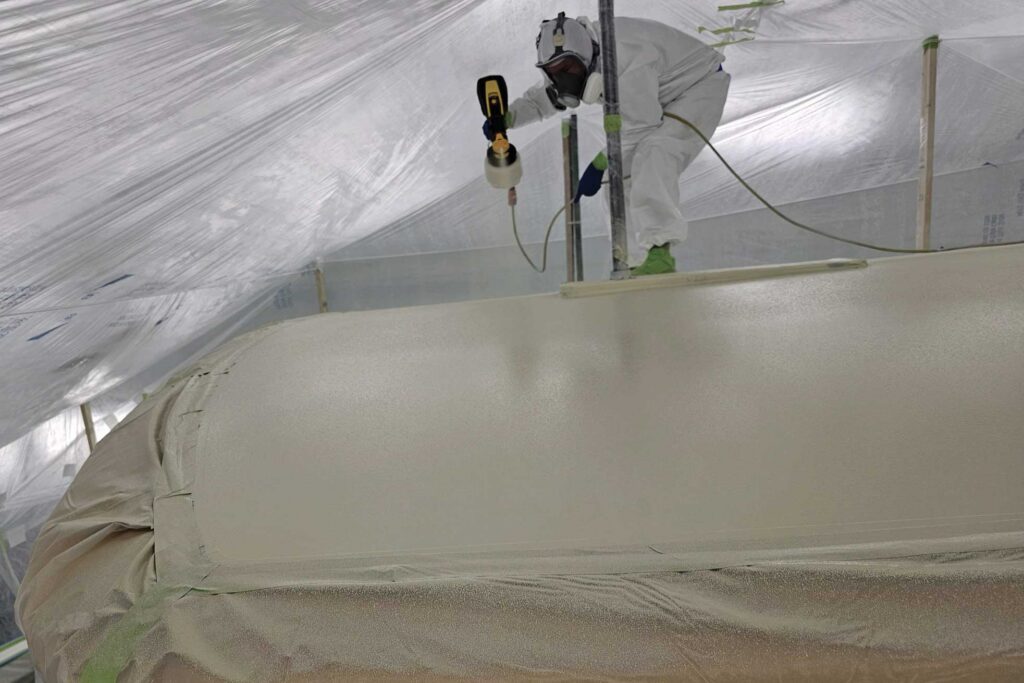
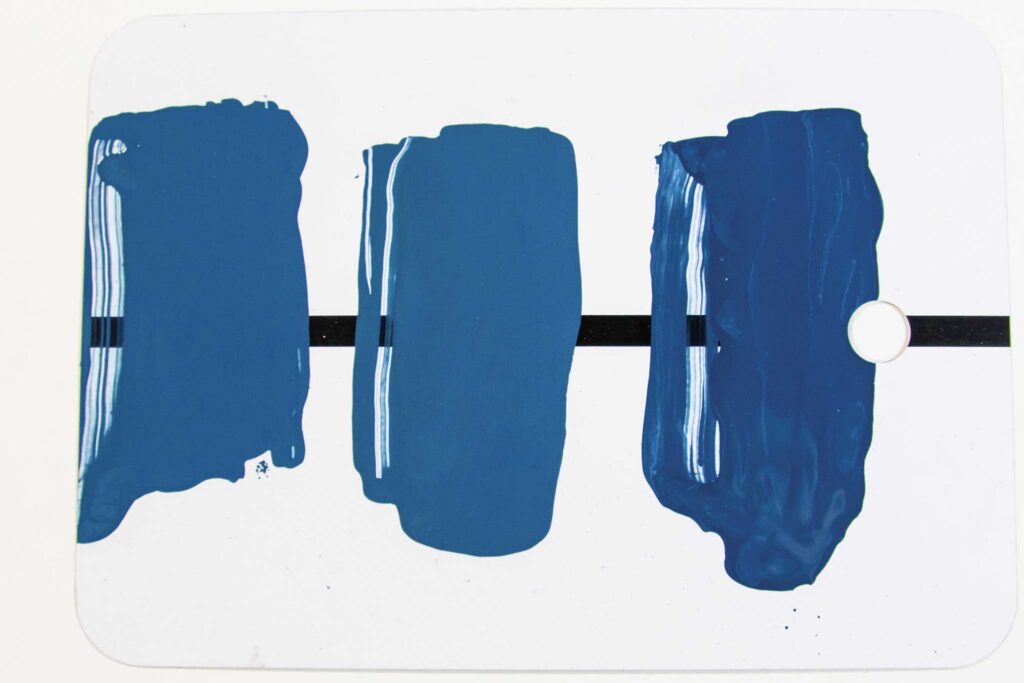
It’s important for a yard to deliver the exact shade the owner expects. But consistency issues can impact color, as manufacturers are shifting from universal tints to toners that allow for more nuanced hues and broader palettes. The unintended consequence is increased variation within individual colors. In some cases, two cans that are labeled the same shade can produce some noticeably different results.
On the eve of a spray, technicians often discover visible hue variations when opening the paint cans—differences that would result in a splotchy hull if sprayed as is. According to Juan Carlos España of Peake Coating, a marine coating specialist in Virginia, variations among cans with identical labeling are becoming more common. His solution is a technique known as “boxing.” This involves pouring all the paint cans into a single tub, mixing thoroughly to even out the hue, then redistributing the blended paint back into the cans.
España, who has several decades of experience applying paint on everything from tenders to superyachts, first began boxing paints more than 15 years ago as metallic finishes grew in popularity. Achieving consistent metallic flake density required premixing all cans in one vat. He soon realized the process also protected against other inconsistencies, making it a standard part of his workflow.
Even common colors like Flag Blue can vary widely between brands, product lines and cans from the same manufacturer. While boxing ensures consistency for a full paint job, it offers no solution for touch-ups. Ideally, owners retain leftover paint for future repairs, though even that doesn’t guarantee a seamless blend if the existing finish has weathered. More often, spot repairs rely on the technician’s ability to color-match.
These issues are arising among multiple manufacturers, so España avoids singling out brands. “All paint products have their quirks,” he says. His advice to owners planning a repaint is to ask how the paint is supplied—factory-direct or mixed by a distributor. Factory-direct paints tend to be more consistent, though delivery times may be extended.
For owners like Corey, that type of wait was worth it, even if the time commitment was as significant as the financial one to get the desired finish. “Be part of the process,” he advises. “If you’re not there to decide, someone else will.”
Aiming for perfection, Corey requested a few small touch-ups after the deck was sprayed because he noticed some slight sags and dust. His attention to detail paid off with a flawless finish.
When inspecting paintwork, boat owners have common questions. They wonder how to judge the quality of work, how much dust is acceptable, and how much gloss is enough? Chris Toole, product manager with coatings manufacturer Hempel UK and a certified marine coatings inspector, says those expectations should be defined before work begins.
“There are international standards, ASTM methods and specific measurements that can be taken to confirm achieving the minimum levels,” he explains. But that’s more homework for a boat owner to take on.
Rather than feeling overwhelmed by information, Corey grew more confident as he asked more questions of the yard, fellow boat owners and experts in the industry. “Looking back, I wouldn’t have done anything differently,” he says. “It was a very collaborative approach.” In the end, he had no hesitation signing off on the work completed at Safe Harbor Front Street, and he’s been an enthusiastic champion of the yard ever since.
Different boatyards bring varying levels of experience and confidence with specific brands of paint, which can influence where an owner ultimately chooses to have the work done. But no matter who drives the decisions, once the paint contract is signed, the responsibility rests with the owner to ensure a boat leaves the dock with topside paint that looks good, holds up and remains easy to repair for many years to come.
This article was originally published in the May 2026 issue.