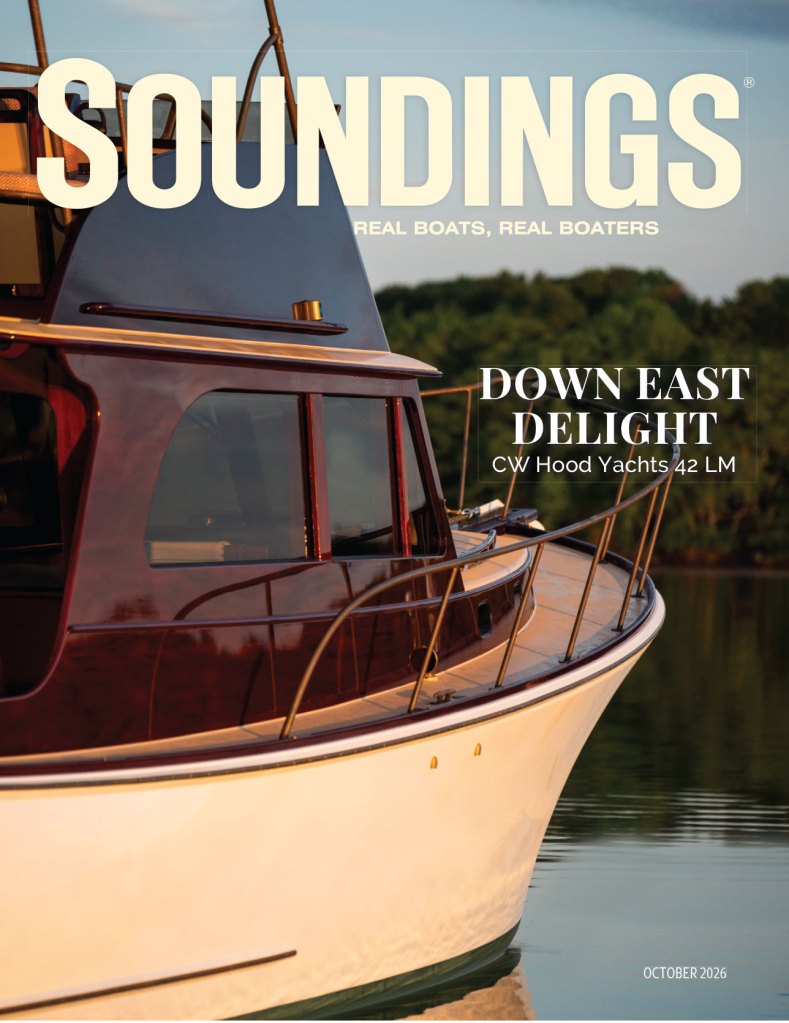
The waters of the Northeast have long been home to some of America’s most enduring maritime traditions, from varnished wooden runabouts to working craft and storied waterfronts. In this photo essay, award-winning photographer Onne van der Wal of Jamestown, Rhode Island, turns his lens toward the boats, builders and coastal scenes that define the character of this region. These images invite the eye to settle on form, texture, light and craft—the graceful sheer of a classic hull, the worn grain of a dock line. Onne shot these photographs with a Leica Q3, whose 60-megapixel, full-frame sensor renders the subtle tonal contrasts that give black-and-white work its quiet power.
Opening Spread: Aleria is a 42-foot wooden motorboat built by Bunker & Ellis in Southwest Harbor, Maine, in 1958. Often described as a “lobster yacht,” she is a prime example of the elegant and seaworthy designs that helped define the Downeast Maine look. She is constructed of white oak frames and cedar planking with a mahogany transom. She underwent a major restoration in 2010 at Johansen Boat works in Rockland, Maine. Power is a pair of 220-hp Yanmar diesels. Here, she is seen passing under the Newport Bridge on Narragansett Bay en route to her Jamestown homeport after a weeklong cruise of southern New England.
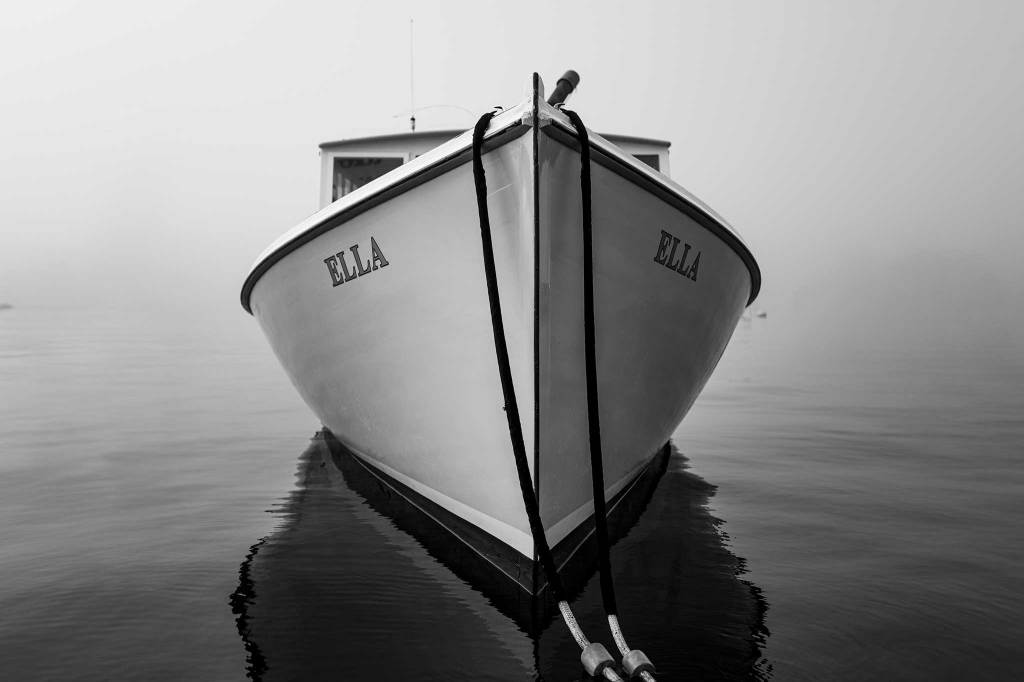
The 37-foot lobster boat Ella—built in Maine in 1983 and designed by Osmond Beal—sits on her mooring off Ida Lewis Yacht Club in Newport, Rhode Island. Onne found her on a sunrise dinghy ride around Newport Harbor. The thin fog added a filter to the light of the rising sun. Her classic deep-V hull was designed to punch through steep Atlantic chop and plane efficiently while crew hauled traps. She was built for seakeeping rather than speed. Beal is a legendary boatbuilder/designer from Beals Island, the spiritual home of the Downeast lobster boat. The Beal family essentially defined the modern lobster boat form. An Osmond Beal hull from that era would be cold-molded or constructed with traditional lapstrake/carvel, likely using local spruce, cedar or white oak framing. A genuine Beal boat is considered a collector-quality working vessel.
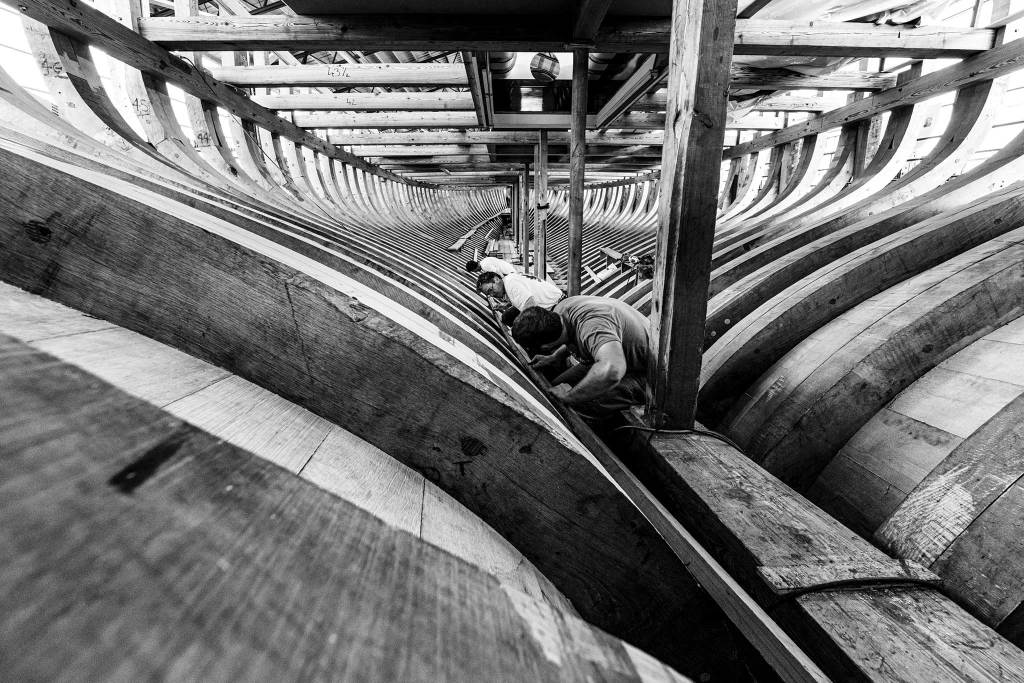
Eric Thesen, shown in the center, was the lead shipwright for the restoration of Coronet. In this photo, he checks for fairness on the massive frames of a 133-foot sloop at the International Yacht Restoration School in Newport, Rhode Island. Coronet is a wooden schooner originally built for oil tycoon Rufus T. Bush in 1885. It is one of the oldest and largest vessels of its type in the world, and one of the last grand sailing yachts of the 19th century. After numerous owners and decades of neglect, it underwent an extensive restoration from 2010 to 2022. The boat was then transferred to Mystic Seaport in Connecticut for the final stage of work.
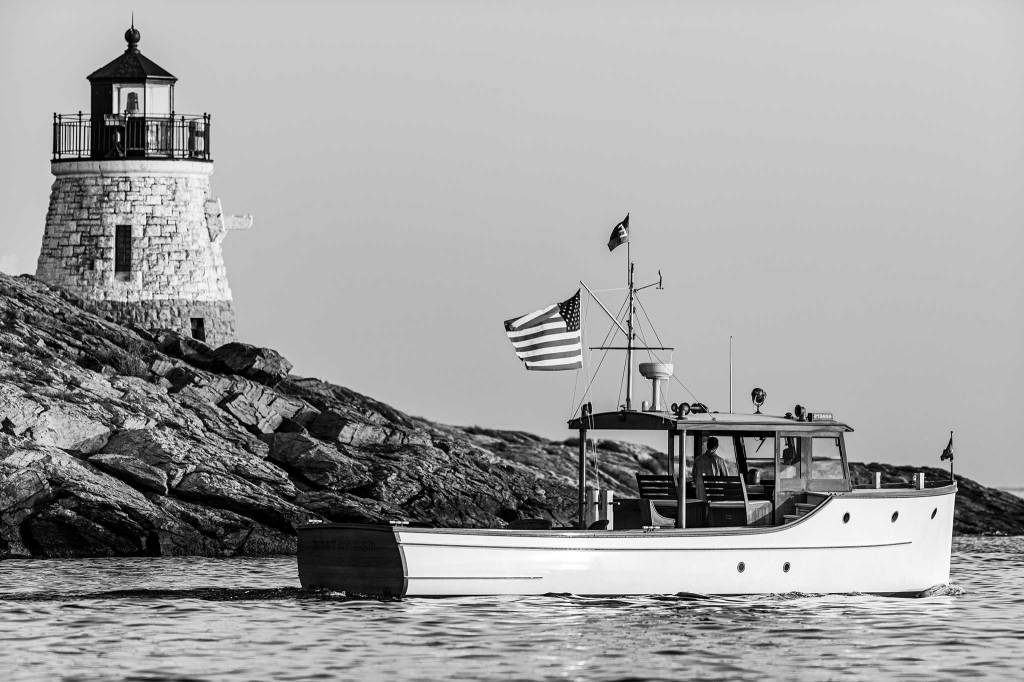
The 42-foot wooden motorboat Bystander was photographed after a complete restoration, around 2009. The boat was brought back to life by Elizabeth Meyer of Newport-based J Class Management in partnership with Narragansett Shipwrights. The project began in 2002 and took nearly eight years to complete. Built in 1929 as a tender to the J Class yachts that competed in the America’s Cup races of the 1930s, Bystander was designed by W. Starling Burgess. Harold Vanderbilt—who skippered three consecutive America’s Cup defenses aboard Enterprise, Rainbow and Ranger—was so taken with her that he purchased the boat from the syndicate in 1935. The restoration drew on Levick glass plate negatives held at the Mariners’ Museum and Onne’s photographs to return the boat to her original plans and construction.
This article was originally published in the August 2026 issue.