Many years before Brechin Lee Morgan picked up a paintbrush or cast off from Block Island aboard a 27-foot sailboat to begin a solo circumnavigation, he had already decided he would one day embark on a great adventure.
He was 7 years old and visiting Mystic Seaport with his parents when he became captivated by the Charles Morgan whaling ship. “I knew right then, beyond a doubt, that as soon as I turned 11, I could be a cabin boy on a whaling ship, and that was going to be my life,” he said. “The romance of being out there, going over the horizon, sailing all of these exotic seas, was something that has always fascinated me.”
Of course, Morgan soon learned that whaling ships were a thing of the past, but that didn’t dampen his resolve to sail. As a teenager in Guilford, Connecticut, he used savings from his paper route to purchase a Blue Jay, which he used to explore the Thimble Islands. After dropping out of high school, he found work at age 17 on sailing charter boats in the Caribbean.
Morgan spent about a year in the Caribbean before signing on to a 40-foot wooden sloop in New Jersey whose owner intended to sail around the world. The voyage was cut short when the boat was badly damaged in a hurricane off Bermuda during its first leg. While the circumnavigation attempt was unsuccessful, Morgan’s time aboard the sloop set the next stage of his life in motion. Another crewmember had attended the Rhode Island School of Design, and she convinced Morgan that he could make a lucrative career in graphic design. So at age 19, he enrolled at the Silvermine College of Art in New Canaan, Connecticut.
Morgan’s mother and great-grandfather were both talented amateur painters, but he had never developed an interest in art himself until he received his first drawing assignment at Silvermine. “I had to go home and produce two drawings for the following day’s class,” he recalled. “I’d blown through about 10 or 12 before I stopped and realized this could just go on. I knew then in that instant that I would be painting one way or another for the rest of my life.”
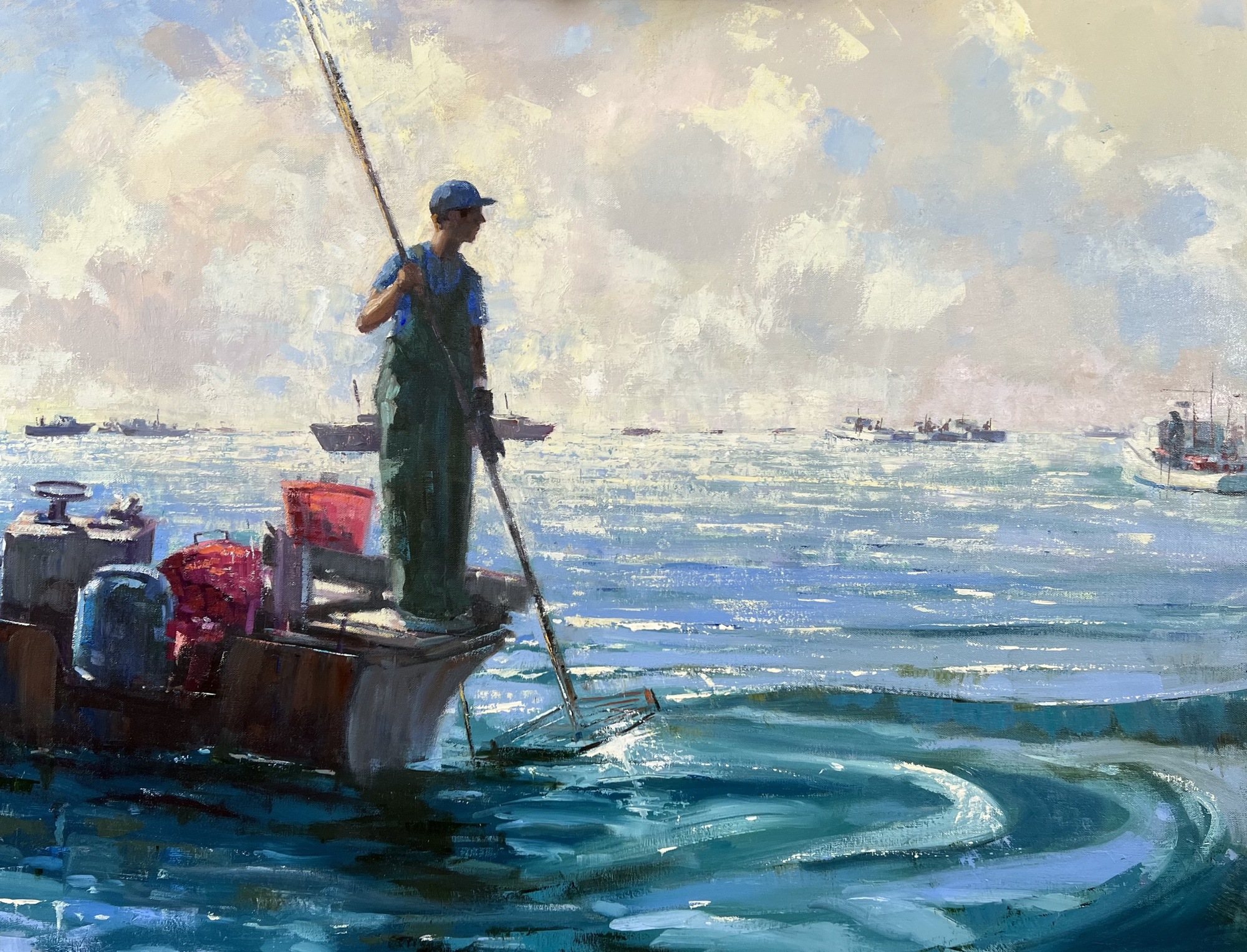
Although art was Morgan’s passion, it provided very little money at first. After two years at Silvermine, he went to work as a deckhand for the Tallmadge Oyster Company in Norwalk, Connecticut. He had always been drawn to the lines and functionality of the rugged oyster boats, which continue to inspire him today, but “the idea and romance of it was very different than the reality,” he said, describing the job as the hardest work he’s ever done. After leaving the oyster company, he opened and ran a sign shop in Norwalk for 23 years, painting in his studio during the evening.
He also continued to sail, and at 51, he embarked on the adventure he had imagined since childhood. In November 1998, he departed from Block Island for his second circumnavigation attempt, this time single-handed aboard his 27-foot cutter-rigged sailboat, Otter. During the next five years, he covered 32,000 miles, visited 32 countries and filled 18 sketchbooks with watercolors and sketches.
After returning from the voyage, Morgan opened a studio and pursued painting full time. For six years, he painted almost exclusively from the sketchbooks he had filled during his circumnavigation, as well as the thousands of photographs he had taken during the trip.
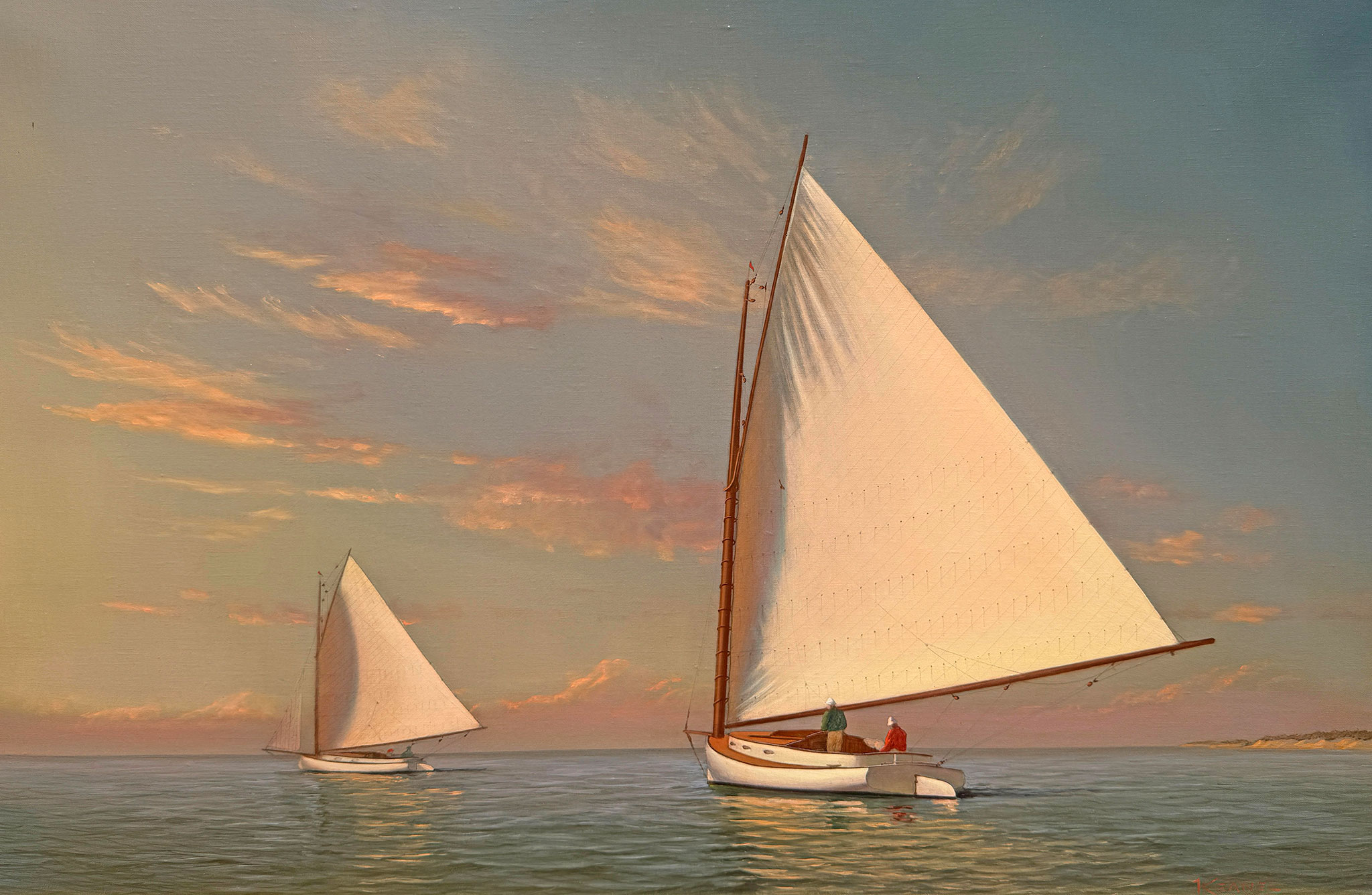
One painting inspired by that journey was the 48-by-48-inch acrylic Wing and Wing, which captures Morgan’s view of the Pacific from Otter’s cockpit. “That particular view was something that I saw often,” he said. “That particular light when you’re in the shadow, and there’s a cool breeze, and you’re moving along at a good 5 knots. You’re making your 125 miles a day, and the boat is gently rocking. You’ve just finished your lunch of a can of tuna and mayo, and you’re having a hot tea.”
Morgan’s fascination with working boats also appears throughout his artwork. One example is his 36-by-36-inch acrylic painting of the 1968 tugboat McAllister Girls. He encountered the tug in New York’s East River one November while delivering a 40-foot catamaran from Connecticut to Miami. The tug overtook the cat, passing to starboard, a moment that later inspired the painting.
Another example is Heading Home, which depicts the 1939 oyster schooner Suzanne heading up the Housatonic River in the late afternoon. “That [boat] is almost exactly the same as the one I worked on,” he said. “Every single aspect of that boat can bring back a memory.”
Today, Morgan still owns Otter and sails out of Bridgeport, Connecticut, where he has a studio. He continues to find artistic inspiration on the water, often sailing to places like Cuttyhunk, Massachusetts, to fill his sketchbook with ideas for future paintings.
“Within 15 minutes of getting outside of Bridgeport Harbor, everything just disappears,” Morgan said. “The world goes away. I’m back on the boat. I can imagine myself in those endless days crossing the Pacific again, with just this endless blue horizon extending forever and ever and ever.”
This article was originally published in the September 2026 issue.