A boatbuilder has a tricky line to tread when the market demands a new model, even when the old one seems to be doing just fine. Changes will be needed, but somehow, everything that helped make the original a success needs to be preserved. The new boat needs to be different, but not too different.
Beneteau recently faced this conundrum, when it was tasked with designing a replacement for its popular Grand Trawler 62. As it turns out, the boat’s successor—the new Grand Trawler 63—shows how it’s done.
As a high-volume yard, the French boatbuilding group’s processes are rigorous, to say the least. Designers create interiors that are quick and easy to build, and when it comes to fiberglass work, they are required on every new model to achieve a 40 percent molding commonality with existing projects. So when you find yourself wondering if you’ve seen that galley cabinet or flybridge seat somewhere before, you probably have.
If all this sounds more difficult than designing everything anew, it probably is. But this conceptual rigor pays off in manufacturing, and it shines through in the appealing price tag.
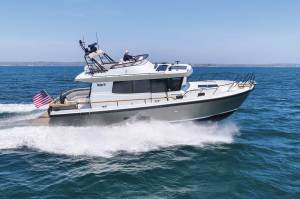
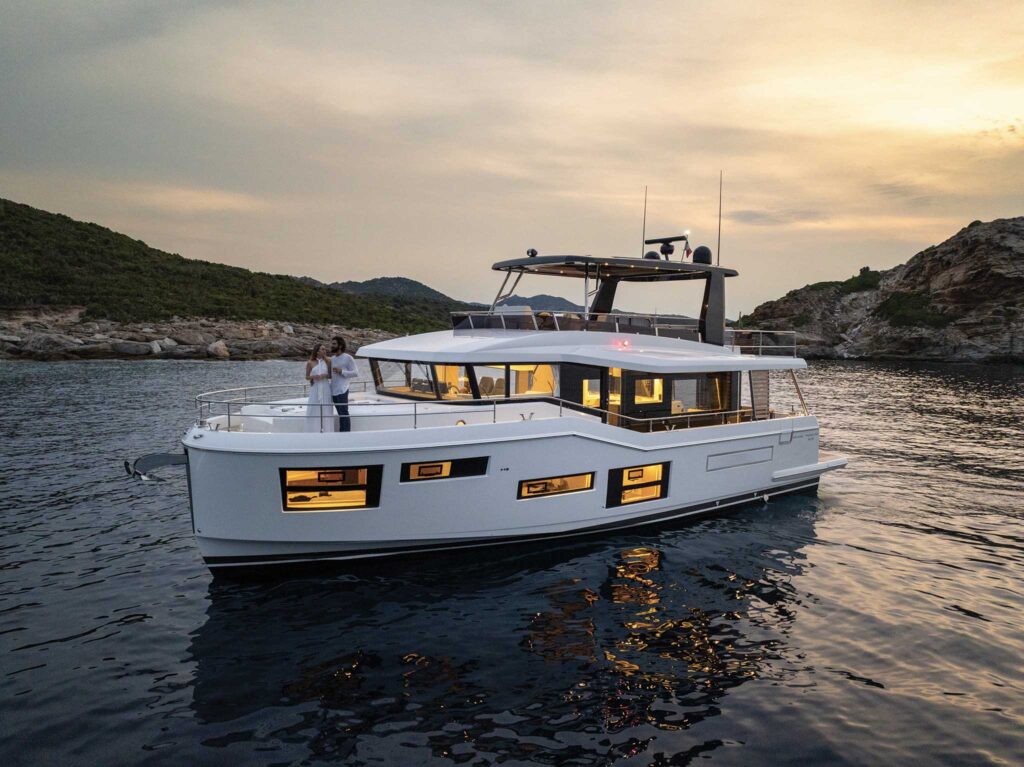
In the Grand Trawler 63, cruising yachtsmen get a big, roomy, trawler-style motoryacht with serious, seagoing looks, an enormous upper deck and a choice of accommodations layouts.
The model that I got aboard was the three-stateroom version, with a full-beam master amidships and the ensuite VIP in the bow. The portside stateroom, with 6-foot-5-inch-long twin berths that can be filled in to make a double, has access to the day head. In the four-stateroom layout, the master is divided into doubles that share the starboard head.
The yacht’s tall, beamy, upright exterior tells you what to expect inside. The Grand Trawler 63 has substantial headroom throughout—nowhere less than 6 feet, 6 inches—and voluminous stowage. The offset arrangement of the double berth and forward bulkhead in the VIP stateroom seems strange at first, but the layout is dictated by the high sides and plumb bow, and it does create useful stowage forward.
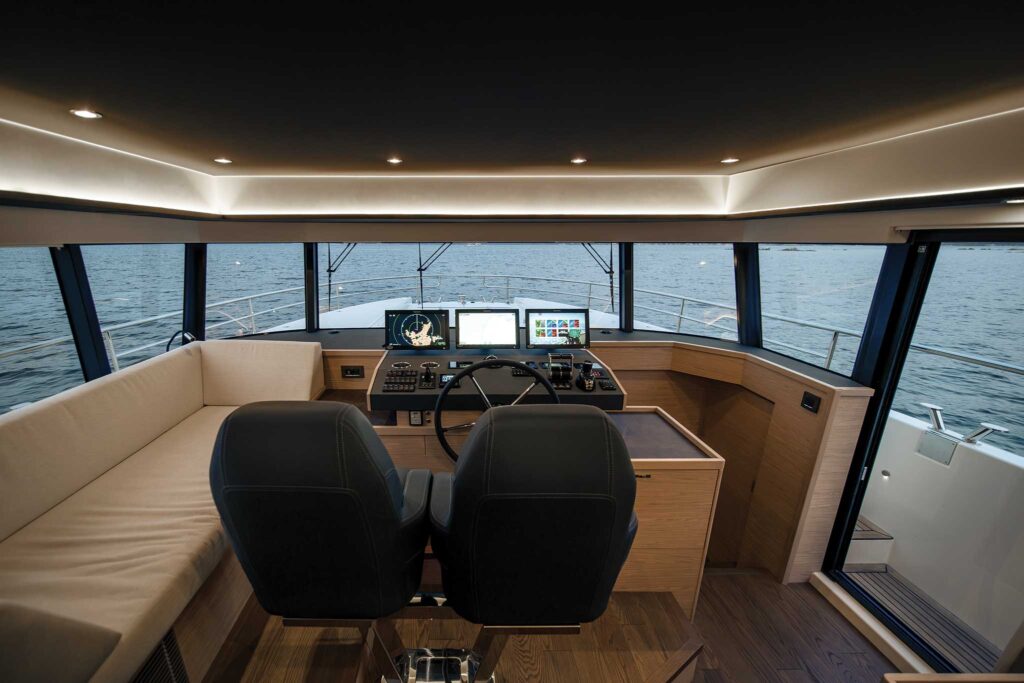
Leather details and fabric linings soften the Scandinavian minimalism of the interior, and owners can choose a walnut or a gloss oak finish. There are even a few curves, such as in the rounded corners of the cabin bulkheads. That’s unusual, given Beneteau’s high-volume production.
How does this new model differ from the Grand Trawler 62? Cosmetic changes include a cool helm console, a solid oak salon sole, tidied-up hull windows, and a modernized transom and cockpit. Other updates are more significant, such as the “silent boat pack,” an optional upgrade that reduces ambient noise through enhanced insulation in the engine room, crew quarters and lazarette, along with improved sound dampening materials. The system can also include features like solar panels, a lithium-ion battery bank, and Victron SmartSolar system.
“It’s an alternative to running the generator at anchor,” says Robert Chaffer, the 63’s product manager. “We had a very good response to this option on the ST54, so it made sense to bring it across to the 63.”
Owners can get 2,000 amp hours of battery capacity and a potential 1,800 watts of generating power from solar panels on the hardtop and coachroof, plus inverters. The silent boat system can be monitored on screens at both helm stations. It is capable of keeping not just the lights on and the fridges running, but also, for a while at least, the air conditioning going strong.
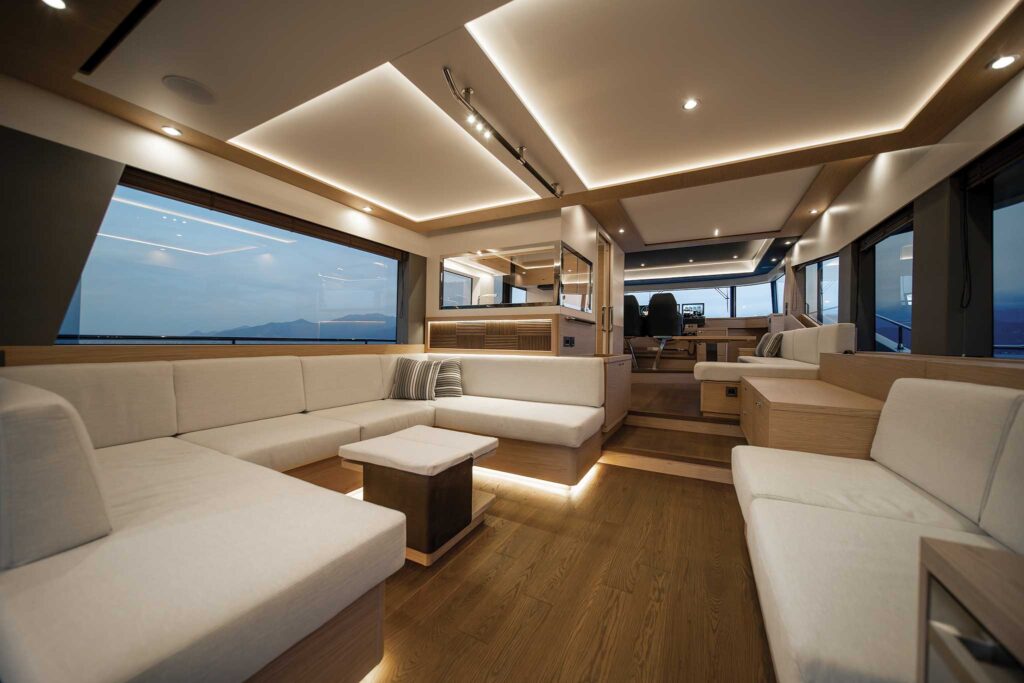
Fans of the previous model will be gratified that Beneteau resisted the urge to make any significant changes to the 62’s main deck, barring the decorative detailing and higher-quality sole. The same winning salon and galley layout remain. The seating area aft is versatile, blending easily with the revamped cockpit. On the raised amidships area, the enclosable galley is at the sociable center of things, with a door out to the well-protected sidedeck. Opening windows bring fresh breezes to the salon seating and across to the dining table.
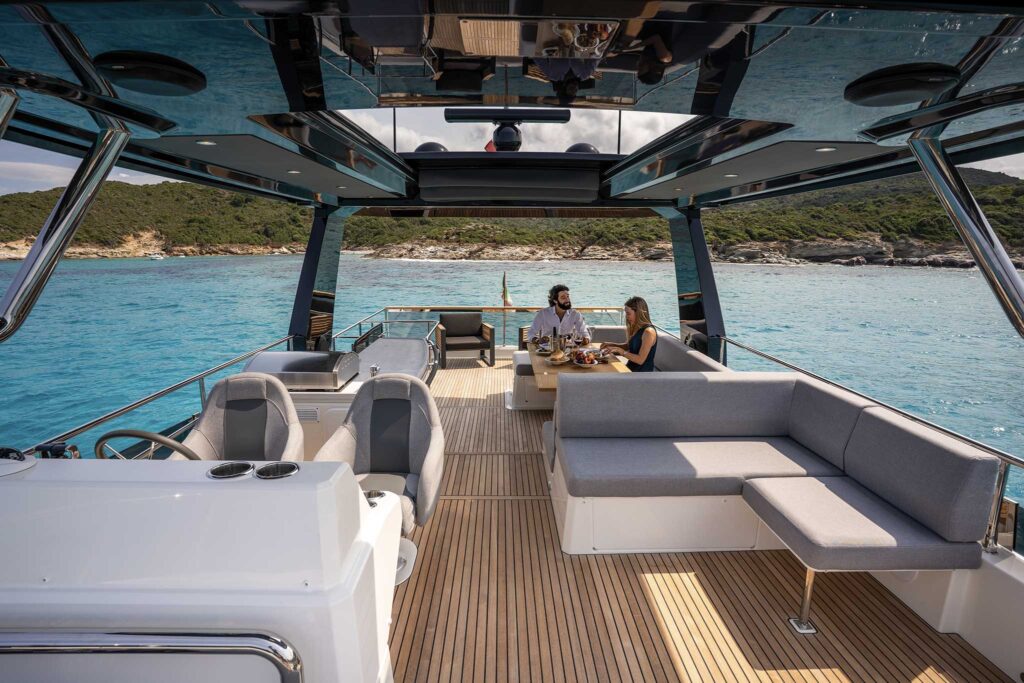
Past the inner flybridge companionway, the lower helm station has the feel of a separate wheelhouse. It’s set up with twin seats and a sofa, and there are stairs down to the lower deck on the starboard side. Up top, the flybridge is a practical mix of spaces for seating, sunbathing and entertaining.
Another thing that hasn’t changed is the naval architecture, which is from the Italian studio MICAD. The twin MAN i6 in-line, six-cylinder power plants with 730 horses each also remain. Beneteau describes this hull as full displacement, and on our sea trial off Cannes, France, we reached its theoretical hull speed of just over 10.5 knots at a relaxed 1500 rpm while burning 20 gallons of fuel per hour. That would represent a cruising range, with a fuel reserve, of around 500 nautical miles. Easing back to 8 knots should get another 500 miles or more.
This is how Beneteau sees the Grand Trawler 63, as a comfortable passagemaker trundling over the oceans at a sensible speed while the Sleipner fin stabilizers keep roll under control. With plenty more horsepower available from the MAN diesels, we actually clocked a maximum speed of 20.1 knots. In the late-afternoon chop with a fresh breeze, the 63 handled well, although it didn’t exactly steer itself when running downwind.
Beneteau built 27 of the Grand Trawler 62s during that model’s four-year production cycle. The 63 is a worthy successor with all the same good bits, plus a few original features of its own. It carries a base price of $2,367,000.
And no, in case you were wondering, the Grand Trawler 63 is not a foot longer than its predecessor. They just had to call it something different, but not too different.
LOA: 62’2”
Beam: 17’10”
Draft: 4’7”
Displ.: 61,729 lbs.
Fuel: 1,022 gals.
Water: 222 gals.
Power: (2) 730-hp MAN i6
December 2025