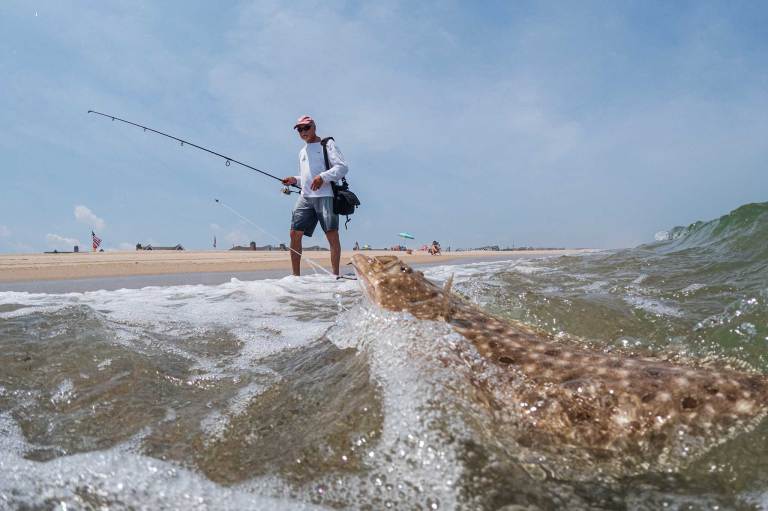
Whether he’s shooting portraits of commercial fishermen, tugboat pilots or Mainers digging seaworms while up to their elbows in soft mud, his work is intentionally that of a documentarian. Michael Cevoli photographs boatbuilders, quahoggers, gillnetters, fly fishermen, dragger men, war vets, charter captains and old salts whose eyes have grown cloudy, but whose stories still trickle out like a young flood tide.
“The first photographers I looked at were street and documentary photographers,” says Cevoli, 41, who lives in Warren, Rhode Island. “Those were the genres that I was drawn to.”
 Michael Cevoli
Cevoli resides in a bright second-floor apartment that’s a stone’s throw from the water. The walls are covered in photographs and artifacts—a clam rake, rod and reel, bleached white cow skull, a small oil painting of a dragger done by a grandfather. In one bedroom hangs a large, framed photo of a commercial conch boat from his first professional marine shoot.
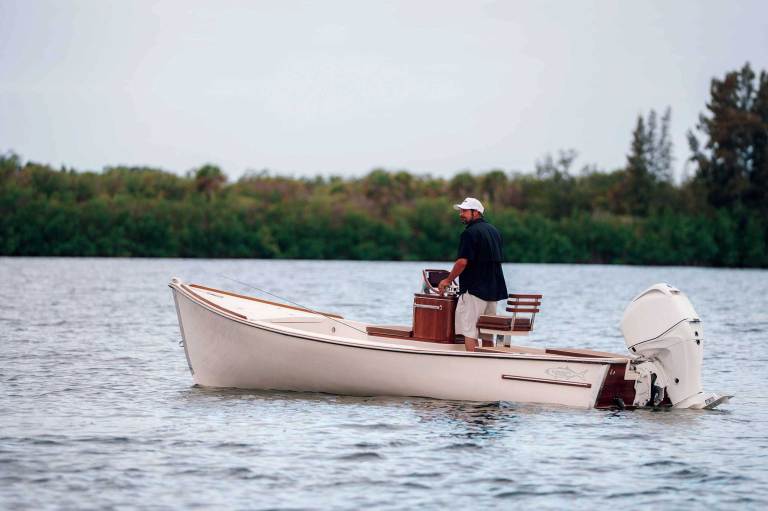
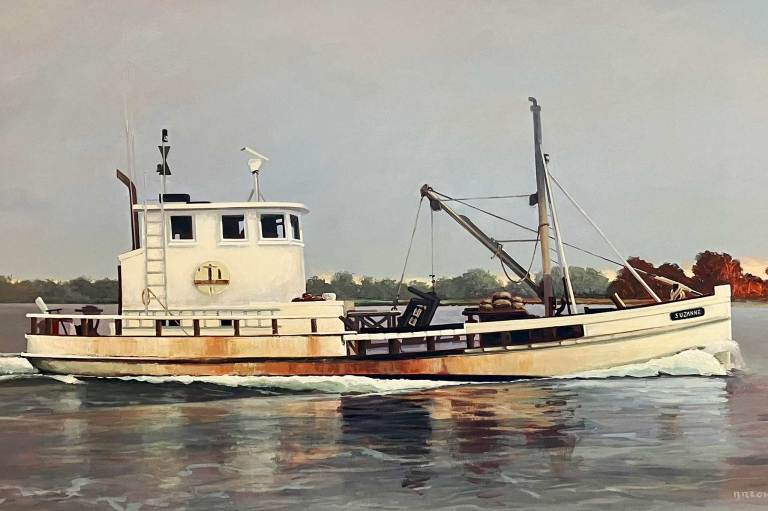
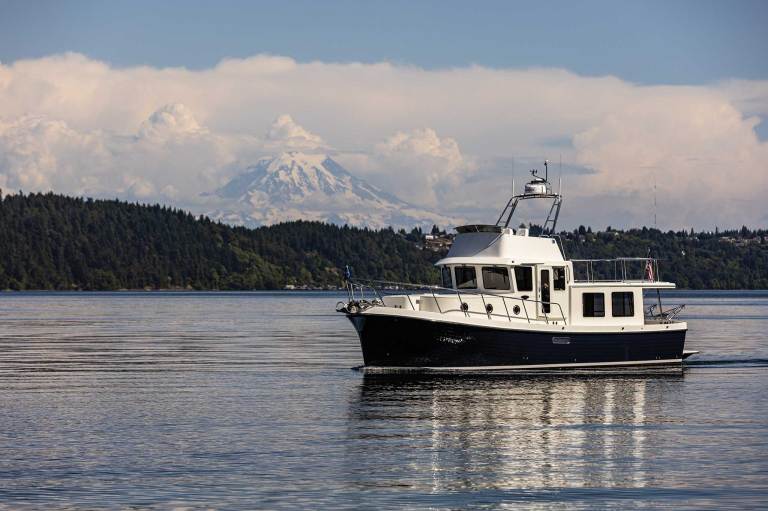
Cevoli, whose work has been featured in Soundings over the years, takes pictures of both pleasure boats and commercial vessels. He shoots with a Canon 5D MK III and often takes photographs for Blount Boats in Warren, which has built everything from vehicle and passenger ferries, commuter boats, small cruise ships, tugs and trawlers to wind-farm service vessels. “I’ve photographed a bunch of their larger ferries from start to finish, which is a very cool process,” he says. “It’s interesting to see the process, starting with the raw materials and then—8, 10, 12 months later—they’re smashing a champagne bottle against the hull as it goes into the river for trials.”
 Michael Cevoli
Cevoli grew up in Norfolk, Massachusetts, and hails from a creative family. His father, Victor, attended the Art Institute of Boston and had a long career with the Hill Holiday marketing agency in Boston, retiring as executive creative director. His mother, Patricia, was a Boston public school teacher and later a suburban high school art teacher. Cevoli’s sister Kim is a graphic designer. While any career path would have satisfied their parents, both Cevoli and his sister knew they’d have their parents’ blessings if they chose creative callings. “I remember my dad telling me, ‘If you want to be a garbage man, just be the best garbage man you can be,” Cevoli says. “As long as you’re happy, we’ll support whatever you want to go do.’ “
As a freshman in high school, Cevoli and his father built a darkroom in the basement wood shop. The school principal, who became a mentor to Cevoli, let the budding young photographer salvage equipment from an abandoned high school dark room. “I loved it,” Cevoli recalls. “After school, I would skateboard, ride my bike and play baseball. On the weekends I’d take a ton of pictures and after dinner, go into my little dark room and develop and print.”
 Michael Cevoli
His early subjects included old mills and junk yards, places that were more common in New England 25 years ago than they are today. “We had a couple of mills around my neighborhood that were abandoned, but still full of all the machines. It’s like they just closed up shop one day and left everything,” he says. While in high school, he also took Saturday classes at the Art Institute of Boston and the Rhode Island School of Design (RISD), from which he earned both undergraduate and master’s degrees.
The photographer is drawn to the types of people he grew up around and has worked with. “Blue collar folk. Working class,” says Cevoli, who worked as a roofer, house painter, scrap metal collector, boatbuilder, bouncer, photo assistant, high school and college teacher before becoming a full-time photographer.
 Michael Cevoli
Cevoli’s unpretentious manner and interest in the lives and work of his subjects comes through in his interactions with them. “Especially with documentary photography, you are always walking that fine line between taking a picture or exploiting the subject,” he says. “I’ve always tried to be very respectful of the subjects.”
Cevoli is drawn to characters and their stories, and they seem equally attracted to him. Several years ago, he did photos for a story on giant bluefin tuna off Prince Edward Island published in Anglers Journal, which is owned by the same company as Soundings. On his way home he stopped in Maine to scout another story the editors of that magazine were developing. They wanted to profile the hardscrabble men and women who make their living on the tidal flats, digging blood and clam worms, for which they get paid by the worm. The diggers aren’t an easy bunch to locate, and they don’t care much for reporters and photographers. In the process, Cevoli bumped into Millard Hassan, a former worm digger who had an automobile repair shop in his backyard in Newcastle. Millard still built worm hoes, hence the interest.
 William Schaff
“He knew I was coming, but he didn’t know who I was,” Cevoli recalls. “When I went into his shop, he had broken the snap on his holster and had his little Beretta ready.” Millard had his guard up, having been robbed not too long before Cevoli’s visit.
Cevoli is quiet and moves unobtrusively around his subjects, blending in as they go about their work. Like many of the people he photographs, he is inked, with two full sleeves and a full chest of tattoos, most of them nautical—a boat, birds, anchor, waves, octopus and the like. Some of the art was done by a legendary Rhode Island tattoo artist named Mondo, who has since passed. “He was a Mexican guy from L.A. who learned how to tattoo on prison machines,” says Cevoli. “And he was the go-to guy in Rhode Island.”
 Michael Cevoli
After grad school, Cevoli took a class on commercial fishing taught by a former Alaskan crab fisherman turned professor. “He was a character,” Cevoli recalls. “He grew up in a crab fishing family and had a couple of boats. He lost a boat, lost a few men. For the very first class, he brought in two survival suits. He picked two kids at random, threw the suits at them and said, ‘Get in.’ A few long minutes later, he told the students, ‘You’d be dead. Welcome to my class.’ Not surprisingly, the two of us hit it off.”
The professor helped Cevoli obtain a residency at the New Bedford Whaling Museum, where he photographed the city’s fish houses and commercial fish boats. “It was a rough port,” Cevoli recalls. “Very tough bunch in New Bedford.” Those commercial fish docks are the kind of insular environment where cameras and outsiders make people nervous. “You stay up a little later, you get up a little earlier, and all of a sudden you’re blending in, and they don’t think of you as a photographer,” Cevoli says. “That helped as far as the comfort level goes with a lot of the people down there.”
Photography, like so many fields, requires that you put in your time, get in your reps and develop your craft.
 Michael Cevoli
“I remember my first editorial job, I didn’t even have a digital camera,” Cevoli says. “I had to beg, borrow, and steal a camera to do this first job for my first client. And they sent me to the Johnston Landfill.”
The enormous landfill in Johnston, Rhode Island, was known as Trash Mountain, which also had the erroneous reputation as being the highest spot in Rhode Island.
“It was like, great, my first professional job, and I’m on Trash Mountain,” says Cevoli. But the shoot went well and led to another job from the same client. “They had a commercial fishing story to shoot. And none of the other photographers wanted to deal with going on a boat in the winter. They called me because I didn’t mind going to the landfill. And that’s kind of how I started shooting a lot of maritime stuff.”
The assignment was to photograph a small commercial conch fishing operation. He shot it from inside the cabin looking aft, through two dirty, spray-splotched windows, one of which is cracked. A small cabin heater glows orange. On the deck of the open transom boat a woman in green oil skins, her wool cap and hood on, is working on something in a corner. The clouds are low and the boat is underway, leaving a long and evocative cold wake trailing off toward a distant shore.
Cevoli’s regular clients include a marine construction company that owns a tugboat and two large barges with cranes. It’s the kind of hard-hat industrial waterfront work that he enjoys shooting.
Cevoli is a battler. He survived a harrowing ordeal with Hodgkin’s lymphoma, diagnosed in 2015. He underwent six surgeries, three weeks in the ICU, six months of chemotherapy and one month of radiation. One tumor in his chest was the size of a grapefruit and collapsed his left lung. “It was very touch and go,” Cevoli recalls. “It was not expected that I would make it out of my first ICU, but here I am. When I got out of the hospital, I was down to 110 pounds.” He hit 5 years cancer-free in July of 2021.
When he reentered the world, he sought out the kind of people he was most comfortable and familiar with. “When I was first healthy enough to be back out in the world, there was a group of five of us who would meet up over at Jack’s Bar here on Water Street and just talk,” Cevoli says. “It was a bunch of crusty old guys. A boatbuilder, a prison employee, a lawyer. Just every walk of life that cancer hits. And sometimes we’d talk about nothing, sometimes we would talk about that, and sometimes we’d just get a sandwich. It was nice to be around people you didn’t have to say anything to. They got it.”
Those who have known Cevoli’s work for a while have told him his portraits have changed since his illness.
“They seem to be maybe more empathetic, more sympathetic,” he says. “I have a different perspective on things and people, and I think a different understanding. If somebody’s having a really bad day, you have no idea what they’re going through. I think I was always empathetic before, but it’s changed quite a bit.”
This article was originally published in the May 2023 issue.