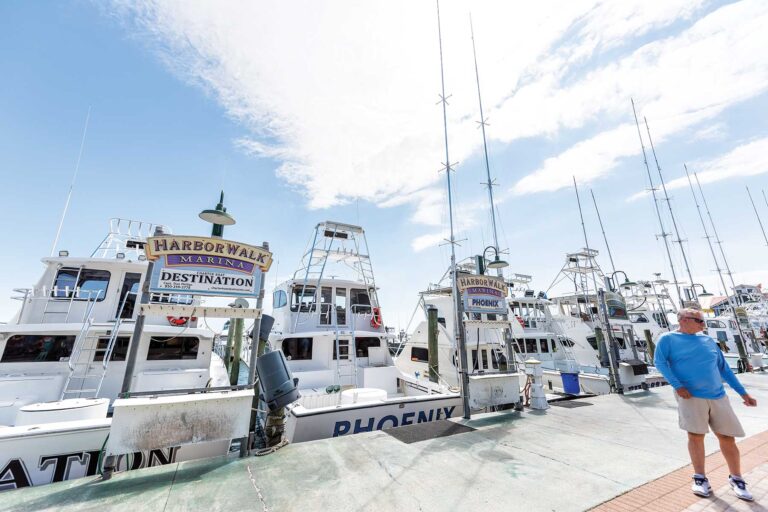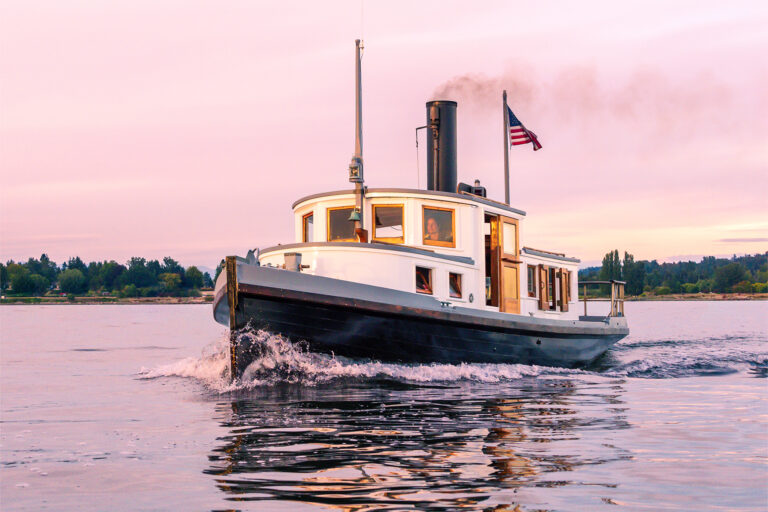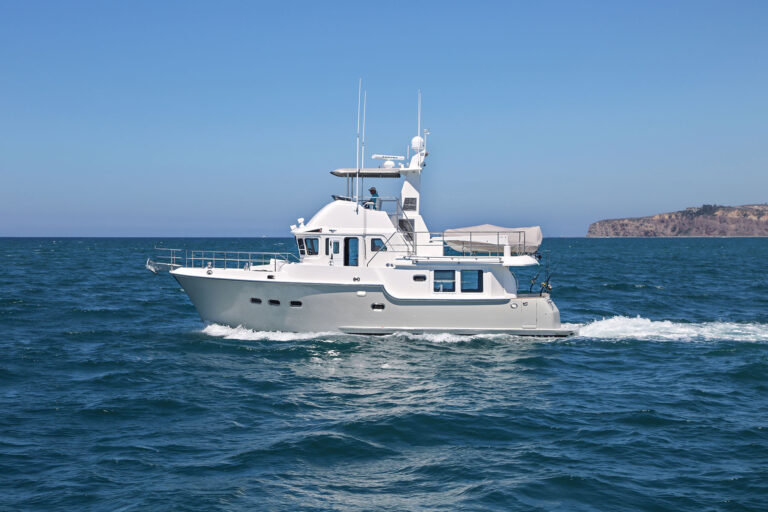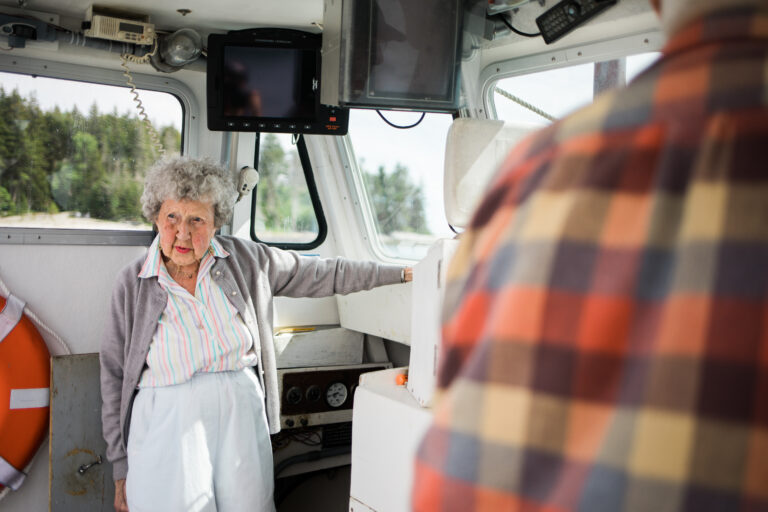
Every afternoon, Robert Creech leaves his home near where the Intracoastal Waterway whisks boaters safely past Cape Fear and Frying Pan Shoals in Southport, North Carolina. He visits Morningstar Marinas, looking for boats flying the America’s Great Loop Cruisers’ Association burgee. Creech and his wife, Kay, are the organization’s harbor hosts for Southport, a job they take seriously—and enjoy enormously.
“The calls start before people arrive,” he says of the Loopers who cruise here. “People are asking about where they can get their boat washed or their engine fixed, or their hair done.”
The Creeches offer rides to grocery and hardware stores, then set out the glassware for a communal libation. “It’s not unusual to have 10 to 15 boats in one evening,” he says. “We usually invite them to our porch around 5 p.m. for porchtails, and have had as many as 27 people in one evening.”
Last spring, the Creeches counted 300 Loopers, many of whom hoisted a drink with the couple alongside the nameplate that once adorned their 43-foot Jefferson Sundeck C-Life. They sold the boat after 18 years, but are now among the AGLCA’s 500 harbor hosts, part of a community of support, inspiration and information for which the 25-year-old membership organization is known.
Founded in 1999, the AGLCA is primarily designed to support boaters cruising the eastern half of the country using the Mississippi River, Tenn-Tom Waterway, Gulf of Mexico, Okeechobee Waterway, Intracoastal Waterway, Hudson River and Erie Canal/New York State Canal System to the Great Lakes. The experience opens new worlds for members. The Creeches’ own Loop was in 2008-09, and they loved it.
“It was the people we met, both on the water and the locals,” he says. “To me, the best parts were the social aspect and the history of what you encounter. This country was founded by the river system.”
Joining the AGLCA and completing the Loop happened just at the right time for the couple, who had recently retired. After their trip, caring for other boaters was a perfect fit. Other boaters value membership because they have access to resources that help them plan trips and select routes.
“Anchoring off to the port side of the channel just before Bear Mountain Bridge on the Hudson is a place I could stay for weeks if time allowed,” says AGLCA member and transplanted Scotsman Mick Anderson of Naples, Florida. He has completed the Loop eight times in his 1982 Cheer Man PT41 trawler, which has 9,000 hours on the engine and some 60,000 miles under the keel. AGCLCA members have helped him discover a number of special places.
“Fayette in the Upper Peninsula of Michigan is an old, abandoned iron ore village; Sheboygan Yacht Club in Wisconsin is one of the friendliest clubs you will ever find, and the Lower Mississippi River and Atchafalaya River is my favorite route back to Florida,” he says.
How It Started
A California couple named Ron and Eva Stob were on a trip with family on Ontario’s Trent-Severn Waterway in 1990. “We saw a boat going the opposite direction, and they had ‘Norfolk, Virginia’ on the transom,” Eva said in an interview. “We said, ‘How did you get here from Virginia?’ They had come up the Mississippi River. It was the first time we realized that Eastern North America was a big island. We said, ‘Let’s do this.’”
After taking some classes, the Stobs set out from Fort Lauderdale, Florida, in 1994 in a 40-foot trawler, Dream O’Genie. Ron was a travel writer, and in 1999 they self-published a book, Honey, Let’s Get a Boat. In the next year, they were making presentations at Trawlerfest events and creating get-togethers in several states as the AGLCA.
The Stobs’ book provided enough how-to information to create long-distance cruisers out of people who had never considered traveling thousands of miles by boat. “Our goal was to serve as inspiration because this is a relatively benign waterway,” Eva says. “We felt like, if we can do it, anybody can.”
Boaters spend a few weeks to a few years along the Loop, most taking time to visit small towns and big cities along the way, each choosing their own route to adventure. In 2024, 270 boats reported completing the Loop. AGLCA Director Kim Russo says as many as 400 are actively engaged. There are 6,300 registered boats in the organization, which she says represents 10,000 to 12,000 individuals.
AGLCA members have access to group discounts, detailed navigational insights, information about budgeting, and updated route planning. The warmth and generosity of other members is a priceless bonus.
“The phrase I often hear used is that the Loop restores people’s faith in humanity,” Russo says. “People still look out for each other.”
One of her favorite Loop stories is of a family with a child on a regimen of medicine that had to be refrigerated. AGLCA harbor hosts picked up doses at local pharmacies and kept it in their homes until they could meet the family’s boat.
Russo is a Legacy Looper, as her father completed the Loop and is a longtime AGLCA and power squadrons member. He was inspired after reading the Stobs’ book and, with his wife, helped the Stobs manage the growing AGLCA organization for about seven years. Russo has been involved since 2008. She took the helm in 2015.
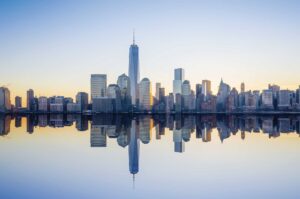
The Perch, a Silverton 410, is Russo’s home and the roving headquarters for the AGLCA’s online presence, greatLoop.org, where she uploads videos, articles, and interviews. She is a Looper who spent much of last summer visiting Lake Champlain and the Rideau Canal. Along the way, her partner, Michael, proposed while they were anchored by the Statue of Liberty, gazing at Manhattan’s twinkling lights.
Inspired to Adventure
The Creeches were inspired by the Stobs’ book, as were Sarah Bowlin and her husband, Brent. In 2020, they set out from Brunswick, Georgia, with their children, 8-year-old Miller and 12-year-old Mary Grace. When visiting Tangier Island in Chesapeake Bay, they were invited to a graduation party for four high-school students. They spent MaryGrace’s birthday anchored in the shadow of the Statue of Liberty. They were hooked.
“Some people plan for years, but there’s no right or wrong way to do it,” Sarah Bowlin says. “We just jumped in and learned as we went. There were always lots of people around us cheering us on and helping to fix anything.”
They also buddy-boated from the Great Lakes to the Gulf with another homeschooling family. Now based near Fort Myers, Florida, the parents work in Loop-related industries. Bowlin (a travel blogger, @MomWithAMap) is certain they will go back to Looping later in life. “It’s never the same trip twice,” Sarah says. “And we always look forward to seeing our friends along the way.”
Improvements that made the Loop more navigable for small boats have certainly aided participation. One was the 1984 completion of the Tennessee-Tombigbee Waterway that slices through Mississippi and Alabama. The 234-mile waterway has 10 locks, allowing travelers to bypass the southern Mississippi River, where navigation issues and floods are common, and services can be widely dispersed.
Likewise, at the northern end of the Loop, Ontario, Canada’s 240-mile Trent-Severn Waterway, completed in 1920, draws those curious about “cottage country” and the Big Chute
Marine Railway, which carries boats over a 60-foot elevation change. The 44-lock waterway includes a series of lakes and manmade canals from Lake Ontario to Lake Huron.
In 2025, two records were set for the fastest loop. Robert Youens completed it in a 16-foot open john boat in fewer than 20 days, and a four-person team in a 40-foot Contender, Lady Lor, finished in just under 13 days. Conversely, there are at least two men looping in kayaks as of this writing.
A Timeless Trip
Ted Pongracz started Looping before social media glory existed. In 1988, the jewelry store owner from Grosse Pointe, Michigan, got tired of the short boating seasons in his home state, so he started taking his Kadey-Krogen Manatee, called Manatee, from Michigan to Marco Island, Florida. Since 1991, he and his wife, Sarah, have looped almost annually, and now they’re joined by their Cavalier King Charles Spaniel, Patches.
Now royalty among AGLCA members, Ted Pongracz, 85, has looped 35 times, for a total of about 230,000 miles, all in the original boat (now on its fourth engine). Says Pongracz, “It’s 240,000 miles to the moon. We’re almost there.”
December 2025