Adobe Stock
I have a fascination with the Gilded Age, when hard-charging industrialists amassed crazy fortunes and lived as only the 1 percent can imagine, with castles and cottages, yachts and steamships—trappings of wealth that even the Kardashians might have had a tough time keeping up with. Maybe I read too many Edith Wharton novels in college, but a delight in that period of opulence and extremes has stoked an interest in the Thousand Islands, a destination that seduced society to its shores in the late 1800s.
Old and new money traveled to this northwestern corner of New York state to escape the summer heat in cities. Today, history buffs and those who love the water come here to explore the archipelago on the St. Lawrence River, and get a glimpse of Gilded Age gold, from behemoth boat houses to palatial homes filled with enough damask and brocade to satisfy a heroine in The Age of Innocence.
Local Knowledge
Jordan Beach meets my friend Joe Pellegrino and I at the dock on Wellesley Island. Wildflowers color the rock shoreline, and white pine trees rise tall, like natural beacons marking the quiet cove. A bald eagle patrols overhead as we board his Correct Craft 24.
Beach, 25, is relatively new to chartering, having spent just a few seasons running tours, but he’s a natural, with solid seamanship skills, a preference for a neat boat, and an easygoing personality. Most important, he grew up here, so he has local knowledge
The St. Lawrence River begins at the outflow of Lake Ontario near Kingston, Ontario, and threads about 50 miles east through the islands to Alexandria Bay, New York, and another 300 miles to the Gulf of St. Lawrence. An international boundary zigzags through the middle of the river, so boaters in the Thousand Islands find themselves crossing between the U.S. and Canada. Conditions alternate from broad and deep reaches of water to twisting passages that thread between islands and make skippers feel as if they’re navigating in a maze. There’s Canadian Shield granite here too, in boulder fields, ledges and shelves—silent threats to a smooth passage. “Navigation can be tricky,” Beach says, “but that’s what makes it exciting to run a boat here.”
As we get underway, Beach hands me a guide to the Gilded Age hotels that once imbued the islands with a resort culture that tried to rival Newport, Rhode Island, and Bar Harbor, Maine. Most are gone now, including the New Frontenac Hotel on Round Island. “That’s the famous one,” Beach says. Tobacco magnate Charles G. Emery bought and renovated it in 1898. He advertised it as one of the most magnificent retreats in the nation. Today, there are mostly casual hotels in the Thousand Islands, but those who return to this freshwater playground season after season don’t stay in them. They pack supplies on their boats and head to island cottages.
Earlier in the day, we’d talked with Rodd McMinn, who’s been summering in his family’s place on Grenell Island his entire life. His great-grandfather purchased a lot for the cottage in the 1880s, having discovered the area while working as an engineer on a train that traveled into Canada. McMinn is originally from Long Island, New York, but he moved his home and business to Buffalo many years ago, so he’d have a shorter commute to the islands. “This place really grows on you,” says McMinn. “I don’t think there’s any place in the world quite like it.” Grenell Island is accessible only by boat, and because conditions get rough, McMinn bought a Grady-White 255 Freedom from Chalk’s Marina in Fishers Landing, New York. “Rain is never a problem,” he says, “but when the wind blows, you need something dependable.”
There are many islands here—more than 1,800, which is just one of the ways the Thousand Islands overdelivers. And they come in untold shapes and sizes. Places like Wellesley (15 square miles) and Wolfe (48 square miles) dominate navigation charts, but around these wooded giants are hundreds of islets, some publicly owned, others private.
As Beach runs the boat upriver, we see a private island with a colossal contemporary house, swimming pool and helipad—proof that the 1 percent is still thriving here. Another has a modest cabin that fills the property, sparing not even a few yards for grass to grow. A few miles later, we pass a boulder rising above the water’s surface. It’s barely large enough for a couple of seagulls to get comfortable, but because it’s at least one square foot in size and can support a single living tree, it meets this region’s definition of an island.
This mix of scale makes for great entertainment. Our crew is equally delighted by the clear water. From the deck of Beach’s boat, we see rocks and weed beds far beneath the surface. Visibility often exceeds 30-plus feet in the Thousand Islands, which explains why divers travel here to swim laps around shipwrecks, including a few from the Gilded Age era, that the cool water keeps well-preserved.
We pass all types of boats. In the distance are colossal freighters. Just off the point are bass boats manned by anglers casting into cover where smallmouth hide. Trawlers are anchored in coves, some taking a breather before heading east to the Atlantic. A Stanley aluminum boat chugs by, loaded with groceries from the local Price Chopper, which has a big dock. “That boat is every islander’s dream,” Beach says.
There are fast boats too, including a sporty, low-slung Formula. Its owners are from Canada and say they trailer the boat to the New York side of the river every summer. They’ll do some nights on the hook and others in visitor-friendly towns like Clayton and Alexandria Bay, where there are public docks, full-service marinas, restaurants, ice cream shops and places to stretch your legs.
Beach makes a turn into Lake of the Isles, where his family lives. “The deepest water is only about 12 feet, so the temperature is higher than elsewhere. “For us, it’s all about warm water,” he says with a smile.
Beach points the bow toward the International Rift. It’s the narrowest stretch of the St. Lawrence River and is prominent because it’s where the borders of the United States and Canada are closest. The distance between the two shores is only about 60 feet, and powerful currents require careful navigation. The starboard side of Beach’s boat seems dangerously close to a can-opener of a granite shelf as he inches by a pontoon boat to port. When we see a white-tailed deer emerge from a stand of trees and step toward the water off the bow, we hold our breath, then exhale when the doe changes her mind and darts away.
We pass other islands. A few have coves filled with boats in raft-ups; others are state parks with trails that hikers can negotiate in sneakers since this region features a pleasantly flat terrain.
“There’s Grindstone,” Beach says, adding that some locals live on that island year-round. “It’s like stepping back in time. There are old barns and dirt roads. You feel like you’re just disconnected from the rest of the world.” That is, until you’re not. Grindstone’s population swells to about 700 in summer.
A Storied Past
The boat traffic also swells as we approach Millionaires’ Row. This section of the river is known for its concentration of estates built during the Gilded Age. Among the power elite who took up residence here were George Pullman, the railroad magnate who made his fortune with luxury sleeping cars, and Frederick Gilbert Bourne, who steered the Singer Manufacturing Company to global success. Singer may not have written a novel to rival one of Wharton’s, but he ensured that the world could stitch together a respectable hemline.
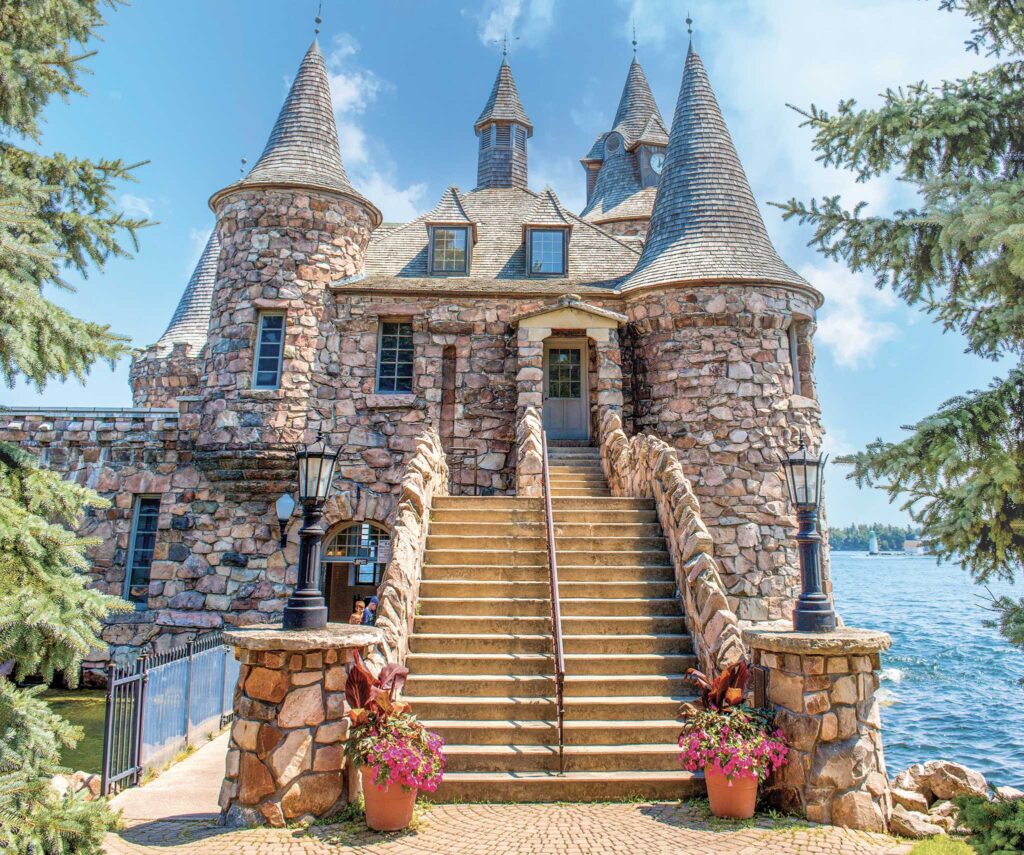
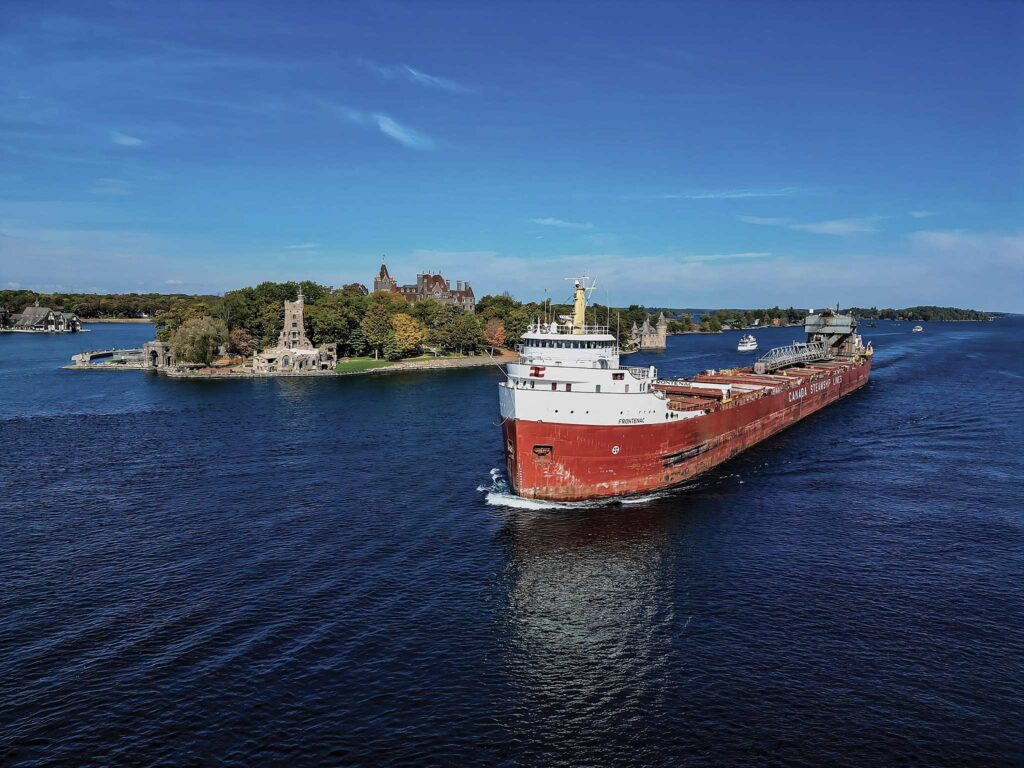
Singer’s Castle is a popular landmark, but many argue that the centerpiece of Millionaires’ Row is Boldt Castle. We toured this estate, which George C. Boldt built as a tribute to his wife, Louise.
Boldt, a hotelier who managed New York’s Waldorf-Astoria, started construction in 1900, but then abandoned the project when Louise died in 1904. It’s modeled after Rhineland castles and built with local rose granite, rising six stories. It was one of the largest private homes built in the United States at the time.
There are some wonderful elements here, including a sweeping staircase and stained-glass dome, but much of the castle remains unfinished, with empty rooms and plaster for walls. We use our imagination to visualize what this castle could have been in that era of one-upmanship. The Canadian pine floors in the ballroom would have been polished slick for dancing, and the floor-to-ceiling sash windows would’ve been flung open to show off the river and boats. That view alone would have been a social flex.
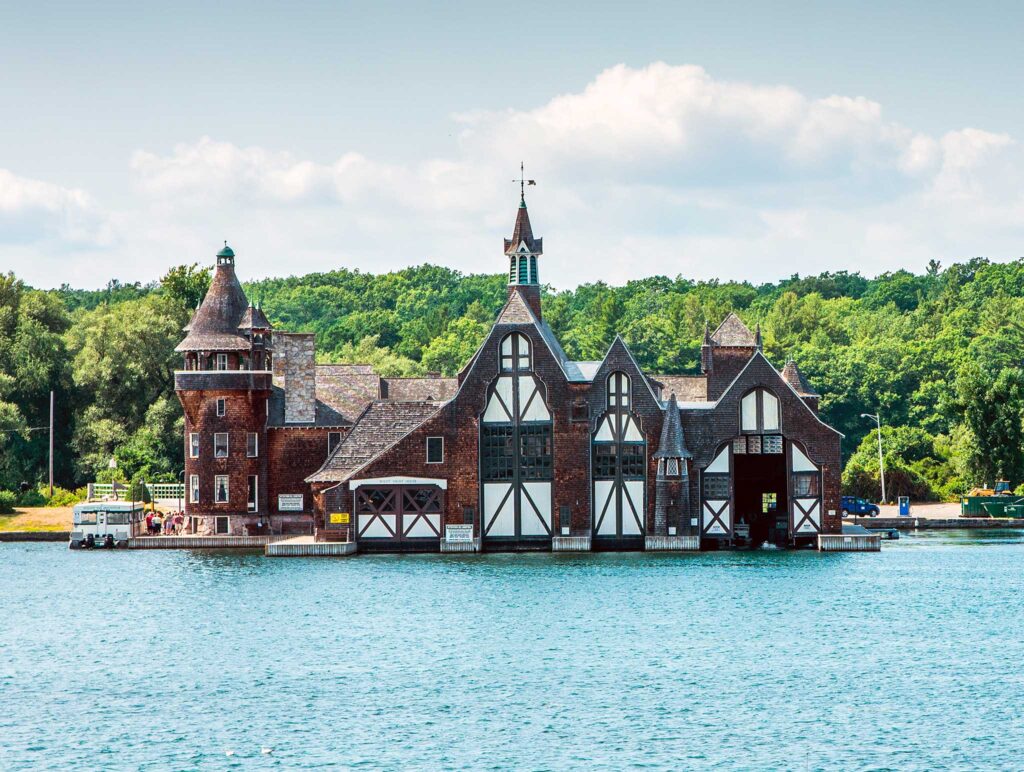
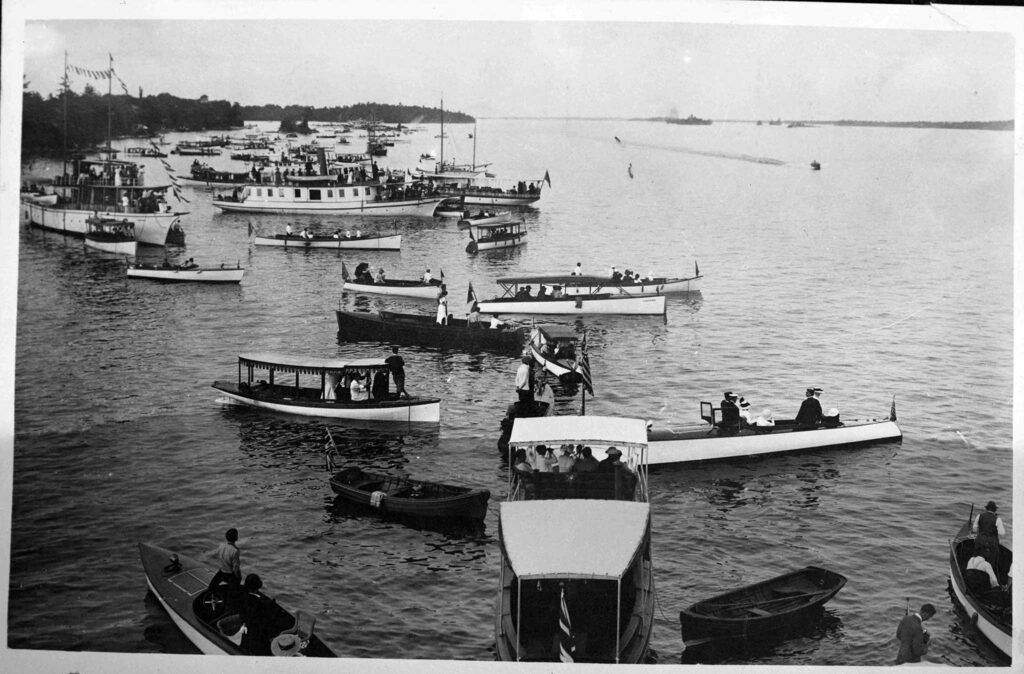
The real cultural currency on this estate is the George C. Boldt Yacht House, with its towering bay doors, steep-pitched gables and crenelated caretaker’s wing. Inside, it doubles as a small shipyard and boat garage. In one of the yacht bays is the 60-foot steam yacht Kestrel, built in 1892 by George Lawley and donated for permanent display by the Thousand Islands Bridge Authority. Nearby is a collection of wooden antique boats, including one from the original Boldt fleet: the mahogany PDQ, a one-design class made in the early 1900s. It’s lightweight, narrow and obviously built for speed over comfort. It belonged to Boldt’s daughter, Clover, who was a force in motorboat regattas on the St. Lawrence River at a time when women who wore bustles rarely took the helm in competitive events.

History and Horsepower
In the Thousand Islands, speed on the water was embraced. By the 1890s, gas-powered runabouts were sharing the river with steam yachts, and informal races became organized competitions. The St. Lawrence proved a good course. Regattas drew crowds, newspapers reported on rivalries, and the islands became an early center of American powerboating.
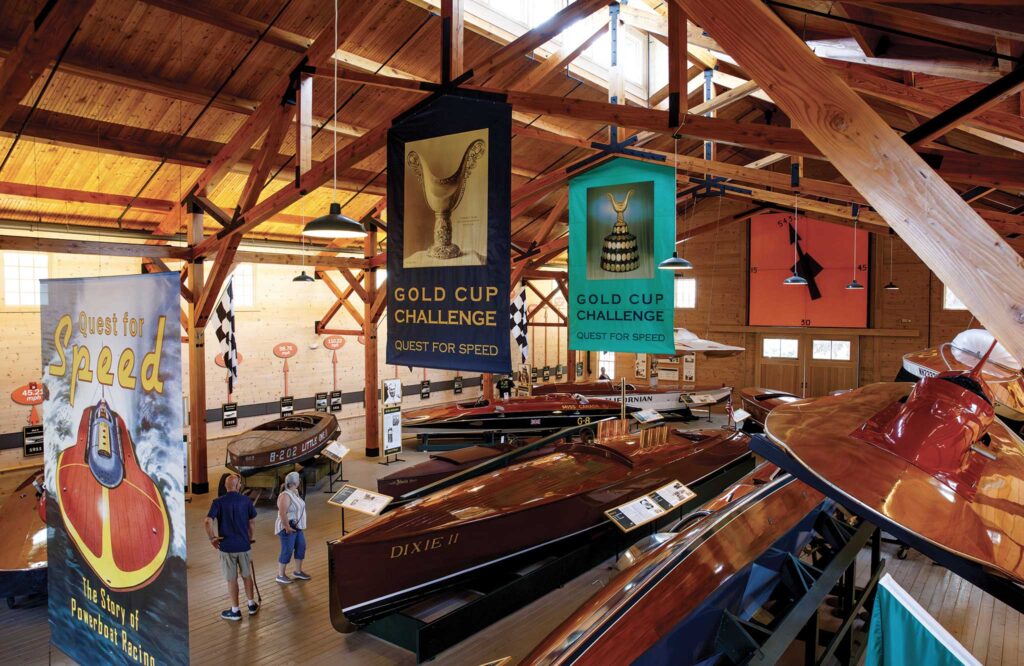
Beach drops us off at the Antique Boat Museum in Clayton. It’s filled with racing icons. There’s the stepped hydroplane Gold Cup winner Miss Canada III, and Gar Wood’s Miss America X, a 38-foot hydroplane with four Packard V-12 engines and about 6,000 horses. Other displays feature classic mahogany runabouts that companies like Hutchinson, Fay & Bowen and Hacker-Craft built in Upstate New York.
The best part of the museum is at the dock, where we board Miss Thousand Islands III as part of the Ride the River program. She’s a 30-foot triple-cockpit Hacker-Craft. The company built her in 2005, but designed her in the image of the long, varnished mahogany runabouts that were fixtures in the Thousand Islands at the turn of the 20th century.
Capt. Mike Cuda lets us settle into the center seating area upholstered in dark green leather. It feels as if we were in a gleaming time machine, running low to the water with spray and wind in our faces, the river slipping by in a blur, as it did for those who ran boats more than 100 years ago. Then and now, the joy is the same. Pure, unfiltered fun.
Past Is Present
Before we pack the car to head for home, we check out of the 1000 Islands Harbor Hotel in Clayton and stroll its riverwalk.
We follow that path around the point and find St. Lawrence Restoration, a family owned business specializing in antique boats. There, we gawk at the fleet of exceptional wooden boats at the dock, and meet the company’s owner, Mitchell Price. He was raised in the Thousand Islands, moved to Europe after college and, years later, returned home. An artist and educator, he knows a lot about the area’s Gilded Age past. I ask him why he thinks those society families eventually drifted away from the area.
“I think a better question is, why do so many families keep coming back today?” he replied. “The ones that return have been doing so for generations, because the place means something to them. There’s a lot to be said for making an effort to have the past play a part in your present.”
November 2025