
The Erie Canal is a manmade superhighway of sorts: a long, narrow waterway that winds through towns, marinas and lakes, and that put New York State on the map as “The Granary of the World.”
Before the canal, mules were the best mode of bulk-goods transportation that early European settlers could muster. The pack animals would carry about 250 pounds apiece through challenging terrain, and then draw a barge along a towpath in a 60,000-pound-per-mule ratio. The first talk of a far more efficient canal was around the turn of the 18th century, and plans were set in motion in the early 19th century.
Even then, people balked at the idea. With a 571-foot elevation change along a winding route, building a canal seemed downright impossible. President Jefferson wrote off the idea as “little short of madness.”
So much for the naysayers. Today, the Erie Canal has seen a full 200 years of servicing all walks of maritime traffic, from barges carrying grain to pleasure boaters toting sunscreen. And although today’s canal carries but a trickle of the traffic it did at its peak in the 1950s, it has become a favorite part of the cruising scene for boaters who like to take their time in Great Loop style.
Clinton’s Folly
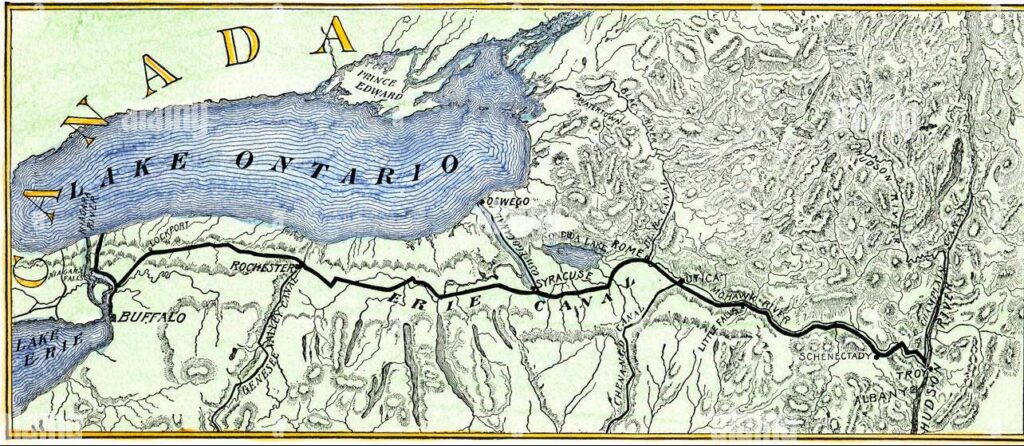
The initial idea for the Erie Canal may have been discussed as early as 1790, and there’s no denying that early talks were greatly inspired by China’s 1,104-mile Grand Canal. A flour merchant from Bridgeport, Connecticut—who was in debtor’s prison for failed westward shipment of products—wrote a proposal for how a canal might be built. During his incarceration, Jesse Hawley penned more than a dozen essays detailing plans for a 400-mile canal from Buffalo to Albany. They were published in the early 1800s in the Genesee Messenger.
New York state Assemblyman Joshua Forman then proposed legislation to determine whether Hawley’s route was actually feasible. It was ultimately De Witt Clinton—who served as a New York state senator, New York City Mayor, New York Governor and U.S. Senator—who got credit for putting the plan in motion. People called the project “Clinton’s Folly” and “De Witt’s Ditch,” what with there being maybe 10 engineers in the entire United States of America at that time. The Army Corps of Engineers was just being established right around that same time.
Nevertheless, some $7 million (more than $165 million in today’s dollars) was afforded to the project, which broke ground in Rome, New York, on Independence Day in 1817. Initially, the diggers were mostly local farmers whose land the canal would flow through. That grueling work was done over the course of eight years, mainly by hand and animal power. Eventually, work gangs were called in, including many Irish and European settlers.
By October 1819, the eastern section of the canal was in use between Rome and Albany. Six years after that, the entire 363-mile-long, 40-foot wide, 4-foot-deep waterway connecting Albany to Buffalo was deemed complete, on October 26, 1825.
Then-Governor Clinton helmed the first passage from Buffalo to New York City aboard the 73-foot steam-powered canal boat Seneca Chief. Upon arrival in New York Harbor, he produced two barrels of Lake Erie water and ceremoniously emptied them to commemorate the mixing of waters.
Somewhere between a year and a decade after the canal’s completion, tolls and taxes had covered the state’s debt to create and build it. A near-constant stream of vessels flowed through the waterway almost from the get-go, with those first passages made primarily by freight and packet boats. The former were towed by horses or mules on a towpath. The latter were passenger boats, in essence, with galleys, wood stoves and bunks for up to 40 overnight passengers.
Boats passing one another on the canal’s first rendition found the space particularly tight. Carol Sheriff methodically described one such passing in The Artificial River: The Erie Canal and the Paradox of Progress, 1817-1862. The vessels, pulled by teams of two or three horses or mules driven by a “hoggee,” had little leeway on the single towpath. The vessel being overtaken was given right of way, which meant the deferring vessel would take to the berm, or heelpath, letting its towline sink. This process, coupled with the fact that horses would have to be changed frequently, meant that things could, and did, get tricky.
In 1835, author Nathaniel Hawthorne took a packet boat cruise and recounted more than one such mishap: “Several little accidents afforded us good-natured diversion. At the moment of changing horses, the towrope caught a Massachusetts farmer by the leg and threw him down in a very indescribable posture, leaving a purple mark around his sturdy limb.” Another entanglement, this time with a fallen branch, ultimately left him marooned at the canal’s edge at midnight, ending his voyage abruptly.
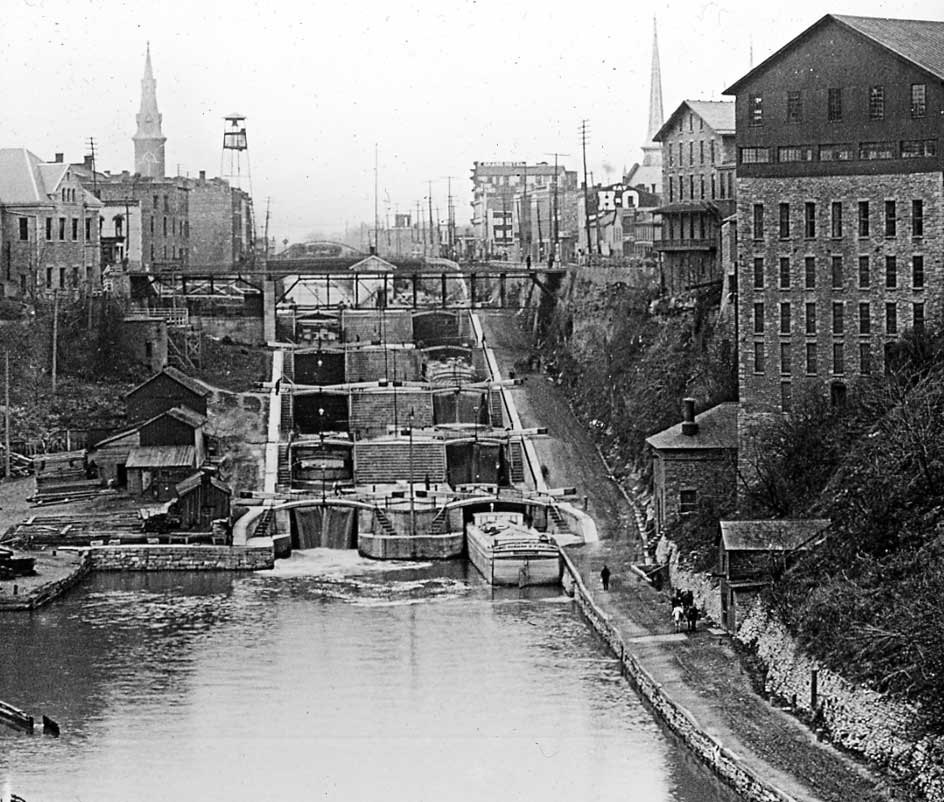
Still, Hawthorne was left enamored by the canal’s splendor. He was so attracted to the burgeoning American communities sprouting along its shores that he made plans to travel its distance from Buffalo to Albany not once, but twice that summer.
“I was inclined to be poetical about the Grand Canal,” he began his account in New England magazine. “Surely, the water of this canal must be the most fertilizing of all fluids; for it causes towns—with their masses of brick and stone, their churches and theatres, their business and hubbub, their luxury and refinement, their gay dames and polished citizens—to spring up, till, in time, the wondrous stream may flow between two continuous lines of buildings, through one thronged street, from Buffalo to Albany.”
Alas, the ever-curious Hawthorne wandered ashore during a hangup due to a towrope disentanglement, and his ride slipped away. Four miles an hour may be slow, he noted, but it was plenty fast enough to outpace him. He was left to make his way to Syracuse by foot the next day.
Right around the time of Hawthorne’s misadventure, New York State—which was, and still remains, the canal’s sole proprietor—voted to widen and deepen the waterway to 70 feet by 7 feet, and to alter each rise to include twin locks. Just 15 years into the canal’s existence, New York Harbor would become the busiest port in the United States, moving more tonnage than Boston, Baltimore and New Orleans combined.
Transitional Period
The sudden influx of canal traffic, commerce and wealth also brought the inherent underbelly of grifts and vices. Bordellos, bars, casinos, and a litany of beggars and hangers-on were quickly drawn to the canal’s proverbial banquet.
Morally concerned citizens protested, leading to social reform and religious revivalism—namely, New York abolitionist Charles Finney’s Second Great Awakening. Finney’s movement helped give rise to western New Yorker Joseph Smith’s Church of Latter-Day Saints. The less-savory elements around the canal were somewhat successfully repelled, and the towns along its banks became relatively family friendly again. This was thanks in no small part to Smith’s Book of Mormon, whose texts are said to have been discovered and translated just south of the canal.
So many memorable moments in history happened here. Frederick Douglass published his North Star newspaper along the canal in Rochester. With the help of Douglass and Finney, the Underground Railroad found a shortened route just beyond the canal’s towpath, allowing refugee slaves to transit the entire state of New York within a week as opposed to a month.
The Women’s Rights Movement, too, is indebted to the waterway. Activist and author Elizabeth Cady Stanton was a driving force behind the 1848 Seneca Falls Convention—the first to call for women’s rights—and joined forces with Susan B. Anthony along the canal, publishing The Lily, the United States’ (and perhaps the world’s) first newspaper edited by and for women. The duo used the canal, its mail-delivery boats and access to the dignitaries who transited the waterway to create a veritable network of freedom. The Erie Canal saw its peak year during this period, with some 33,000 commercial shipments in 1855.
At the outbreak of the Civil War, the Union army used this superhighway to deliver a flow of goods, including artillery and supplies, at a rate of speed comparable to the Mississippi River. The Erie Canal played no small part in the Union’s ultimate success.
Modern Times
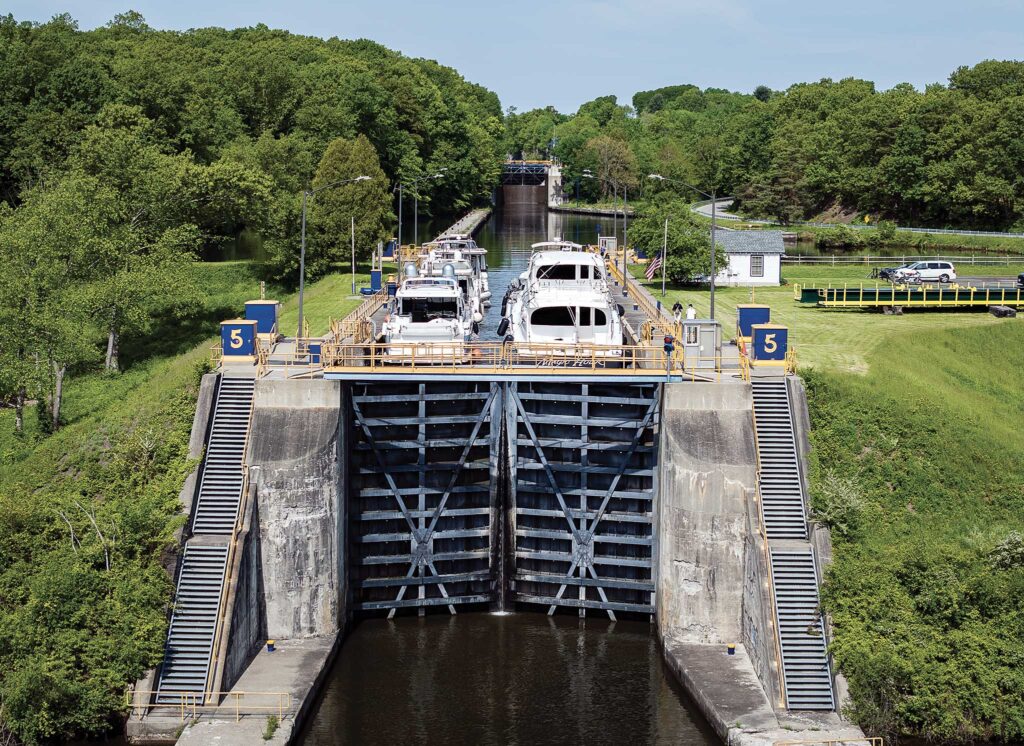
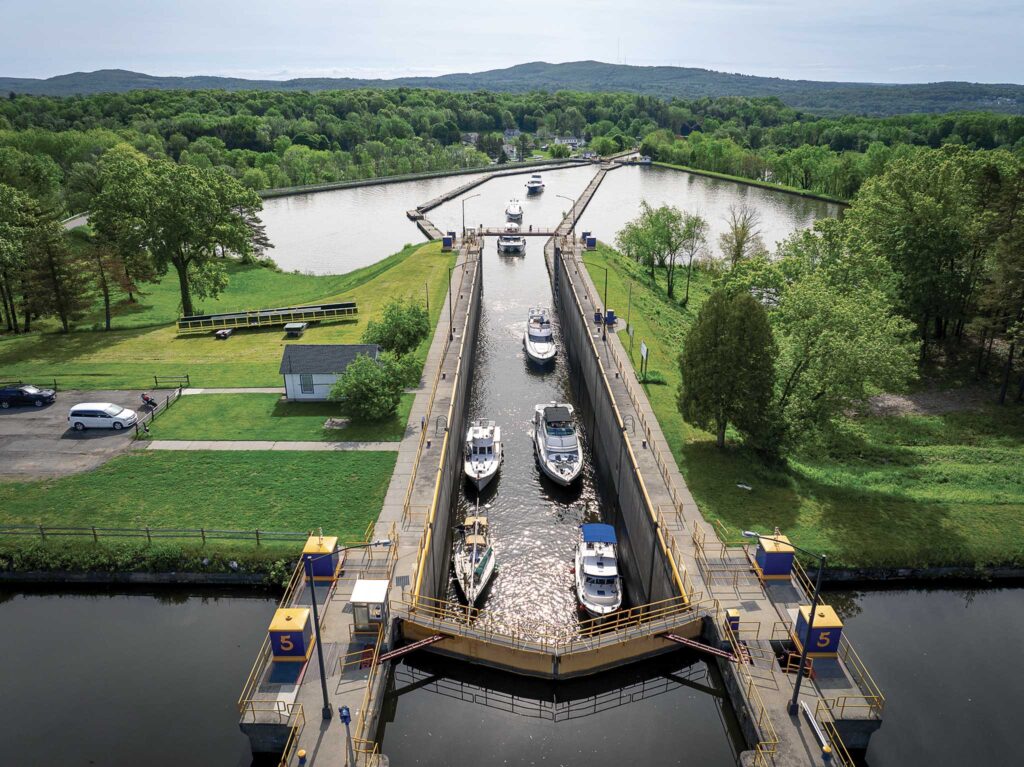
The turn of the 20th century saw waterways giving way to railways. Fearful and at times disdainful of the increasingly monopolistic railroad industry, President Theodore Roosevelt called in 1905 for construction of the Barge Canal. It was a nearly $100-million-dollar ($3.5 billion today), 13-year-long undertaking that diverted the canal and created a 120-foot wide, 12- to 24-foot deep waterway, including 34 new locks and the Waterford Flight, the United States’ steepest set of locks to date.
This expansion kept the Erie Canal competitive with railroads into the mid-20th century, with 1951 seeing more freight than any other year in history. Shortly thereafter, though, it gave way to Canada’s then-new St. Lawrence Seaway to the north.
Coinciding with this transportation revolution was the grinding halt in American steel production, leaving the Erie Canal and the towns and cities along it in the rust and dust. Commercial traffic was reduced to a trickle. By the 1980s, the canal and its communities faced a decrepitude that would have been unthinkable in the century past. The New York State Canal Corporation was created in 1992 to, among other things, rejuvenate the waterway and its communities. Tens of millions of dollars were invested in maintenance and operations, slowly but surely opening the floodgates to more economic opportunity.
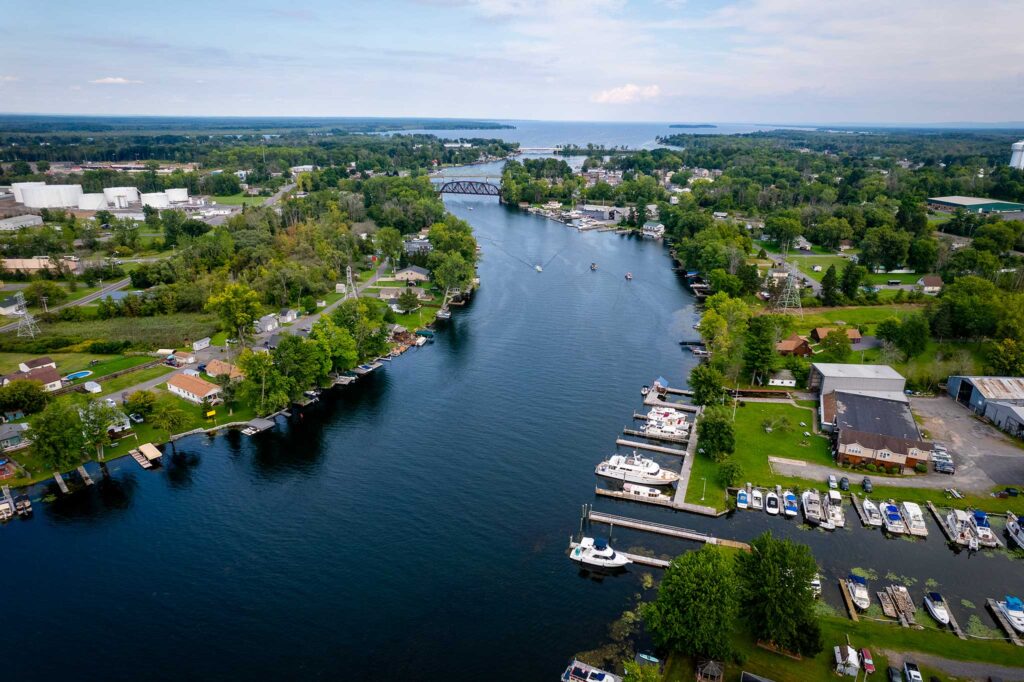
Boaters—especially cruisers in the Northeast cruisers and Great Loopers—also played a sizable part in the canal’s rejuvenation. As commercial traffic bottomed out, they discovered a leisurely tour. In recent years, vacant mills and industrial facilities have been given new life as bars, restaurants, galleries, spas, bed-and-breakfasts and casinos.
“That’s where investments have been made,” says Jean Mackay, director of communications for the Erie Canalway National Heritage Corridor in Waterford, New York. “Some communities just simply, either because of politics or poverty or both, have a harder time making a comeback because they don’t have the resources, but there is that spirit of like, ‘OK, let’s keep tackling this. Let’s figure it out.’”
Today, the New York Power Authority invests an average of $140 million a year into not only the canal’s functions, but also the communities around it, through grants, better access and 365 miles of New York’s 750-mile-long Empire State Trail. In anticipation of a bicentennial commemoration, the past five years have seen double the investment.
200 Years and Counting
Festivities for the Erie Canal bicentennial this year kicked off in May with the seasonal opening of the system. The action will run through November 3 with a later-than-usual closure to accommodate a reenactment of the original Seneca Chief’s voyage. It will include a full-size replica that the Buffalo Maritime Center built.
In addition, this year’s World Canals Conference will be held in September in Buffalo, welcoming representatives from Venice, Italy, England and China. Additional canal events on the schedule for this year include a walleye-fishing derby, weekly canal-side concerts, a floating circus and festivals galore.
The celebratory festivities will be best enjoyed by boat, and are sure to be a sight for the ages—or, at the very least, a couple of centuries.
September 2025