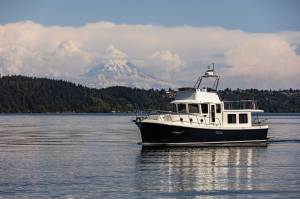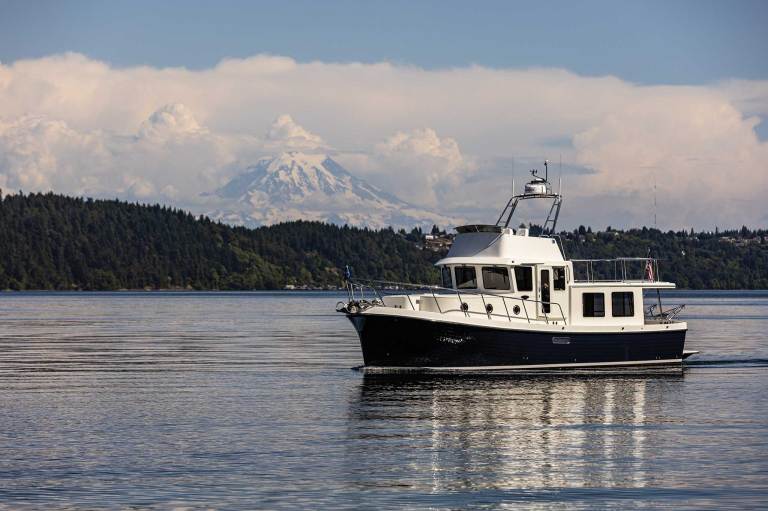
The 60 in 2017. Courtesy Grand Banks
“Today is a long way from the beginning,” says Steve Fithian, who would know that’s true better than just about anyone. Fithian has specialized in selling Grand Banks boats since 1995, first as a broker and now as a consultant for the shipyard. Not a lot of boat salesmen can talk about that kind of longevity with a single brand.
“How many companies do we know that built boats 70 years ago and are still here, with a thriving business at the top of the market?” he says. “We still build boats. It’s incredible.”
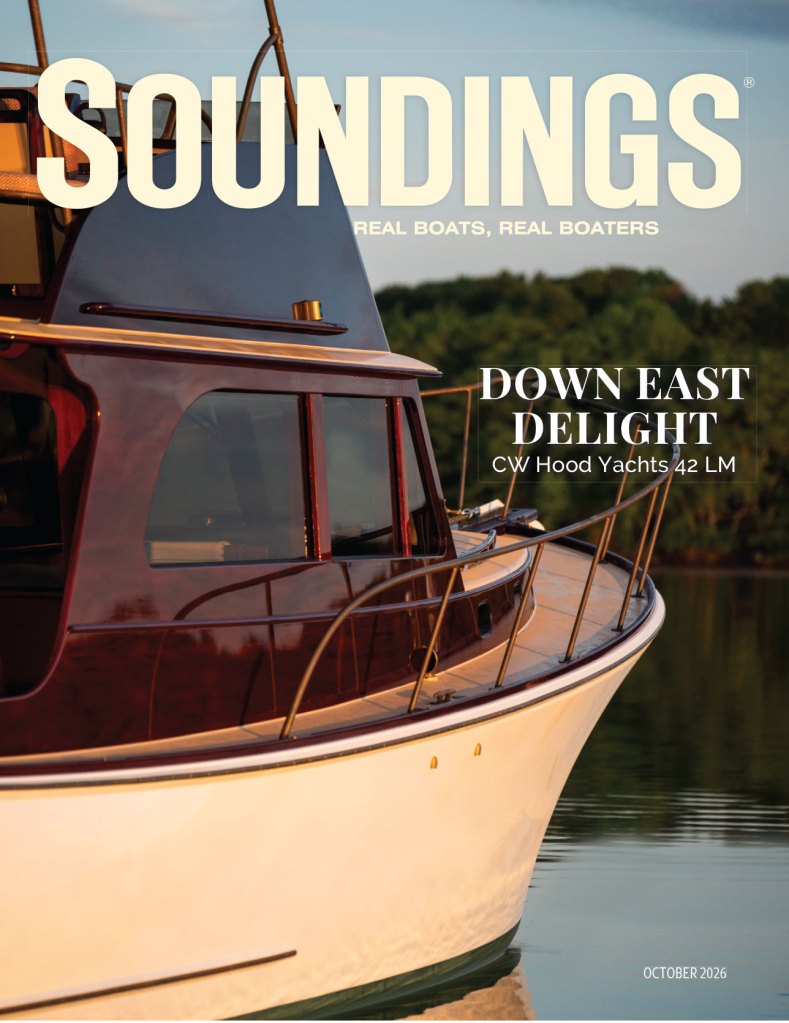
Grand Banks is celebrating its 70th anniversary this year, with nine models currently in its lineup. They include two Eastbays and a 70-foot Grand Banks that goes into production this year. It will also be available as a 73 that extends the cockpit.
“We already have a lot of interest,” Grand Banks CEO and Chief Designer Mark Richards says about the 70 series. “It’s a really exciting boat that could put Grand Banks on the map for long-range cruising boats everywhere around the world—Pacific Northwest, Mediterranean, all sorts of places. It’s a zero-compromise 70.”
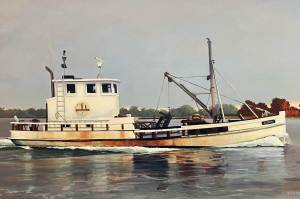
Today’s offerings from Grand Banks still carry the hallmarks of classics from the company, such as the Grand Banks 36 that originally brought the builder to the forefront of boaters’ minds. The company produced 1,141 hulls of that model built before it was retired in 2003. It was quite the run for a boat that premiered when Bonanza was the hot show on TV and carried on until NCIS hit the airwaves. That boat set up the Grand Banks brand for the success it continues to enjoy today. “It was an unbelievable start,” Fithian says.
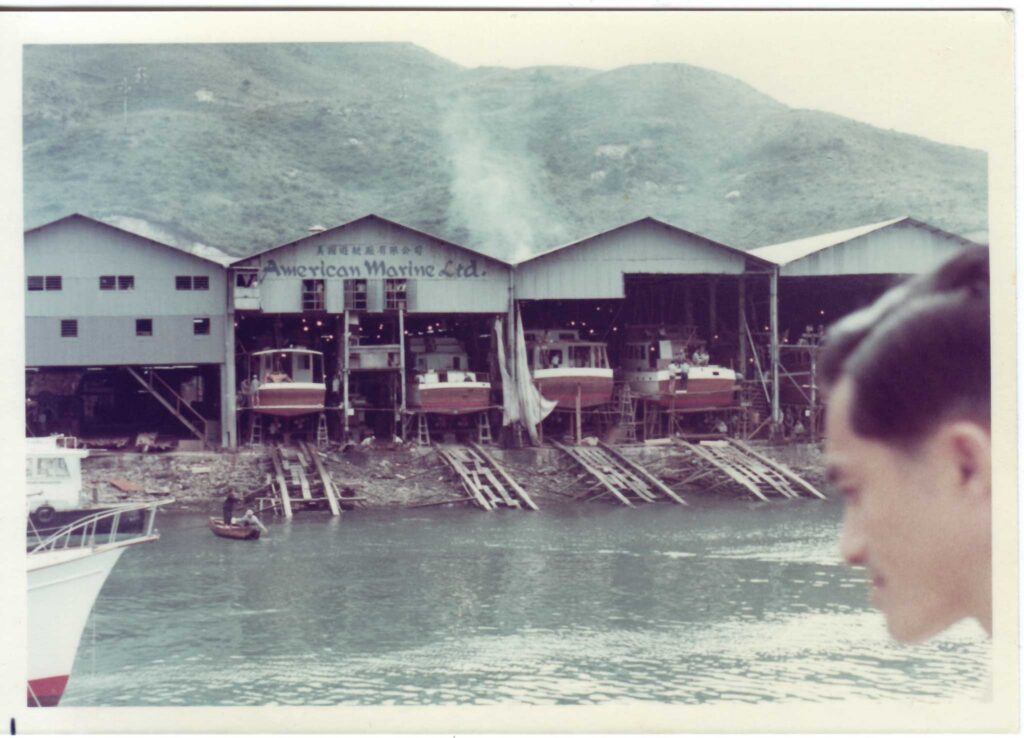
The company began life as American Marine in 1956. It was the brainchild of Robert J. Newton and his sons, John and Whit. In all the decades since then, some of the best-known boat designers and firms have contributed their expertise for various models, including Art DeFever, Tony Fleming, Tom Fexas and C. Raymond Hunt Associates.
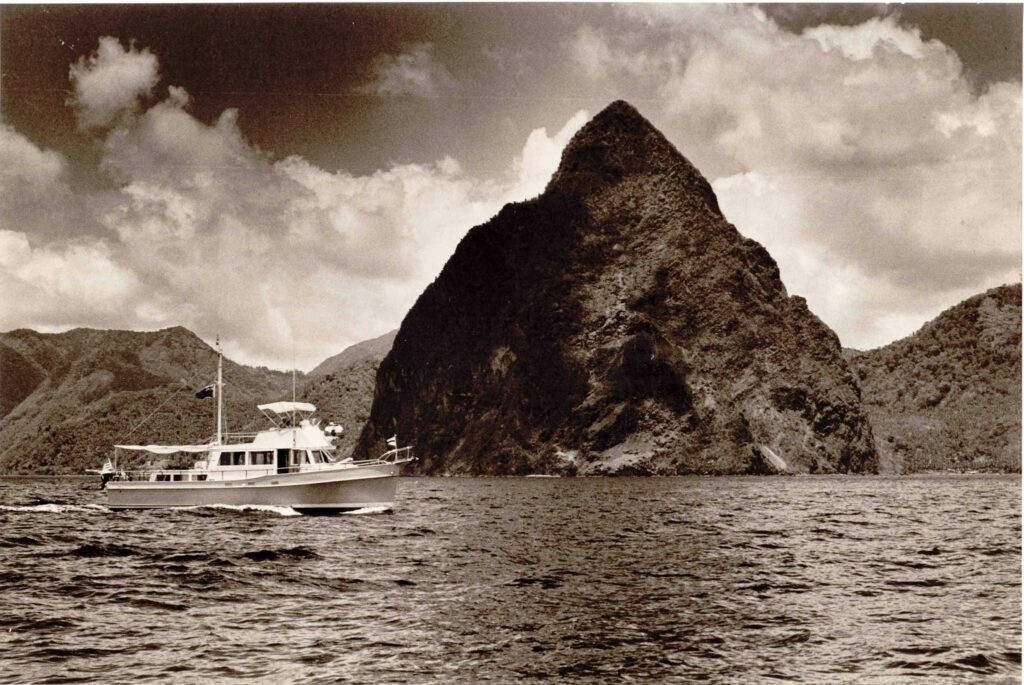
Early models were different from today’s designs primarily because of their slower speeds, but they always drew attention from cruisers who wanted to go longer distances. The Grand Banks 42 proved especially popular and became one of the longest-running production boats in history, having been on the line for about 40 years. “That model was accompanied by a range of boats that really got things going,” Fithian says. “It showed the public what Grand Banks was—it set the foothold.”
Eventually, the company added performance to its model line, for boaters who wanted to go faster than 9 knots, with features and styling evolving to match. “The original GB-style boats had flybridges designed around going those slower speeds,” Fithian says. “The newer boats all have a bridge that’s designed around being able to go at speed and be comfortable in the seating.”
Today’s models add the ideas that Richards brings, including his knowledge from competitive sailboat racing. He knows how to squeeze every knot out of a boat’s systems and hull design.
“The big thing for us is efficiency,” Richards says. “It means you can go a lot longer and a lot farther. If you can get Internet, which Starlink gives you anywhere in the world, and you have a watermaker, you can go for a long, long, long time. You can disappear to the Bahamas for a couple of months.”
That’s what an increasing number of today’s boaters are looking to do, he adds. Or at least are hoping to do someday.
“Everyone’s different, but knowing that you have those capabilities is a nice thing,” Richards says. “You can own a Ferrari and maybe never go 100 miles an hour, but it’s fun to know that you can.”
With the new 70 series, Richards says, the way that owner-operators use their boats was top of mind in the design process.
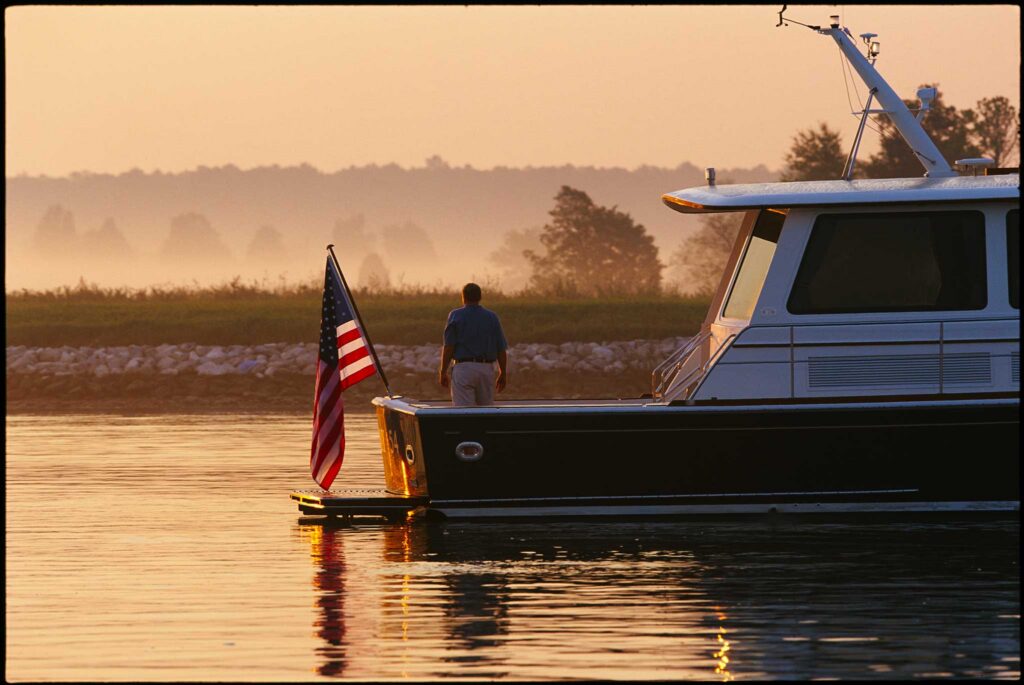
“The nice thing about the 70 is the visibility for the owner-operator,” Richards says. “With a raised pilothouse, you can’t see the deck of the boat from the helm section. You’re relying on cameras and other people. With the 70, you’ve got 360-degree visibility. That’s great for an owner-operator.”
It’s that kind of attention to detail in design, along with increased efficiency, that keeps fans of the Grand Banks brand coming back, Fithian says.
“It’s mind-blowing to see the evolution and the construction,” Fithian says. “You take a GB60, a boat that lets you cruise along at 20 knots and it’s burning 30 gallons of fuel, and it’s got almost no wake.” That same boat will burn just 11.5 gph at 10.7 knots, for a range of 1,286 nautical mile. “That’s unbelievably efficient to the point that, at one time, I never believed anybody would have a boat that could do those things.”
Richards says there’s much more to come with the company’s 70th anniversary. “It’s very exciting. Grand Banks is an iconic brand. I’m honored to be at the helm right now, and I look forward to many more years.”
This article was originally published in the June 2026 issue.