U.S. Department of the Interior, National Park Service, Historic American Engineering Record
The birthplace of the legendary New England fishing dory, Lowell’s Boat Shop in Amesbury, Massachusetts, has been producing seaworthy craft for more than two centuries. Founded in 1793 by Simeon Lowell, it is the oldest continually operating wooden boat shop in the United States.
Simeon is credited with developing the Surf Dory, a radical design featuring a simple, flat, football-shaped bottom. The Surf Dory was less expensive to build than boats with complex hand-carved keels, and it was also remarkably stable. The design was well suited to navigating the Merrimack River’s 3-knot current and was utilized by the Coast Guard for lifesaving missions for nearly a century.
Design innovations continued under Simeon’s grandson Hiram, who created the Banks Dory, a straight- and high-sided vessel ideal for hand lining from a parent ship. The design became a mainstay in New England fishing fleets. Hiram also established assembly-line production at the shop, allowing it to build more than 2,000 boats in a single year. The system is said to have greatly influenced Henry Ford’s mass-production processes.
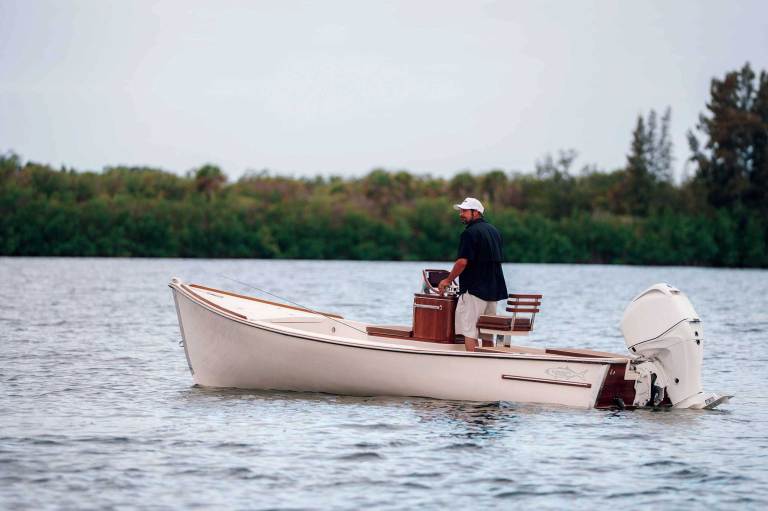
Further evolutions took place as Lowell’s Boat Shop passed through seven more generations of the family. The Lowell’s Amesbury Skiff pictured here is one of those. Closely related to the Surf Dory, it emerged around the turn of the 20th century, when heavy, single-cylinder engines were growing in popularity and causing fine-sterned dories to squat. With a wider bottom at the transom, the Amesbury Skiff addressed this problem.
The skiff is lapstrake-planked and flat-bottomed. From midships to the bow, the design is nearly identical to the Surf Dory, with flared, rounded sides. But unlike the Surf Dory, whose hull narrows to a traditional tombstone transom, the Amesbury Skiff remains beamy, with its flat bottom ending at a broad transom.
The Amesbury Skiff is dry, easy to maneuver and capable of planing. Though originally developed for inboard power, it was later modified to accommodate an outboard, as seen in this photograph. Stable and seaworthy, the boats have been used for decades for livery, fishing, rescue work and family cruising. Lowell’s Boat Shop still offers the design in models ranging from 12 to 20 feet.
Lowell’s remains a working boatyard where dories and skiffs are built in the tradition of the Lowell family. Ownership passed to the Odell family in the 1980s and then to the Newburyport Maritime Society in the 1990s. The shop was listed on the National Register of Historic Places in 1988 and designated a National Historic Landmark in 1990. In 2006, Lowell’s Maritime Foundation, an independent nonprofit, purchased the property and has since guided the historic yard into its third century of wooden boatbuilding.
This article was originally published in the August 2026 issue.