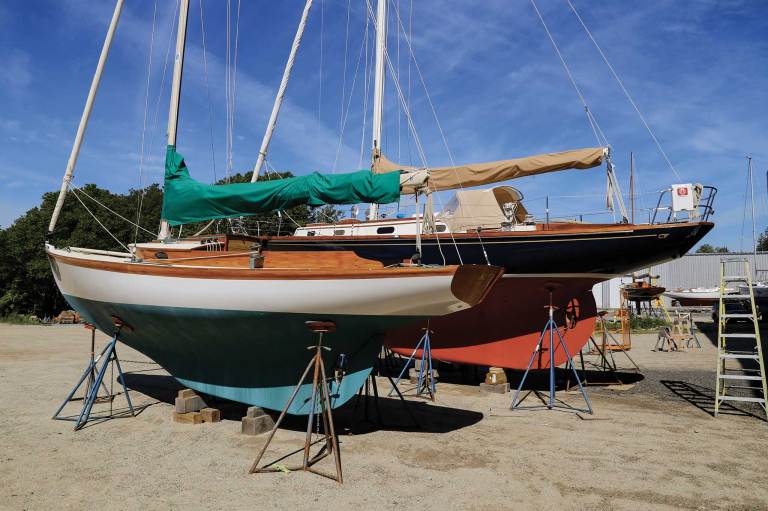

A thick, white fog blankets the tree-lined hills above Sausalito, California. By mid-morning, the sun will burn through the overcast sky, cresting above the treetops. The docks of Pelican Harbor will slowly warm and creak awake as boats roll gently in their slips. The air will hum with the low caws of seagulls and the sharp barks of sea lions.
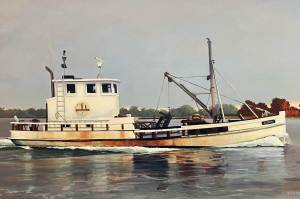
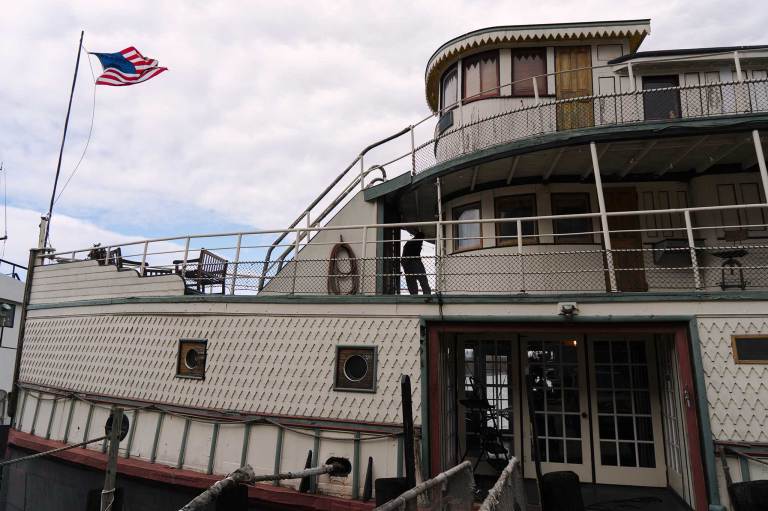
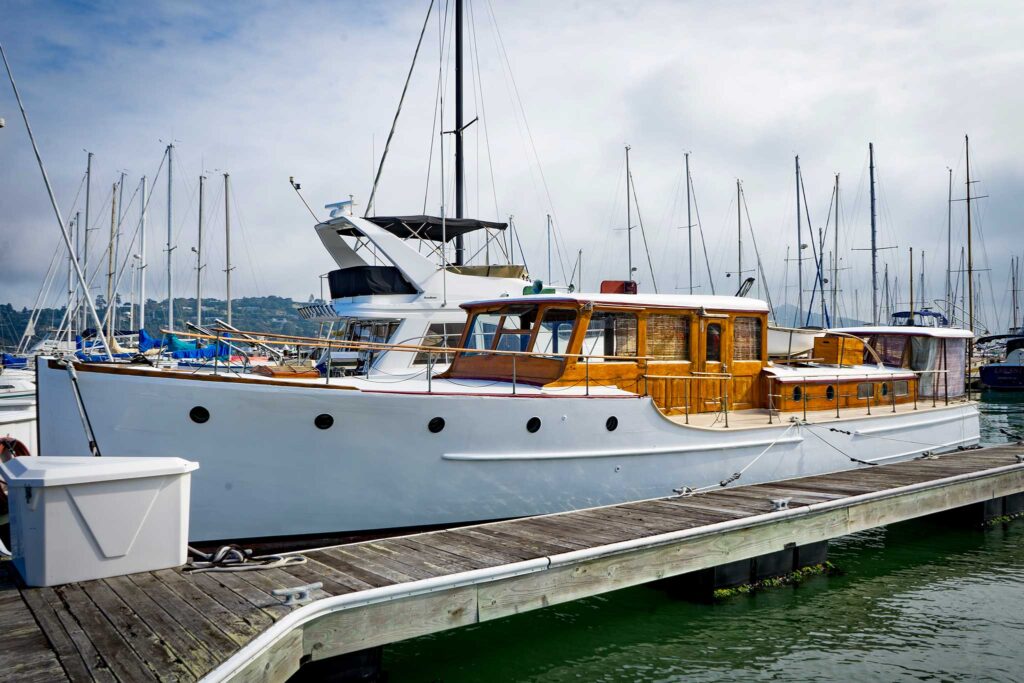
Soon, Lauren de Remer will make her way down the docks to board Tautira, a sleek, white wooden cruiser built in 1930. In another life, this 52-footer’s owner was the film director King Vidor. The boat served as a floating playground for a who’s who of the Los Angeles film scene. During World War II, the U.S. Navy seized her, outfitting the boat as a surplus vessel along the Pacific Coast. In the decades that followed, she passed through a carousel of owners, restorations and far-flung voyages.
Now, Tautira is poised for a new chapter. “I envision her as the therapy boat for the San Francisco Bay area,” de Remer says.
The boat is the flagship vessel for the Tautira Foundation, a nonprofit organization working with licensed clinicians to offer therapy, counseling and integrated care to terminally ill cancer patients and their families. If all goes according to plan, Tautira will be the first floating care center in the Bay Area.
First, however, a refit is required. It’s no small feat to transform a 95-year-old vessel into a treatment and therapy space that complies with the Americans with Disabilities Act. In May, the foundation kicked off the first phase of its fundraising campaign to support a 36-month-plus yard period.
Because the boat will carry patients who are immunocompromised, the rebuild demands an unusual degree of care. “You have to tear it apart down to the bones to rebuild it for this specific use,” de Remer says. “It’s a process that feels extremely cathartic for me personally, but it’s also the right thing to do to achieve our goal of fulfilling gaps in care for our community.”
She intends to offer outpatient services that ease the burdens of serious illness for those facing chronic or terminal diagnoses, and for the families who care for them. The space must be flexible, accommodating, practical and, most important, safe and comfortable for patients in pain. “It can include integrated wellness services like bodywork and acupuncture, psychotherapy, or even insurance guidance and nonclinical patient navigation,” she says. “Some couples might also be dealing with fertility issues, or even challenges as basic as transportation.”
De Remer, a caregiver herself, understands complex challenges firsthand. She lost two people in the same year to brain cancer. Now serving as academic program manager at the University of California San Francisco’s Weill Institute for Neuroscience, she is building a career in research. “My background is in the outdoor industry and adventure travel, so working in health care wasn’t something I anticipated,” she says.
A Sausalito native, de Remer grew up in and around Bay Area marinas, sailing Lasers. At 29, she bought a Cal yacht. She also worked for San Francisco’s Modern Sailing School & Club, managing a fleet of 22 boats. She’s always been drawn to old wooden boats. In her 20s and 30s, she crewed on a variety of traditional schooners and tall ships along the West Coast, earning a 100-ton Master license.
Her path to Tautira began largely with a chance meeting in the same marina where the boat now resides. De Remer met Dana Hayden in 2018, out on the water, paddleboarding through Sausalito’s moorings. Hayden, the previous owner of Tautira, lived aboard the yacht, just a few slips down from de Remer’s sailboat.
Soon, the pair fell in love. At the beginning of their relationship, Hayden was diagnosed with glioblastoma, a malignant and aggressive form of brain cancer that, in his case, was untreatable. Around the same time, de Remer’s 11-year-old cousin received a similarly devastating diagnosis: an incurable melanoma brain tumor.
Suddenly, her world became defined by caregiving, navigating medical appointments and grappling with the realities of end-of-life care.
“We met and fell in love, and he tragically passed, all within a year,” she says. “His son Alexander and I were his primary caregivers. It was very short, but obviously a profound turning point in my life.”
As Hayden’s illness progressed, he and de Remer spent more and more time aboard Tautira. The boat became a refuge, a beacon of comfort amid the turbulence of his declining health. After Hayden died, de Remer sold her own sailboat and purchased Tautira from the Hayden family for $1. In the months that followed, she attended counseling and grief support programs for caregivers, became more involved in the university’s neurology efforts and reflected on what it meant to steward the classic vessel.

“I used to ask myself, ‘Why am I doing this? Who am I doing this for?’” she says. “I think, initially, it was a large sense of responsibility to save the boat and do something with it.”
She spoke with Alan Olson, who built the Matthew Turner, Sausalito’s iconic tall ship. The idea came up to do something for the cancer community, to create support. “I just felt immediately that I couldn’t do anything else,” she says.
Palliative care, in its traditional form, often involves easing people’s suffering at the end of life. What it rarely accounts for are the caregivers.
“The place I went had one support group for bereavement in your 20s and 30s,” de Remer says. “And it was an hour and a half, once a year. That was it. You can’t build community that way.”
As the Tautira Foundation begins to develop its programming, de Remer is starting there: creating a space for caregivers and the recently bereaved to gather, participate in support groups, and receive services such as EMDR therapy, among other offerings. She also envisions Tautira as a space for solace, where people can rest, reflect and create legacy content for their loved ones.
“My boyfriend and I made audio recordings,” she says. “Those were really important to him, like telling the story of how we met. But we always struggled to find time, a quiet space or the right equipment, and even the mental bandwidth needed to sit down and have highly emotional conversations.”
These services will be offered free of charge. To cover operational costs, the foundation will have for-profit offerings—ash scatterings, living wakes and fundraising events—and hopes to make its programs billable to insurance. The goal is for Tautira to occupy a “third space” in medicine. End-of-life care typically unfolds in hospitals, hospices or patients’ homes, settings often defined by routine and clinical necessity.
“When you get people out of a hospital—a sterile space with vinyl floors and fluorescent lighting—that’s when a lot of amazing things can happen,” she says. “Sure, some people just want to be at home, but even home can be triggering.”
Research has shown that stimulating environments with access to natural light, views of nature and similar elements can help ease pain in hospital patients. In practice, this might mean incorporating interior gardens into hospital design, and installing larger windows throughout medical facilities.
De Remer is considering what might happen when that concept extends to the water. Already, she has invested more than $175,000 into stabilizing the boat over the past seven years. A full restoration is expected to cost around $1.75 million. A precise estimate will follow a full marine survey and engineering review, which may require dismantling the vessel down to its framing to ensure long-term seaworthiness.
The foundation’s first investment came from Belinda Vidor Holliday, daughter of the vessel’s original owner, King Vidor. She and de Remer had connected years earlier through a mutual acquaintance with a love of film noir and wooden boats. Vidor Holliday recalled long afternoons in Catalina spent aboard Tautira, then named Runaway, and was so inspired by de Remer’s vision that she became the inaugural contributor.
For de Remer, the work has been therapeutic. And if all goes according to plan, the boat will offer that same sense of purpose and healing to others.
“I think the process of buying time so far, restoring her, and creating something new to give back to the community has, in many ways, been a very personal journey,” de Remer says. “She has given purpose to what I went through. She’s a gift, and I won’t stop until the gift is paid forward.”
December 2025