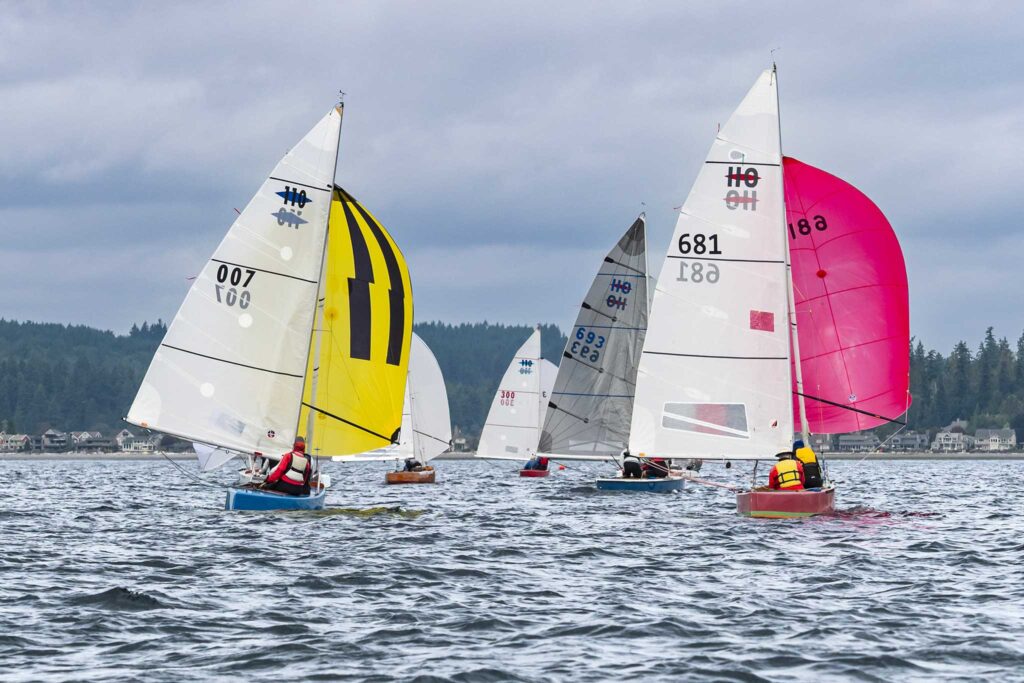
Take a left on Hidden Cove, and then go left again at the totem pole. Such were the instructions to get to the Port Madison Yacht Club on Bainbridge Island, Washington, a tiny but tidy sailing institution on the north end. It was the venue for the first official International 110 regatta in this area in many years, reviving Fleet 19, which was based at Corinthian Yacht Club in Seattle before dispersing decades ago.
The race had a good turnout, drawing competitors from multiple Pacific coast fleets. The 110, designed 86 years ago, still seemed to have spectacular appeal. The design is swift, affordable and trailerable, and it needs only one crewmember. Yet, it’s demanding to sail. The vessel also has the cachet of being designed by Ray Hunt, the same guy who gave us the deep-V hull, the Boston Whaler and Concordia yawls.
SKIPPERS OF A CERTAIN AGE
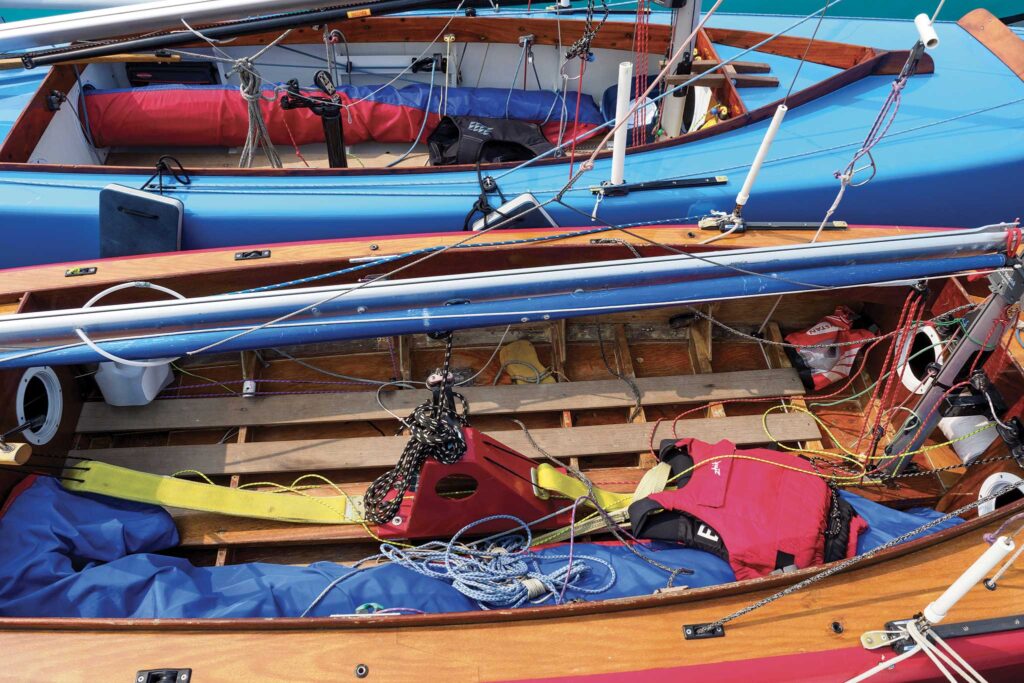
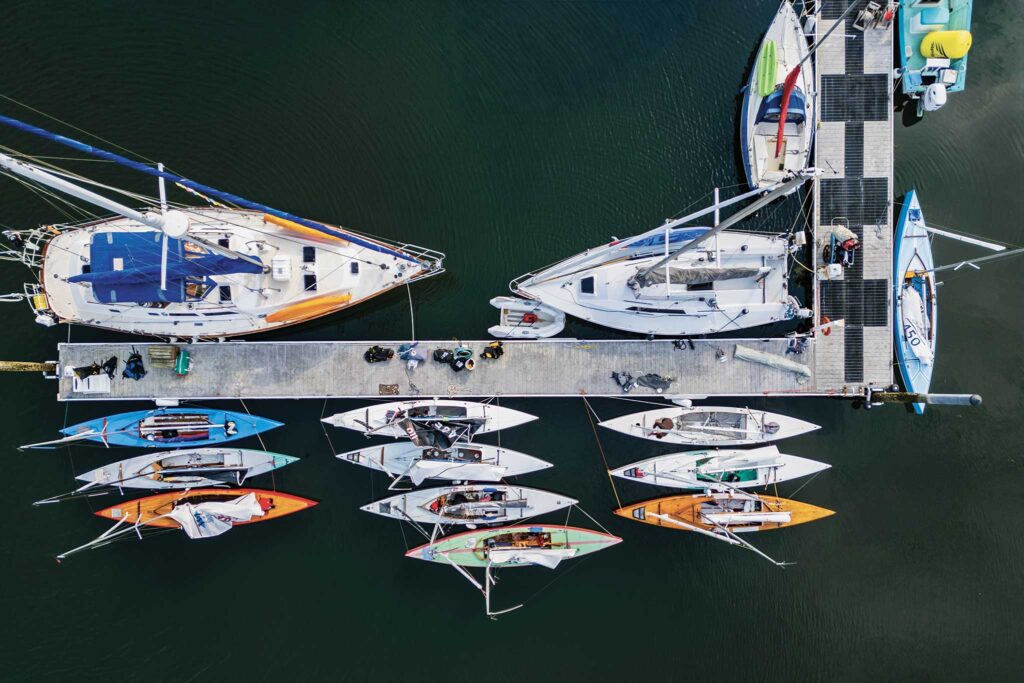
The elegant double-ended 110s were ramp-launched and then rafted up in the marina, in colorful glory. The combination of red, blue, pink, turquoise and white boats looked like a box of crayons, as one spectator observed. Half of the boats on site had made the 850-mile trek from the Inverness Yacht Club in California to challenge local teams, who previously had traveled the opposite way to race on Tomales Bay near San Francisco.
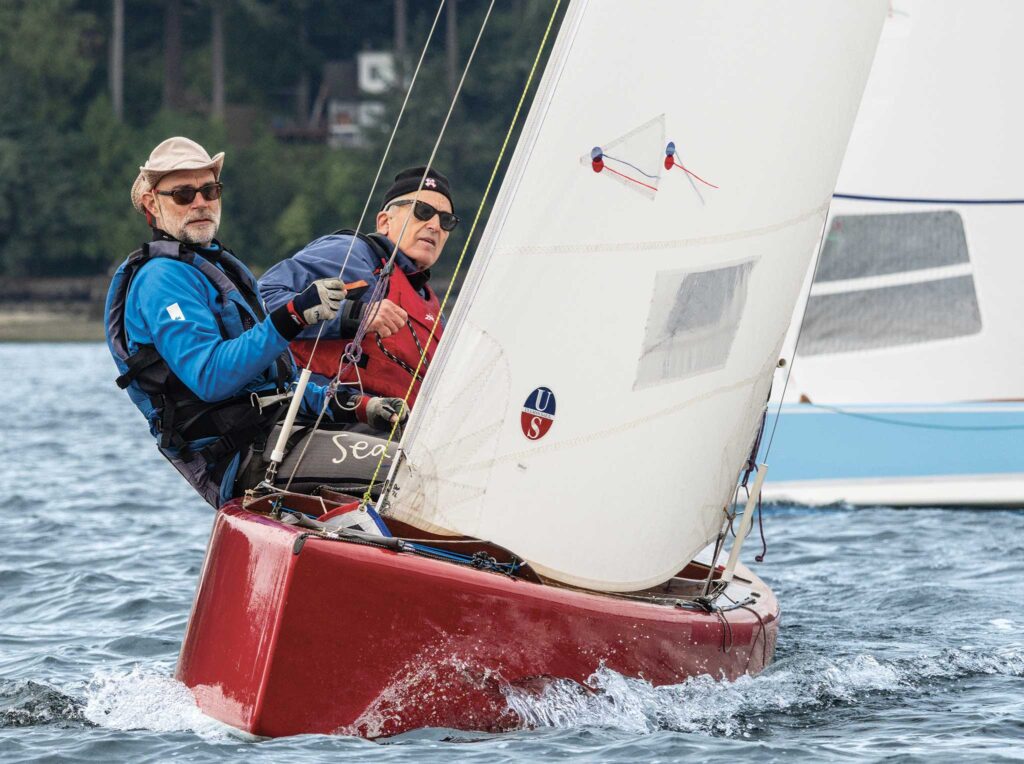
Dock talk swirled around heroics and heartbreaks on the racecourse, boat speed and sail trim. But contestants in the Grand Master’s age bracket (55 to 64) also traded jokes about sailing with hearing aids and replacement joints. That and the 110’s ridiculously narrow hull (maximum beam is 4 feet, 2 inches), which earned the nickname “geezer canoe.” And yet, watching these seasoned sailors roll-tacking, doing the limbo to squeeze under the boom, and getting out on the trapeze was like witnessing real sport, aches and pains be damned.
Sailing legend Skip Allan from Capitola, California, helped with the race’s management. The man is a cult hero, with a long list of trophies and other achievements, including US Sailing’s Arthur B. Hanson’s Rescue Medal for pulling folks out of the drink in 2002.
“The 110s have good skippers, and the people are wonderful,” Allan said. “They are all of a certain age and go through similar issues.” He should know. In 2022, his first and only season in 110s, he won the Nationals practically at the finish line of the last race at the tender age of 77, which makes him the oldest skipper to earn that distinction.
Aside from the nimble golden-agers, competitors in this inaugural regatta also included decorated locals like Kris Bundy and Fritz Lanzinger, professional rigger Erik Bentzen, sailmaker Eric Taylor, and Michael and Molly Karas, who usually race fast dinghies. (They won this year’s WA360 distance race in Puget Sound on their G32 catamaran.) “It’s about the communities we hang out with,” said Molly, who is 38. “We often race on boats that are owned by friends or by the best sailors in town.”
Having grown up sailing in Port Madison, Molly wasn’t going to turn down an offer to race this year’s PCC in a loaned 110 with her husband while the grandparents watched their lively little daughter. Theirs was one of four co-ed teams, and Molly was one of three female drivers.
Racing the 110s means “realistic scale and budget, and a boat that does not favor gender, size or body type,” Bentzen said.
EVOLUTION OF THE 110
Hunt’s design of the 110—a scaled-down version of the bigger, pricier 225—created a stir from the start. But what mattered most for its development was the economy. “It just occurred to me that I ought to be able to design racing boats that wouldn’t be so darn expensive,” Hunt said in an interview.
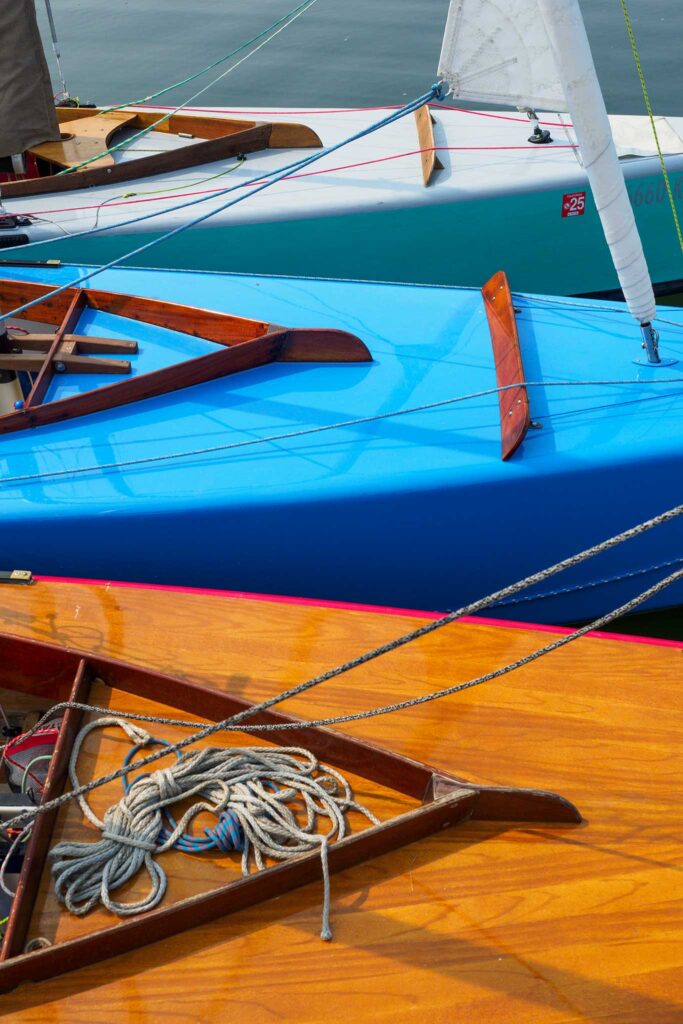
The 110’s narrow, slab-sided and flat-bottomed 24-foot hull runs out to a pointy stern that appears to seal the water behind the boat. For construction, panels of marine plywood (a new boatbuilding material at the time) were tortured into shape. Minimum weight was 910 pounds, including a 3-foot, 300-pound fin keel. An upwind sail area of 157 square feet produced more than enough horsepower.
Licensed yards like Lawley in Neponset, Massachusetts, and Graves in Marblehead churned out copies at a rapid clip. Builders in the Midwest and on the West Coast later helped push the total number of boats built to about 800. (Around 75 are still active in the United States.) Rule changes kept the 110’s design current. There were experiments with asymmetrical spinnakers and different size headsails, but the major change was the pivot to fiberglass construction and the addition of the trapeze for better righting moment and more upwind speed.
Many sailors say the boat slides through the water effortlessly, nearly like a snake through grass. But like anything else that looks easy, sailing a 110 takes skill and experience. Keeping the boat heeled and pointing without pinching are key when going to weather. Loosening the shrouds to push the boom and mast tip forward, plus good spinnaker work, are essential off the wind.
“As a double ender, it settles in and goes to weather with no fuss,” said Brendan Meyer, who claimed the winner’s trophy at the end of the day, and would take it back to California. “The 110 has a manageable sail area and no bad habits.”
BUILDING A FLEET
Two people were integral to getting this event off the dock, as well as organizing the Puget Sound fleet of 110s. Zigmond Burzycki, 67, is a former sailboat dealer in the Pacific Northwest, and James “Kimo” Mackey, 78, is a retired business owner who used to sail Six Meters and wanted to downsize. Both are members of the Port Madison club. They keep their boats there and pool their talents, resources and experience. They started to rebuild the Puget Sound fleet during the pandemic. Since new 110s were not in production, they had to find used boats, including in the Inverness fleet, which is home to about two dozen. (Later, Burzycki had a new boat built in Port Townsend by Tom George from a kit developed by Turn Point Design.)
“Zig and Kimo contacted me out of nowhere,” says Milly Biller, 72, port captain of the Inverness Yacht Club, 110 fleet captain and boatbuilder. She’s used to hearing from strangers who want information about 110s. “I once had a call from a guy who found a 110 with a targeted search on Google Earth,” she said. “The boat sailed in San Diego, but at that time sat on top of a cooler and a motorcycle.” Since it had a lien for unpaid bills, the yard sold it to the guy who had called Biller. To get sails and other kit, he visited the boat’s former owner in a seedy part of Los Angeles and nearly got caught up in a drug bust when police showed up to make an arrest.
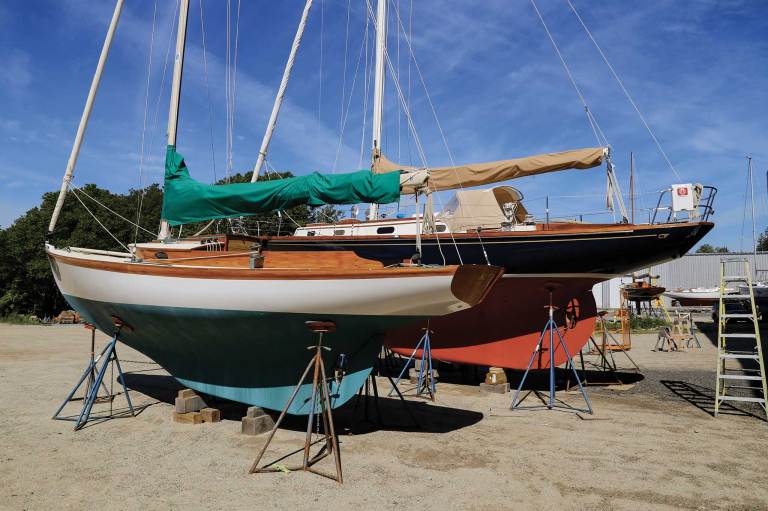
Back in Port Madison, in light and fickle winds that strengthened late in the day, Bundy and Lanzinger took second place on a boat they borrowed from Mackey. In the past, they’d campaigned high-performance dinghies like International 14s or 505s, which are on the cutting edge of technical development and unlike the 110 fleets, where well-maintained boats from the 1940s and 1950s can still be competitive. “The [110] class is stacked with sailing talent,” Bundy said, “and people are more relaxed while still having game.”
As I left the event and passed that totem pole at the entrance to the Port Madison Yacht Club, it felt like this would be the first of many 110 regattas to come in these waters. The reinvigorated fleet, it seemed, could bring back more International 110s to this part of the Pacific Northwest.
December 2025