Capt. Terry Sullivan has a lifetime of experience trailering boats. Since the 1980s, he has owned a Mako BayShark, a Contender 25T and his latest ride, a Pathfinder 2200 TRS. He has never had a slip, instead opting to keep his boats on trailers in his yard. Sullivan has trailered boats from Florida to New England and has more than 2,500 launches under his belt.
During his years as a light tackle guide, he fished with clients about 150 days a year. Even now, after retiring from the charter business, he still fishes more than 100 days a year for personal enjoyment. Every day on the water requires a boat launch and retrieval, and at least some preventive maintenance. At the ramp, this wizard of launching and retrieval uses a solo method. He has long been my go-to guy whenever I have questions about trailering my own boats.
Selecting a Trailer
Sullivan will tell you this, to start: Successful trailering begins with the selection of the trailer. Whether you’re buying a rig or replacing an old trailer, you have choices, some that are better than others.
Most trailers are constructed from galvanized steel or aluminum with rollers or bunks to support the boat. If you are going to use the boat in salt water, don’t even think about a painted steel trailer. I owned a galvanized roller trailer for a 23-foot center console for many years. More recently, I had a custom aluminum bunk trailer for my 27-foot hybrid bay boat. I can assure you that there are differences.
Aluminum trailers tend to ride softer because of the inherent flexibility of the material, which helps soak up some of the impacts and vibrations on the road. Properly maintained, both materials will last many years.
Roller trailers carry the boat higher off the ground, creating a higher center of gravity while reducing visibility behind the tow vehicle. That also makes climbing onto the bow when launching more difficult without some type of ladder.
Bunks carry the boat lower to the ground and distribute the weight more evenly, providing greater stability on the road. They also make launch and retrieval easier, especially if the trailer is designed for a specific model boat.
After years of using both trailer types, I will always opt for an aluminum bunk, and Sullivan agrees wholeheartedly.
Gary Caputi
Solo Launch
At a local public ramp, Sullivan parks in the staging area to prepare the boat. He loads his gear here—never on the ramp—and then removes the transom tie-downs. He next makes sure the engine is raised enough not to scrape on the ramp. Then, he checks the bilge plug.
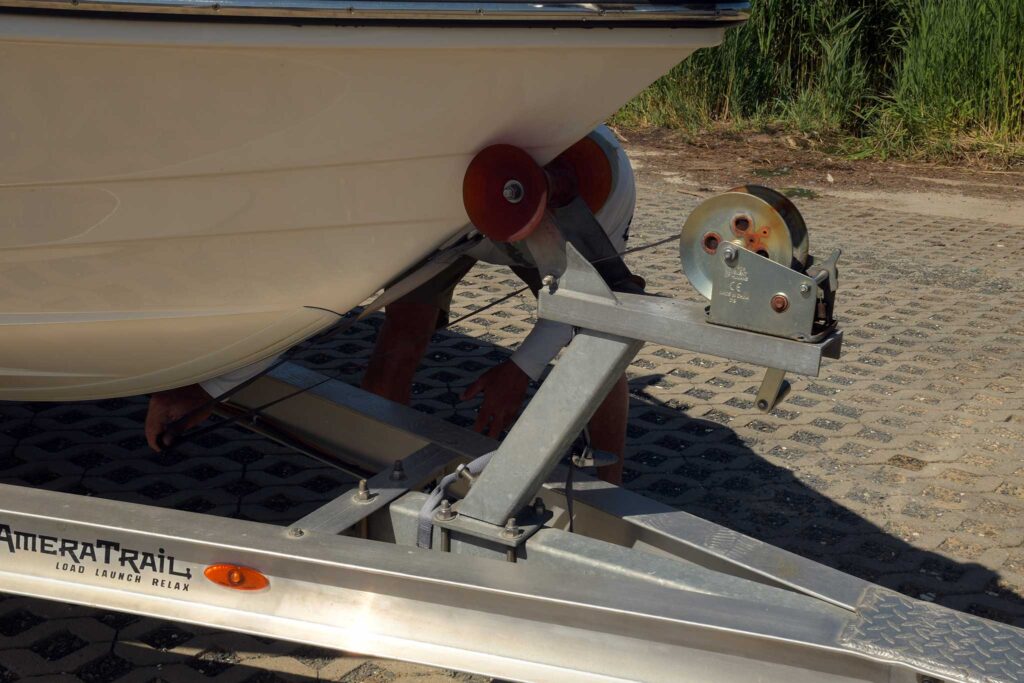
Moving to the bow, he removes the safety chain hook from the bow ring, but he leaves the winch strap hook attached. Then he removes the hook for a hold-down strap that attaches to the center beam of the trailer frame. Safety tip: The hold-down strap prevents the bow from bouncing against the bow stop, in case the winch strap loosens on the road. Next, Sullivan pulls about 6 feet of strap off the winch and leaves it hanging free before re-engaging the lever to lock the winch reel.
With all of that done, he moves the boat into position and slowly backs it down the ramp until it floats off the bunks. Then he pulls the trailer forward until the loose winch strap comes tight. In this position, the truck’s rear tires are high and dry, and he can easily climb onto the trailer frame forward of the winch stand without getting his feet wet.
He uses the winch strap to pull the boat forward until the bow is resting on the forward bunks. Then he disconnects and secures the winch strap and hook, and climbs onto the bow. His weight keeps the bow resting securely on the forward bunks as he lowers the engine, starts it, puts it in reverse and slides the boat off the trailer.
He then ties the boat at the ramp staging dock, and parks the truck and trailer in the nearest lot. Pro tip: Sullivan puts nonslip skateboard tape on the areas of the trailer where he walks.
To retrieve the boat, Sullivan backs the trailer down to about the same position he uses for launching. He centers the bow on the winch and then slowly drives forward. The act of the bow contacting the rear bunks keeps the boat centered, and he can power forward until the bow is near the bow stop. Retrieval tip: If the boat is hard to get on or off the bunks, put Dawn dish detergent on the bunk carpet when the boat is off. It will make it more slippery and will last a long time.
Once the bow is resting on the forward bunks, you can power it the rest of the way to the stop or pull the boat into position with the winch. Sullivan then climbs down onto the trailer, hooks up the winch strap, winds it tight and exits the ramp slowly.
Back at the staging area, he will hook up the safety chain, bow hold-down and transom straps for the ride home. I used his method with my Pathfinder 2700 Open, and it works like a charm.
Getting the most from your trailer requires having the best systems and never scrimping on maintenance, Sullivan says: “If you have a long-term relationship with your boats and trailers, or plan to, order the trailer with the optional stainless-steel brakes. You will justify the expense in not having to replace the standard brakes every few years.”
He also recommends Vortex sealed axle bearings, which require no regular maintenance and will last for thousands of miles of use. “Trailer tires are another item I’ve had issues with,” he says. The imported tires that come on many trailers are poorly made, don’t handle the heat well for long-distance pulls, and get worn on the outer edges quickly, especially on dual-axle trailers. Pro tip: After extensive research, Sullivan has found U.S.-made trailer tires by Goodyear have the best marks for performance and longevity.
He also swears by SaltX for preventing saltwater-induced corrosion. He built a 20-gallon tank, pump system and hose that reside in the bed of his pickup, filled with a solution of SaltX and fresh water. He also uses it on the trailer wheels, brakes, hubs and torsion bars after each dunking. Most boaters won’t go that far, but he said a pump-type garden sprayer with the solution will also add greatly to the trailer’s lifespan.
Sullivan also recommends frequent checks of the wheel lug nuts on the trailer, especially if you’re planning to do a highway trip. When removing the wheels and tires, never use anti-seize compound on the lug bolt threads. It is toxic, and the lug nuts tend to loosen when it is applied. Instead, he uses waterproof grease on the threads before tightening and torquing the lug nuts.
Sullivan says that if a trailer has standard tire lug nuts with open ends, replace them with acorn nuts, which better protect the studs. Pro tip: If a trailer has aluminum wheels, spray them and the lug nuts with Yamashield, a Yamaha product, to prevent corrosion caused by the dissimilar metals reacting. It will also keep the wheels looking new.
Sullivan carries an inexpensive, gun-type infrared thermometer and checks the tires at each fuel stop when trailering long distances on highways.
Monitor the tire temperature as high temps can indicate hub or brake component troubles, or loose lug nuts. Any of these problems should be remedied before you continue on your way.
Heed Sullivan’s insights and advice, and there’s a good chance you will avoid many of the potential pitfalls of trailering your boat on a regular basis. I know I have, and that’s why I call him the trailer doctor.
Key Takeaways
- Choose wisely: Aluminum bunk trailers offer stability, longevity, and easier launches.
- Solo mastery: Sullivan’s method makes one-person launches simple and safe.
- Maintenance matters: Use stainless-steel brakes, sealed bearings, and U.S.-made tires.
- Combat corrosion: SaltX and Yamashield keep wheels, brakes, and hardware in top shape.
- Safety first: Regularly check tire temps, lug nuts, and trailer components before long trips.
September 2025