
Modern marine electronics rely on seamless communication between various devices to ensure smooth operation and navigation. NMEA 2000 (N2K) is an industry-standard communication protocol that enables devices such as GPS receivers, depth readings, autopilots, digital switching, and engine monitoring systems to share data efficiently. Built on the Controller Area Network (CAN) protocol, NMEA 2000 provides a robust, high-speed network that simplifies integration and enhances the capabilities of marine systems.
The two cable/connector specifications covered under the NMEA2000 standard covers are Micro and Mini, and this article focuses on the Micro standard due to its dominance in the marine recreational market.
How NMEA 2000 Works
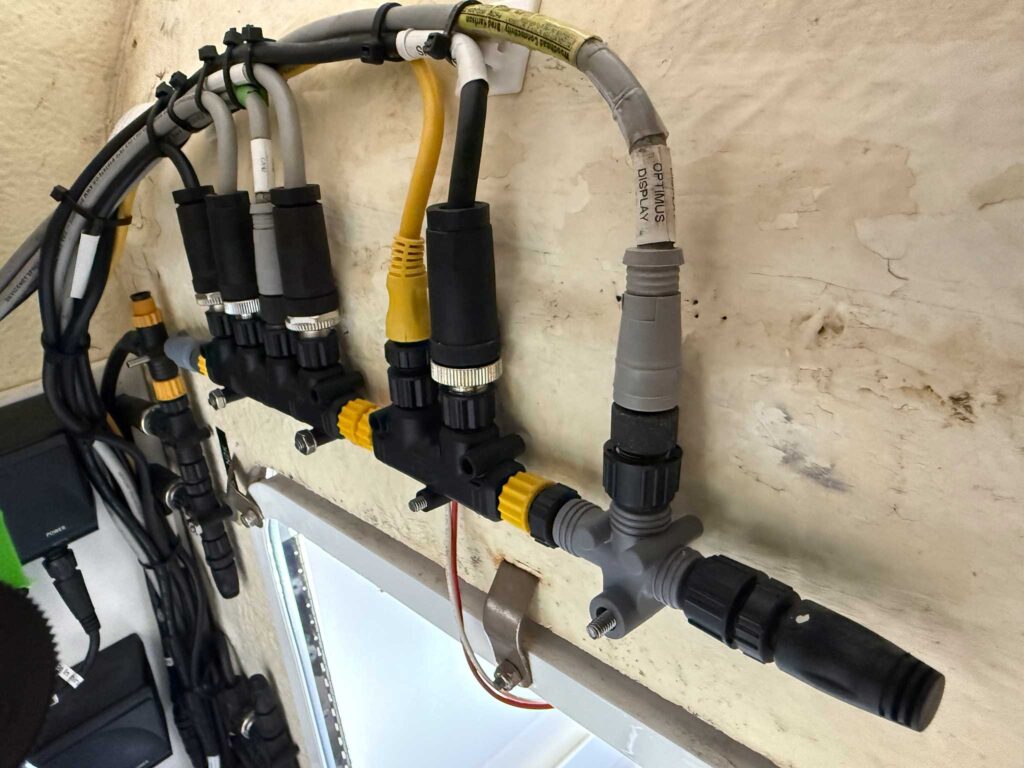
NMEA 2000 devices connect to a structured network via specialized cables and connectors. These connectors were adapted from the automation industry, and the connector used in Micro specification is referred to as an M12 5-pin connection. These M12 connectors have also been adopted by marine manufacturers for their own proprietary CAN communication network, which are not typically compatible with the NMEA2000 standard, and should not be connected to the same network.
Communication on the N2K network occurs through predefined data packets referred to as PGNs, which help devices identify and filter relevant information. The system also includes built-in features such as data prioritization and error checking, ensuring reliable and efficient data transmission across the network.
Load Equivalence Number (LEN) and Power Considerations
A crucial factor in designing and maintaining an NMEA 2000 network is understanding power consumption, which is measured using the Load Equivalence Number (LEN). One LEN represents a 50mA current draw from the network. Device power requirements are always rounded up to the nearest 50mA increment. For example, a device consuming 56mA is assigned a LEN of 2.
Since the Micro NMEA 2000 network is limited to a total of 3A, the maximum supported LEN for all connected devices is 60. Ensuring proper power distribution and monitoring voltage drop is critical to maintaining a stable network.
NMEA 2000 System Layout
A well-structured NMEA 2000 network consists of several essential components. The backbone serves as the primary data communication highway, connecting all devices. Terminators are installed at both ends of the backbone to prevent signal reflection and ensure stable communication. These should never be used as covers on unused tee connectors. Tees serve as intersection points, allowing devices to connect to the backbone via drop cables. The power tee supplies power to the network and should be placed near the center of the backbone to minimize voltage drop issues.
Installation guidelines specify that the backbone length should not exceed 100 meters. Each device’s drop cable should be no longer than 6 meters, with a total drop cable length across the network limited to 76 meters. Voltage input must be maintained between 9 and 16 VDC. Boats with 24V systems often require a DC/DC converter to provide the correct voltage.
For networks exceeding NMEA 2000’s limitations, network bridges can be used to extend the backbone, exceed drop length limitations, or connect multiple networks. Bridges draw power from only one side of the network and do not transfer network errors.
Power Management and Voltage Drop Considerations
In smaller networks, power requirements are usually straightforward. However, as a network expands, maintaining proper voltage levels becomes more critical. Voltage drop is a common issue that can lead to communication errors. It can be calculated using the formula:
Voltage Drop = LEN × Backbone Length × 0.006
If the voltage drop exceeds 1.5V, network stability may be compromised. Solutions to mitigate this include:
Adding a power insertion point to the network.
Relocating the power tee to a more central position.
Reducing excessive backbone length by removing coiled or unnecessary cables.
Manufacturer Specific Protocol: Seatalk NG and Simnet
While the equipment specified in the NMEA2000 standard uses a specific connector, some manufacturers developed proprietary versions of NMEA 2000, with the most common being SeaTalk NG (Raymarine) and SimNet (Simrad/B&G). While these protocols use the same core communication principles, they employ different connectors and wiring configurations.
Fortunately, electronics manufacturers have since moved to fully support the connector standard set by NMEA, however, many of these priority networks are still installed and being used. When this is the case, adapter cables are needed to integrate these systems into a standard NMEA 2000 network.
Troubleshooting NMEA 2000 Networks
If you are experiencing issues with your NMEA 2000 network, several steps can help identify and resolve the problem. First, check all physical connections to ensure devices are securely plugged in and cables are properly installed. If an issue persists, unplug devices one by one to isolate potential faulty components.
Another key aspect is verifying the power supply. Ensure all devices receive adequate voltage and that power sources are functioning correctly. Measuring resistance across the network’s terminators should yield approximately 60 ohms; any deviation may indicate a wiring or termination issue.
Additionally, outdated software and firmware can cause compatibility problems. Check for updates from device manufacturers to ensure all equipment is running the latest software. Electrical interference from onboard equipment such as alternators, electric motors, or winches can also disrupt network stability. Using a magnet compass near electrical systems can help identify interference sources.
Professional Tips, Tricks, and other Recommendations
When installing or optimizing your NMEA 2000 (N2K) network, following best practices will help ensure a professional, reliable setup.
Label Your Cables: Proper labeling significantly improves troubleshooting efficiency. Clearly mark cables with the corresponding device names. While heat shrink labels may not fit over M12 connectors, standard label tape can be flagged around the cable for easy identification.
Use Multi-Port Connector Tees: Instead of using multiple individual tees, opt for 4-way and 2-way connector tees to minimize backbone size and reduce failure points. Excessive single tees can create a “smile” effect if not properly secured, which may lead to connection instability or component failure.
Support the Backbone Properly: Ensure the NMEA 2000 backbone is securely supported. When mounting to thin fiberglass, avoid unnecessary drilling by using Weldmount studs, which provide a secure mounting point without damaging finished surfaces.
Managing M12 Connector Limitations: The large size of M12 connectors can make cable routing difficult. To simplify the process, consider cutting off the connector and installing a field-installable connector after running the cable. Maretron offers high-quality connectors, but be sure to add heat shrink over the center blue pin as the set screws are known to short out against the ground shield if left exposed.
Proper Power Tee Installation: For effective electromagnetic interference protection, always connect the cable shield to the DC negative when installing the power tee. This step ensures the network remains stable and protected from onboard electrical noise.
The use of a power isolator in your network will allow you to increase your LEN past 60, or control N2k powered equipment from a separate power source.
Other Marine Communication Protocols: J1939, NMEA0183 and Ethernet
J1939 is a CAN bus-based network primarily used by outboard and inboard motors, as well as generators, to communicate engine data to engine controllers. NMEA 0183 is the first-generation NMEA standard that predates NMEA 2000. It relies on a network of talkers and listeners to share and transmit data.
Both J1939 and NMEA 01823 can communicate to a NMEA2000 network via a gateway specific to the communication protocol. Specific to NMEA 0183, it’s important to note that the BAUD rate varies between models, particularly in AIS devices, so any gateway equipment must be chosen or configured accordingly.
Ethernet is widely used in modern marine electronics and serves as the foundation for NMEA’s third-generation communication standard, known as OneNet. The Ethernet networks currently installed on boats are typically manufacturer-specific and support high-bandwidth data transmission for systems like radars, cameras, and fish finders. While OneNet is designed to interface with NMEA 2000, these networks currently operate independently of each other, at least until OneNet is adopted by manufacturers.
Conclusion
NMEA 2000 has revolutionized marine electronics by providing a standardized, efficient communication protocol that simplifies device integration. Whether installing a new system or maintaining an existing network, adhering to NMEA 2000 standards is essential for seamless and efficient marine communication.
Mike Garretson is founder and president of Sea & Land Yacht Works, a marine service company in Wakefield, Rhode island.