Gunnar Christensen will sail his Hans Christian 34 around the world in the Golden Globe Race, which begins Sept. 6 in France. Jason Ludlow
On a blustery and overcast day typical of late spring in England, I stand in the yard at Lymington Yacht Haven and look up at a boat on jackstands. She is an orange and white Hans Christian 34—a sturdy, full keel double-ender built in 1978. Pompoen, nicknamed the Mighty Pumpkin, looks solidly seaworthy. And she’d better be, because she is about to sail one of my favorite people around the world in the Golden Globe Race, departing from Les Sables-d’Olonne, France, on Sept. 6.
Gunnar Christensen, 60, grew up in Maine and has been on the water since he could walk. He’s had a varied and interesting career as a professional mariner, sailing everything from yachts to research vessels. For the last 10 years, he’s been living in the U.K., managing large yacht construction projects and refits.
Those skills are being put to good use as he readies his boat for the 2026 edition of the GGR. It’s famously nicknamed The Voyage of Madmen. Entrants travel 30,000 nautical miles—circling the globe via the five Great Capes—single-handed, and with no modern electronics, in a full keel production boat of 32 to 36 feet built before 1988. The race is modeled on the infamous 1968 Sunday Times Golden Globe Race that Sir Robin Knox Johnston won, and it hews in spirit as closely to the original as possible. In the age of multimillion-dollar, hydro-foiling IMOCAs that can be sailed single-handed around the world in two months, the GGR is a grueling test of traditional seamanship skills and endurance. It’s slow, lonely and dangerous.
Gunnar was racing on the Solent with a client one day when he suggested Gunnar enter the GGR. (“Did the client not like you,” I asked?) When he went one step further and offered to pay Gunnar’s entry fee, Gunnar was in.
“I thought, OK, why not? I’ll sail around the world,” Gunnar says.
He was looking at a Rustler 36 or a Tradewinds 35 when I happened to spot the Hans Christian 34 online and sent him the listing. This sturdy circumnavigator was on the hard in Trinidad and Tobago when the owners’ plans changed and they put her up for sale. Gunnar flew to Port of Spain, checked the seacocks, sail inventory and rigging, and took her out for an hour to learn how to use the windvane. Then he wrote a check.
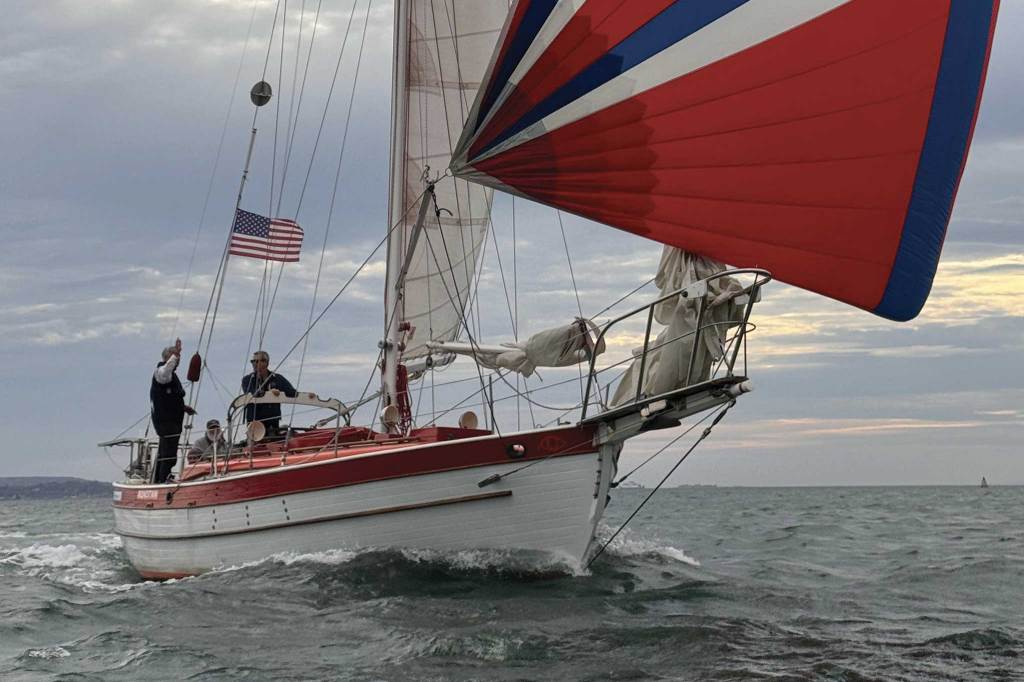
Hurricane season was just beginning, so he monitored the weather, loaded her with food and water, and four days later sailed north through the Caribbean. After an eight-hour stop in Sint Maarten for stove fuel and a cheeseburger, he took a right and crossed the Atlantic. Gunnar was thrilled with how the boat handled—his quick provisioning, not so much. He sailed into Lymington 32 days later, looking happy and svelte.
“It’s never necessarily a great call to take all your money and spend it sailing around the world,” Gunnar says. “But when I moved to the south of England, I started racing again and remembered how much I loved it. Work had spoiled that for me, a little. And I see this race as a chance to do something I love, on my own terms.”
On board Pompoen, it looks like a small bomb has gone off. There are tools and parts everywhere. An old weatherfax has been mounted near the chart table. A new battery bank has been installed, and the boat’s being completely rewired. I spot an SSB radio and cassette player. (No phones or iPads allowed, of course.) A partial list of completed projects includes the addition of an enclosed cockpit entry, new central water tank, AIS, YB tracker, solar panels and controllers, Hydrovane self-steering gear, a hydrogenator, new engine controls, and a woodburning stove for the Southern Ocean. Lots of sanding, varnishing and painting has happened, too, as sponsors’ names and logos are added to the hull.
Luckily, Gunnar hasn’t had to go it alone. “I am so lucky,” he says. “I have an amazing team of volunteers behind me. I could not do this without them.”
He also has a slew of benefactors and a main sponsor, a charity called Seafarers Mental Health. Dedicated to improving the mental health and well-being of seafarers on commercial vessels worldwide, it aims to create and deliver mental health first aid training in collaboration with MHFA International.
“I could have funded this adventure on my own, but it’s fantastic to have this support and not have to wipe out my entire savings,” Gunnar says.
A new mast is one of a few things he might have squeaked by without but could fortunately afford to add. (Gunnar set the mast atop a Maine quarter featuring the schooner Victory Chimes.)
Despite his lifetime of experience aboard, including four previous trans-Atlantic crossings, Gunnar had never made a solo passage before his Atlantic crossing in Pompoen. Loneliness surprised him, and it’s something he expects to encounter again during his 200-plus days underway. He’ll be better prepared this time, with books and music on cassette tapes for entertainment, and much better food options. The GGR community will make a difference, as well— he likes knowing his fellow race participants will be out there on the high seas, facing similar challenges and heading toward the same goal.
The one bit of the GGR that deviates from circa-1968 authenticity is safety equipment. Life rafts, EPIRBS, fleet tracking and communication are all state-of-the-art. Don McIntyre, founder of the GGR, takes safety very seriously.
This year his company has invested in a custom black box that opens a one-way, live window into the scenes on seven GGR boats. (Gunnar has opted to host one of these.) The window will display skipper heart rate, yacht pitch and roll, apparent wind speed and direction, speed and course over the ground, as well as live action aboard. With the push of a button, sailors will choose to turn on one of three cameras; race HQ takes over from there. Even though participants will get no feedback from the device, it’s bound to be comforting, knowing that friends and family are watching.
And for us, well, we’ll get a small sense of connection—as well as a thrilling glimpse of what it’s like to take on one of the world’s most challenging sailing adventures.
RACE RESOURCES
For more information on the 2026 GGR entrants, the rules, and live tracking once the race is underway go to golden globerace.com. You’ll also find a history of races since the 2018 GGR, which revived the event for the 50th anniversary of the original. A maximum of 30 boats are allowed to compete. You can also adventure vicariously by reading a riveting account of the epic 1968 GGR, Peter Nichols’ A Voyage for Madmen. And pssssst: Kirstin Neuschafer’s electrifying victory in 2022 demonstrates that madwomen are welcome to race, too. For more information on Gunnar Christensen, go to gunnarsails.com.
This article was originally published in the August 2026 issue.