Photography by Debbie Egan-Chin
During the American Revolution, Caleb Brewster spent much of his time in whaleboats on Long Island Sound, skirmishing with the British and, more important, carrying messages between Long Island and Connecticut for George Washington’s Culper Spy Ring. To commemorate the 250th birthday of the United States, a group of volunteers in Port Jefferson, New York, have launched a 24-foot, 6-inch replica whaleboat named for the Long Island native whose dangerous runs across the sound helped win American independence.
After almost three years of construction, volunteers from the Long Island Seaport & EcoCenter (LISEC) Bayles Boat Shop launched the small craft for sea trials this spring.
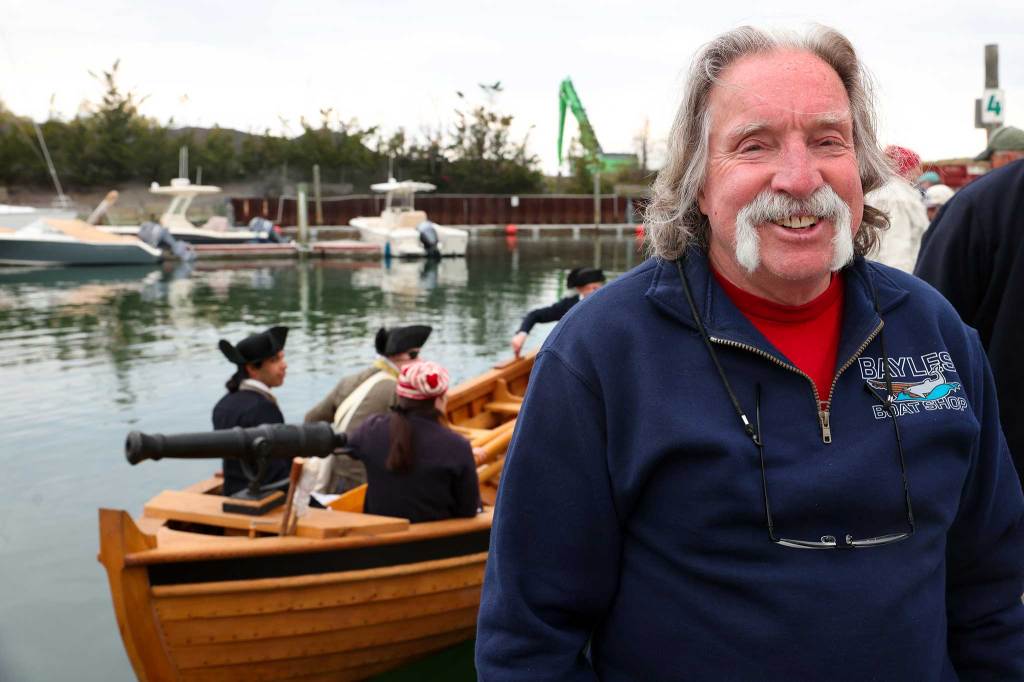
“It went very well,” said John Janicek, the LISEC treasurer who headed the project. “Absolutely no surprises. She took on some water, which is expected for a new lapstrake boat, but a lot less than we expected. It’s a little bit awkward to row with 16-foot oars, but we got the hang of it. She’s a very responsive boat once you get in sync with the rowing. It moves very quickly, although quarters are a little tight when you have five oarsmen and someone at the tiller.”
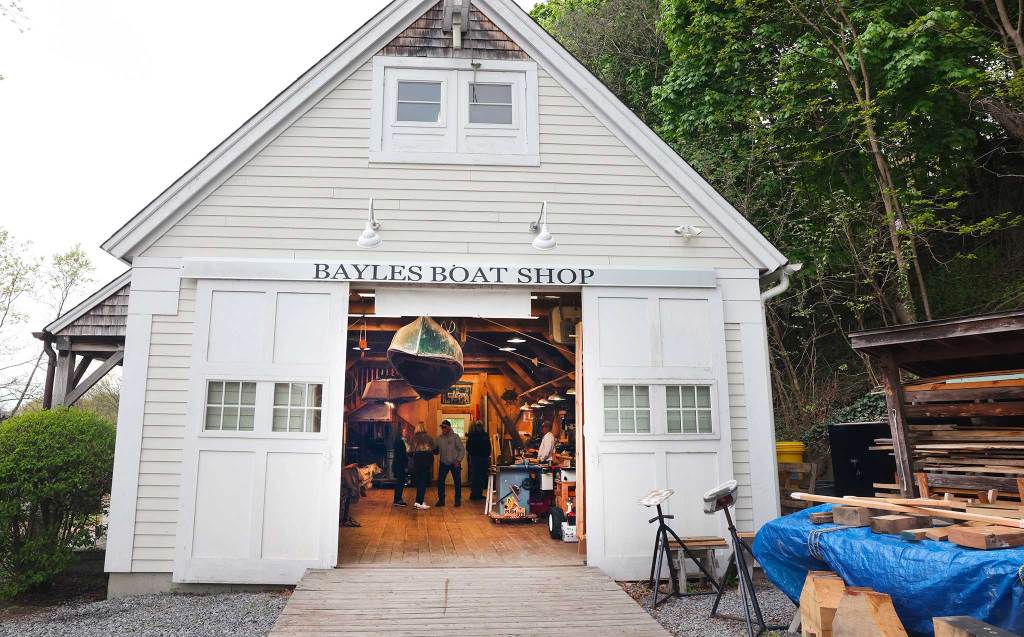
A christening took place near Bayles Boat Shop, a community-run wooden boatbuilding and restoration workshop located in the Port Jefferson Village Center. Janicek recited a poem about the Caleb Brewster written by volunteer Bob Gallagher, who died in December, and he placed a branch of green shrubbery on the bow.
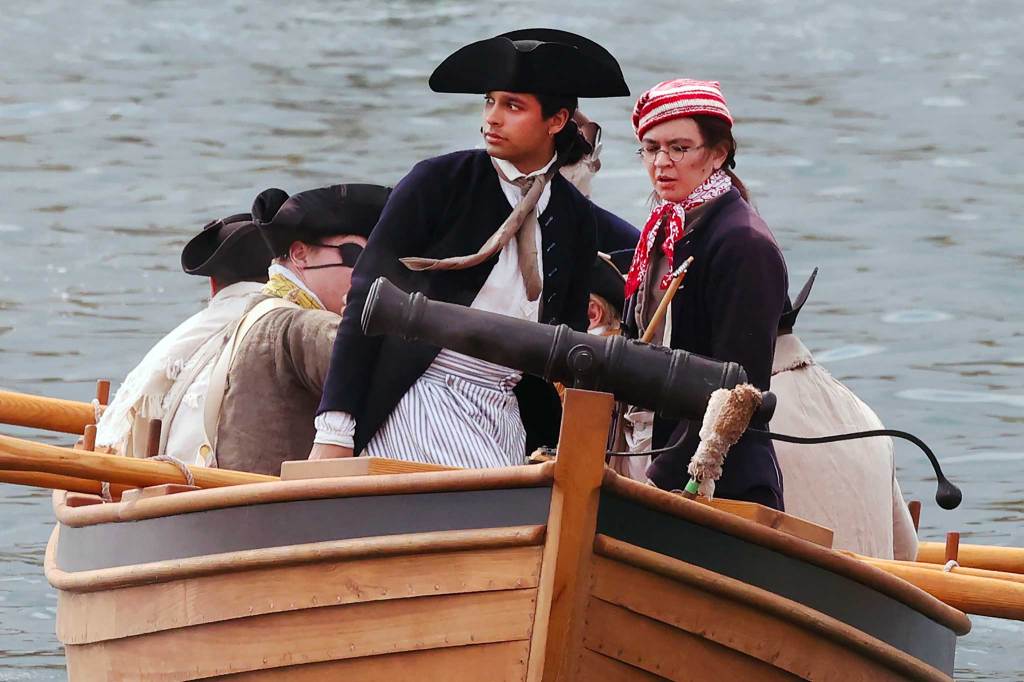
“It’s a good luck omen,” he explained. “It signifies that the boat returns home safely from all her journeys.” There was a toast to the boat, and to the sailors of yesterday and today. Then Janicek broke a bottle of Madeira on the bow. The official unveiling was a few days later, with the whaleboat rowed by members of the New York 3rd Regiment reenactors’ group, who were decked out in full Colonial military attire.
Things went mostly according to plan, but there was “one minor glitch,” Janicek said. The slow match used to ignite the swivel cannon on the bow refused to stay lit, causing a 10-minute delay in firing a salute.
ANATOMY OF A WHALEBOAT
Whaleboats were developed by Native Americans on Long Island’s South Fork by the early 1700s to pursue whales offshore and later used aboard large sailing vessels for deep-water whaling. Ranging from 25 to 30 feet, they were strong, light and maneuverable, double-ended for speed in any direction, and could be rowed or sailed. Those qualities made them equally valuable in the Revolution, when the American Patriots and the British used them to raid across the sound, scout enemy positions, capture prisoners and attack strongholds. Many were fitted with a bow-mounted swivel cannon, and with oars muffled in cloth, they could slip silently toward an enemy or away from one.
“In building the whaleboat, the importance was twofold,” said LISEC president Len Carolan, a retired physical education teacher who lives in Port Jefferson. “We had a group of 30 volunteers come together to complete this project. These guys come from all walks of life and had a great experience. In addition, there’s historical significance, as this is a replica of a boat used during the Revolutionary War, right here on Long Island Sound.”
Caleb Brewster was the Culper Ring’s main courier on the sound throughout its operation, from 1778 to the end of the war in 1783. The ring was run by Benjamin Tallmadge, one of Washington’s aides. Its chief spy was farmer Abraham Woodhull, who used the codename Samuel Culper Sr., while Robert Townsend of Oyster Bay operated in New York City as Samuel Culper Jr. Intelligence on British troop movements and other operations gathered by Woodhull and Townsend was passed to Brewster, who carried it across the sound to Tallmadge. Historians consider the Culper Ring the most effective Patriot intelligence operation of the war.
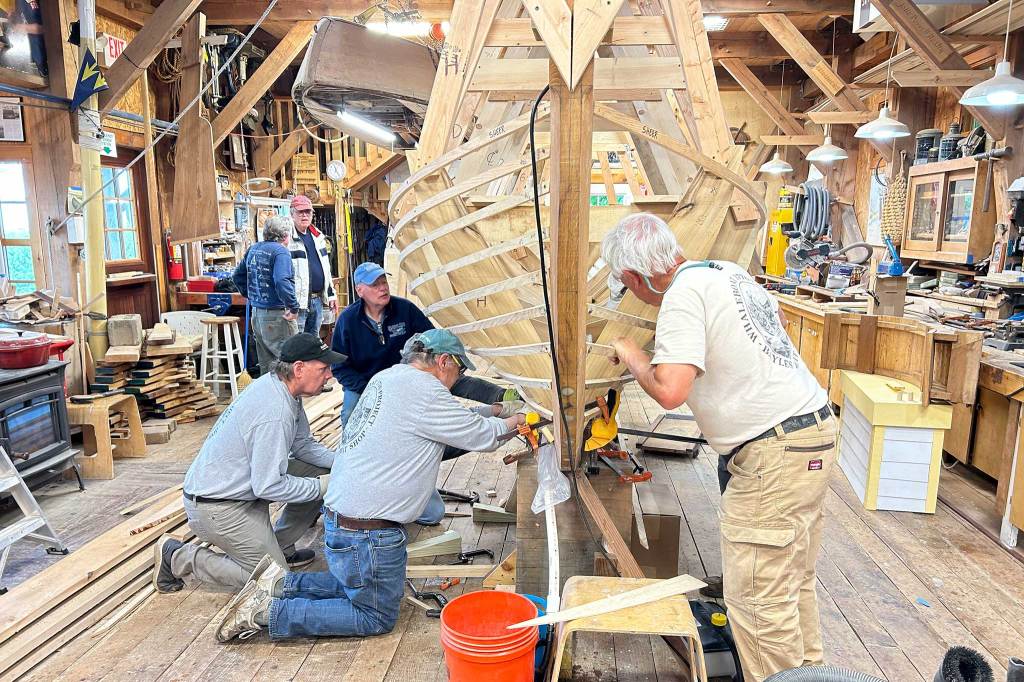
Last winter, the volunteers put the finishing touches on Caleb Brewster in the boat shop owned by LISEC. On a February day when the thermometer read 29 degrees and Port Jefferson Harbor was frozen over, the volunteers were installing the rail caps and the keelson, with heat provided by a potbelly stove fueled with wood scraps that Janicek called “our mistakes.”
The boat shop is situated on the site of the former Bayles shipyard, which was slated to become a village parking lot until the founders of LISEC argued that the property overlooking the harbor should be a park. Ultimately, the village converted the former shipyard into an events center and then gave LISEC a piece of the property. “Members of a timber-framing guild from Massachusetts came down to help us build the shop,” Janicek said. “We had an old-fashioned barn-raising.”
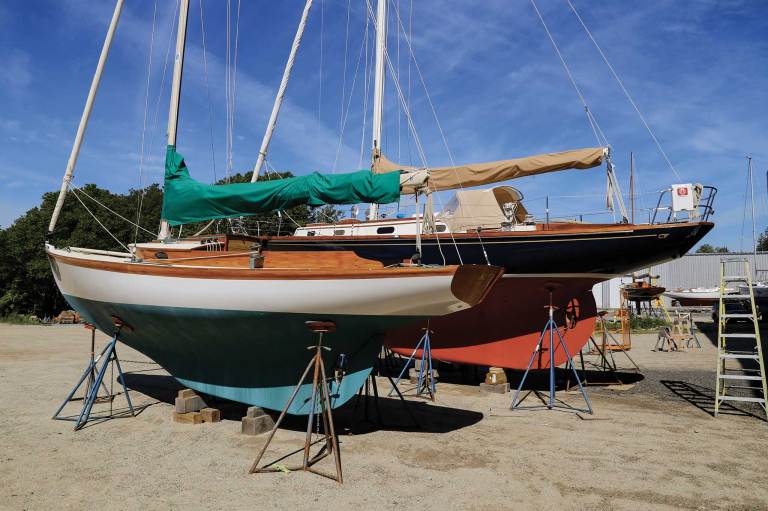
Suspended in the loft is a Comet sloop that was donated; it’s being refurbished for sale. “We’re nonprofit, so we focus on what makes us money,” Janicek said. “Outside, we have a beautiful Lightning we’re restoring. Both got put on hold when the whaleboat came in. Our total membership is about 85 people, but a lot of them are supporting members. The number of people who come in and work on boats varies between 20 and 30, and most of our members are retired.”
Janicek is a retired Fairchild Republic engineer who got involved with the shop a dozen years ago after his wife heard about it. “I had built an Adirondack guide boat myself, so I row a lot in the harbor over here.”
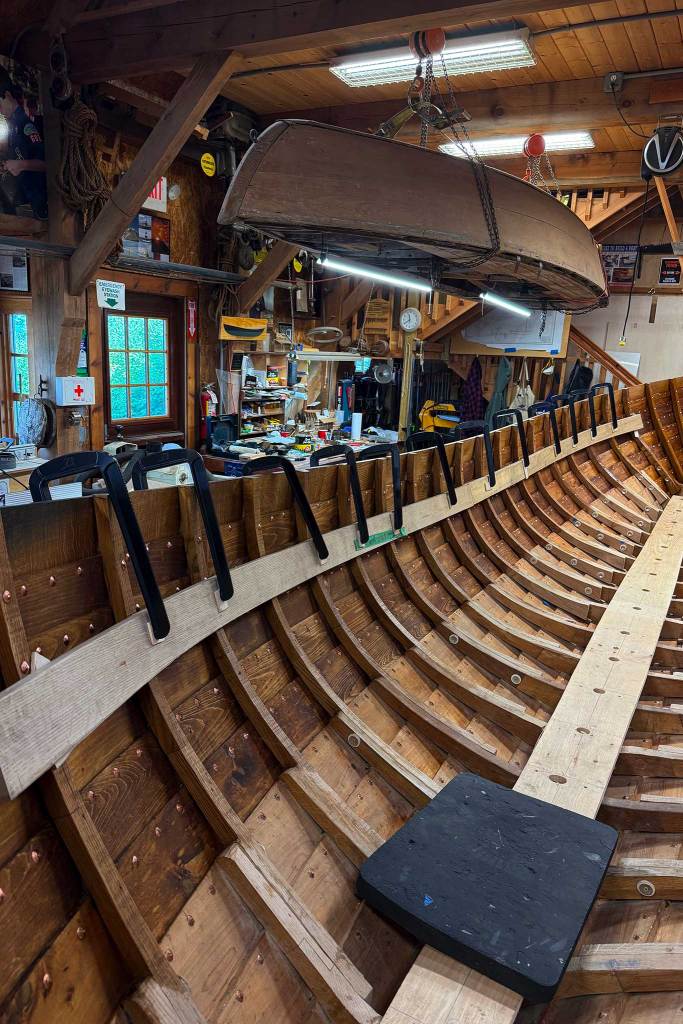
Ralph Antignano of Port Jefferson Station began volunteering at the suggestion of two friends who were already working at the shop when he retired from running a contracting business four years ago. “The whaleboat project is great because we’re preserving a piece of history, not only for the Revolutionary War, but wooden boatbuilding in general. It’s a dying art, and we’re keeping it alive here.” He helped with the lofting process and making templates.
Jay Lippert, a retired ranger at Fire Island National Seashore who has been boating his whole life, made wooden cleats. “We’re sanding by hand; we’re planing by hand,” he explained. “We’re steaming planks to get them to fit around a form. We’re using modern tools, so it’s a mating of new tools and old-school skills.”
THREE YEARS AND 30 VOLUNTEERS
The Caleb Brewster project was suggested by Port Jefferson Village historian Chris Ryon about four years ago. “It has become the symbol of Port Jefferson,” he said. In fact, the village recently turned an image of the whaleboat into a new logo. “Caleb Brewster means something to people, and this project is relevant because he was the one going back and forth during the war.”
Throughout the project, volunteers also consulted with Mark Sternberg, an expert on the Culper Spy Ring who serves as curator at the Drowned Meadow Cottage Museum in Port Jefferson, former home of two members of the spy ring.
The boat is based on a design by the late William Baker, a naval architect and historian from the Massachusetts Institute of Technology who also designed the Mayflower II. The Darien Historical Society in Darien, Connecticut, contracted with Baker to come up with the plans for a whaleboat for the U.S. bicentennial celebration. During the American Revolution and the whaling era, whaleboats ranged up to 30 feet. Baker designed a replica at 24 feet, 6 inches to fit in the space that the Darien group had to work in. Besides the one built in Darien, the town of Huntington on Long Island built a second one, also for the bicentennial. Janicek said both still exist but are not seaworthy because they were stored outdoors.
To build the Port Jefferson version for the 250th, Janicek said volunteers put in 400 to 500 hours every month over three years, though the project wasn’t expected to take that long. “We lofted it for a while because we hadn’t lofted anything big before,” Janicek said. “We had thought we could finish the planking in about three or four months. It took us almost eight. We’re all neophytes, just volunteers here. It’s kind of a big learning curve.”
The nonprofit spent almost $60,000 on materials. “We get a shipwright [Josh Herman] in every now and then. So we’re probably up to around $90,000 for the entire bill,” Janicek said. “The village gave us initially $5,000 seed money, and we raised the rest through corporate sponsors, businesses and individuals.”
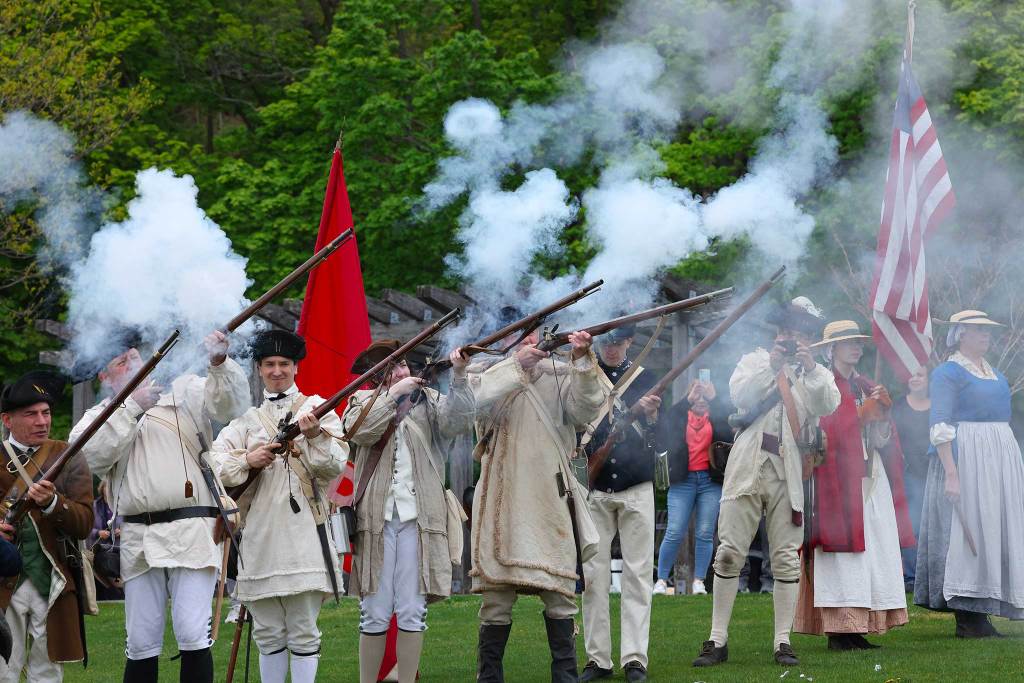
All the main structural wood in the boat is white oak, sourced locally. “The son of our president, Len Carolan, runs Terrapin Sawmill in Setauket,” Janicek said. “He set aside big timbers. The next big hurdle was the planking. We used Eastern white cedar from Ned Crosby and Sons up in Cape Cod. We went up there, and we took about 700 board feet.” American ash for the thwarts and five oars, and Sitka spruce for the mast came from M.L. Condon Company in White Plains, New York. The oars weigh 27 pounds, so it wasn’t easy for the reenactors to handle them.
The construction melded traditional and modern techniques, such as copper rivets and fasteners installed with power tools and West System epoxy. Above the waterline, inside and out, the Caleb Brewster was coated with a combination of pine tar and linseed oil called Salty Dog—it’s made by the George Kirby Jr. Paint Company of New Bedford, Massachusetts. “It duplicates the old-time soup mixture that they used way back when,” Janicek said. Anti-fouling was applied to the bottom because the whaleboat is expected to remain in the water for the boating season. The traditional-looking sail was made with rigging by Matt Bartells in Boothbay Harbor, Maine.
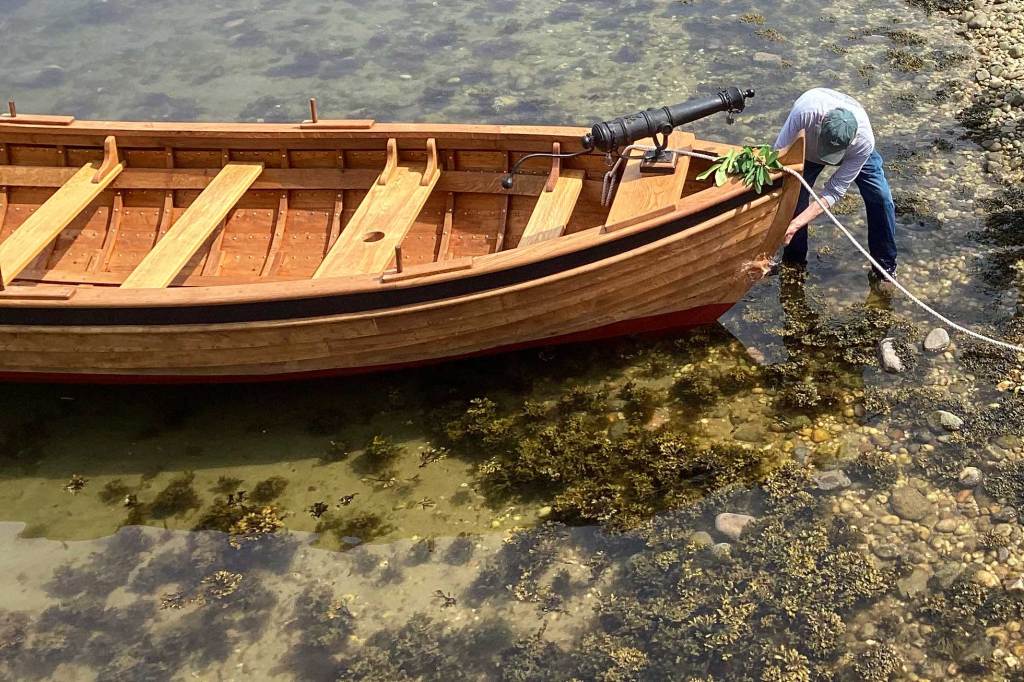
The 34-inch cannon was made in Ontario by Jim Hamm and cost $2,000. Transporting the piece was interesting, Janicek said. “When we got to the border, a young agent asked, ‘Do you have anything to declare?’ And I said, ‘Yeah, I have a replica of a Revolutionary War muzzle-loading swivel cannon.’ And the guy looks at me. He says, ‘That’s cool. Can I see it?’ I took him around the back. He thought it was the neatest thing he had ever seen. He says, ‘Okay, you’re good.’ ”
The Caleb Brewster will spend the season in the water, a seaworthy reminder of the dangerous runs her namesake made across Long Island Sound when the fate of a revolution depended on getting the message through. For the volunteers who spent three years building her, the launch was reward enough. For residents of Port Jefferson, she is something more—a symbol of local pride and a tangible connection to the moment, 250 years ago, when Long Island played a decisive role in winning American independence.
This article was originally published in the July 2026 issue.