Illustration by Jim Ewing
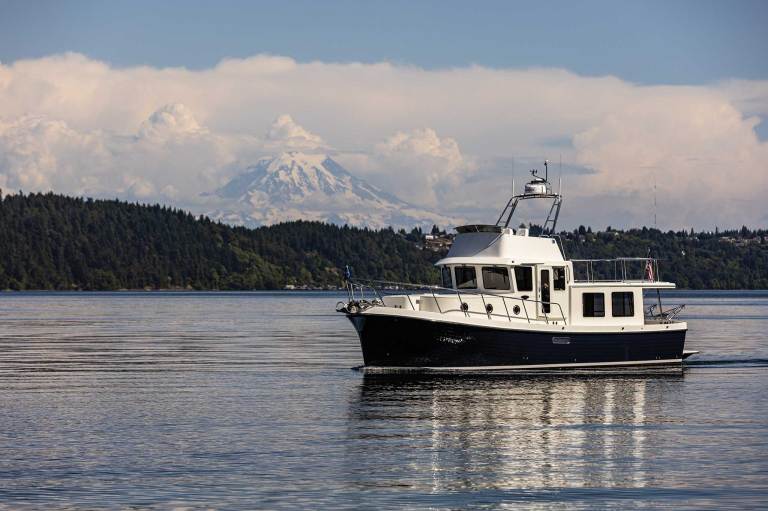
John and Warren Luhrs—third-generation sons of the well-known New Jersey family of boatbuilders, as well as founders of Silverton Marine—launched a line of Mainship Motor Cruisers in 1977 and 1978. They foresaw a burgeoning market for fuel-efficient, diesel-powered boats that were built of fiberglass and could be made affordable in serial production.
The Mainship 34 was designed by John Cherubini, who gave the solid fiberglass hull modest flare and sufficient buoyancy forward to tackle coastal offshore conditions safely. The deep, gently rounded forefoot merged into a full-length keel that protected the single- engine running gear. There were rounded bilges for good handling, and an approximate 16-degree deadrise at the transom for a comfortable ride in rough waters at semidisplacement speeds.
This hull was used in three iterations of the Mainship 34 between 1978 and 1988. They were designated Mainship 34 I, II and III. Most measurements remained constant in versions I and II, although the overhead cockpit cover was removed and a larger cockpit was created for easier angling.
However, beginning with the addition of a larger deckhouse in 1983, and with the addition of larger fuel tanks (300 gallons, up from 220 gallons) and water tanks (70 gallons, up from 50 gallons), the measured draft increased from 2 feet, 10 inches to 3 feet, 2 inches, while the dry weight increased from 14,000 to 18,500 pounds.
Cherubini gave the original version, sometimes referred to as the Mainship 34 Trawler, a roomy cockpit with space for four folding chairs, wide side decks with handholds, a modestly tall deckhouse made light and airy with large windows and a glass bulkhead aft, and a flybridge with a centerline helm and a pair of chairs that converted to loungers.
Inside, the main cabin had loads of space for loose furniture on a carpeted sole, along with two built-in cabinets and a countertop to port forward, and a lower helm to starboard. Forward to port and down three wide steps, the C-shaped galley was ready for meal prep and well-lit under the forward windows. The single head compartment with a separate shower was opposite to starboard. A stateroom forward included a hanging locker and other built-in stowage, a V-berth with an insert to create a double, and overhead hatches for natural ventilation at anchor.
Power for the basic model was a single 160-hp Perkins diesel, with a 200-hp Perkins available. Some owners put consumption at about 4 gallons per hour while cruising at 10 knots for their 200-hp propulsion systems. Others with boats running 160-hp drivetrains cited burns of 2 gallons per hour at 7 knots. Speeds for the basic motor were said to top out at 10 or 11 knots.
This article was originally published in the May 2026 issue.