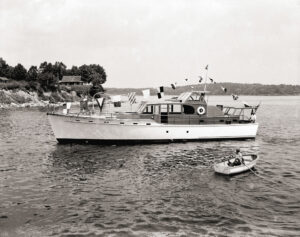
In this scene from 1911, Patrikos emerges from under the North Side Bridge in South Bristol, Maine, passing the Thompson Boat Shop, where laundry hangs drying on the line. At the helm is most likely author and lawyer Edgar O. Achorn, the boat’s original owner.
Patrikos means “gift of the father” in Greek (the boat was a gift from Achorn’s father). The Rice Brothers Company in East Boothbay built it in 1908. Established in 1892 by Frank, William and Henry Rice, the builder spent more than six decades producing a variety of small craft for private owners, as well as ships for the U.S. Coast Guard and U.S. Navy. Their launches included schooners, catboats, yachts, yawls, sloops, ketches, fishing trawlers, motorboats and lightships, as well as 10 of the 75-foot patrol boats the Coast Guard used to intercept rumrunners during Prohibition.
Patrikos is one of the builder’s pleasure craft. Originally powered by a two-cylinder Knox engine, this 27-foot V-stern cruiser was well-suited for Maine’s waterways. In 1934, physicist and World War II naval officer Harold Mott-Smith, Jr. bought her, after purchasing a summer cottage on Rutherford Island. He immediately removed the boat’s awning and name, which he felt were not suitably nautical. Mott-Smith used the vessel frequently for local cruises to Boothbay Harbor, Pemaquid and Outer Heron Island, and sometimes ventured as far as southern New England and the St. John River in Canada.
For many years, Shew & Burnham in South Bristol maintained the boat, which Mott-Smith never renamed her. By the early 1960s, however, that yard was no longer able to complete the work, so Mott-Smith enlisted the help of local builder Bruce Farrin. The two of them became close over the years, and when Mott-Smith died in 1991, Farrin inherited the boat and cottage.
Farrin renamed the boat Doc’s Pride. The first year he owned her, he refastened her with No. 9 bronze screws and placed four floor timbers from the steering bulkhead aft to stiffen the keel section. He also installed a three-cylinder Westerbeke gasoline engine, which he later replaced with a three-cylinder Universal diesel after coolant seeped into one of the Westerbeke’s cylinders.
Although Farrin used the boat frequently during his first year of ownership, he ultimately struggled to find the time to go boating. To save her from rotting in a relict pile, he decided to find her a good home for her final days. In 2020, he donated her to the Maine Maritime Museum in Bath, giving thousands of visitors each year the chance to see this piece of Maine’s boatbuilding history.
December 2025