Generally, when you see a product with Mark II after its name, it’s the same as Mark I, but with a tweak or two to make it a little bit better. Not so with the Nordhavn 46 Mark II from Pacific Asian Enterprises.
The 46 MKII isn’t just an update of the original Nordhavn 46. It’s a completely new boat, one that’s designed, engineered and equipped for 21st-century tastes. About all the MKII shares with the older boat is the 46 in her name, and the fact that an experienced cruising couple without crew can handle her.
Built at the South Coast shipyard in Kaohsiung, Taiwan, the first 46 MKIIs will be delivered in 2026—quite a few decades since the years between 1989 and 2003, when PAE built 82 Nordhavn 46 hulls. Many of them have completed long bluewater passages and circumnavigations, thanks to the seaworthy design, rugged construction and 3,000-nm cruising range, all characteristics of every Nordhavn built since then.
Today, even the youngest 46s are showing their age. Jim Leishman had inspired his younger brother Jeff, now PAE’s chief designer, to design the original 46 as his graduation project from naval architecture school. Today the brothers and their longtime friend Dan Streech are the principal owners and officers of PAE, where Jeff Leishman started with a blank sheet of paper—or, nowadays, maybe a blank computer screen—on this updated model.
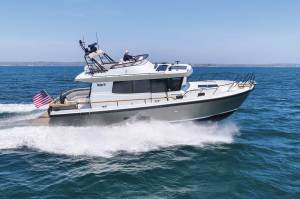
The 46 MKII shows her Nordhavn genes but looks very little like her predecessor. Her contemporary styling includes hull-side windows, a nearly plumb stem, an uncluttered deck and a molded radar arch. The Portuguese bridge of the first 46 is gone, as are the unwieldy booms for handling paravanes. Humphree 24-volt all-speed stabilizers are standard. There’s access between the pilothouse and foredeck via bulwark-protected side decks on both sides, with flybridge steps to port and passage to the cockpit to starboard. A tender will fit nicely on the aft cabin top. A hydraulic davit is standard.
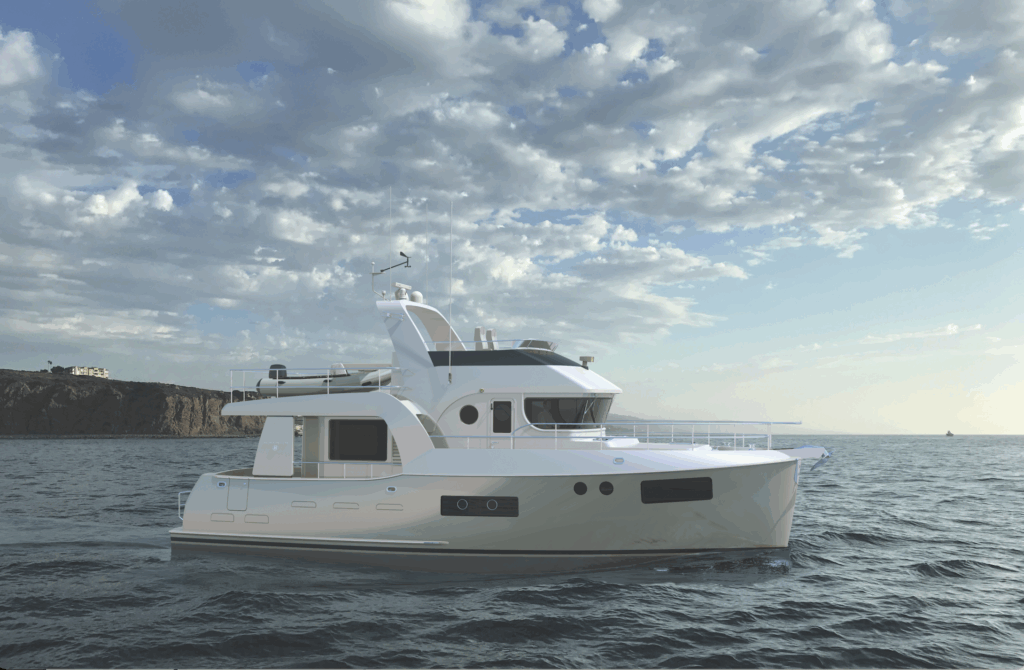
The change in profile from the first 46 is obvious, but without a look at the specs, you might miss a more important improvement: Although just 6 inches longer overall, the 46 MKII is more than 6 feet longer on the waterline (44 feet, 7 inches vs. 38 feet, 4 inches) thanks to minimal overhangs fore and aft. Combined with fuller aft sections than the original 46, Jim Leishman says, the MKII’s added waterline length improves motion at sea by reducing pitching and increasing cruising speed.
The added 6 feet of waterline length also adds a huge amount of interior volume, Jim Leishman says. And that lets the boat carry full fuel (1,200 gallons), fresh water (400 gallons) and passagemaking gear without affecting trim. The boat just settles in the water, while the original 46 could have trim issues when fully loaded.

On the other hand, more hull volume versus length generally reduces efficiency. Nordhavn minimized that loss by using computational fluid dynamics. The added volume allowed Jeff Leishman to increase the fuel load compared with the older boat, and to maintain a 3,000-nm range. That’s the sweet spot for world cruising. “Honolulu to the Marquesas is 2,500, to 2,600 miles,” Jim Leishman says. “You need a 3,000-mile range to have some reserves.”
The original Nordhavn 46 carried a single 140-hp John Deere/Lugger diesel with its prop hidden behind a skeg; an optional 30-hp Yanmar wing engine provided get-home power. The new boat has twin 140-hp Nanni diesels that can push her at optimum cruising speed (about 7 knots for passagemaking) using only 50 percent power. If one engine dies, the second one can be throttled up to maintain speed. For long-distance cruising where maximum range isn’t a concern, cranking up the Nannis will produce a few extra knots, convenient for harbor-hopping. The twin props spinning in clear water get better efficiency than a single prop behind deadwood, according to Nordhavn. If the boat grounds, the underbody protects the props, rudders and stabilizer fins.
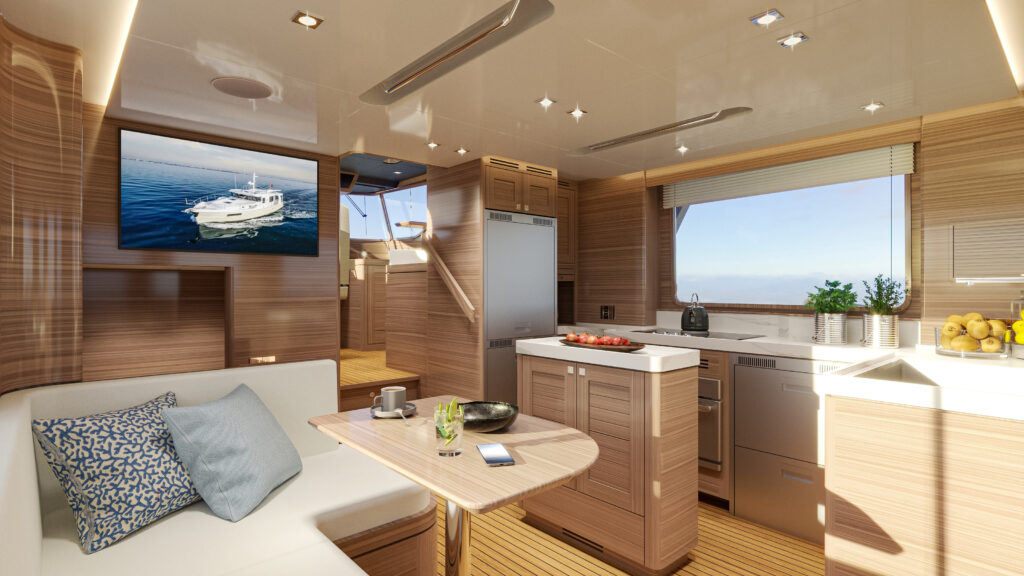
Like all Nordhavn models, the 46 MKII comes well-equipped, with an 11-kW Nanni genset; lithium-ion batteries with enough capacity to reduce genset usage; a Side-Power bow thruster; Garmin electronics, including radar and autopilot; a full-size GE washer and dryer, and more. According to Jim Leishman, a tender and a watermaker are the only major gear not included as standard, although watermaker hookups are installed on every hull.
This article was originally published in the February 2026 issue