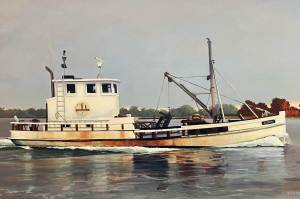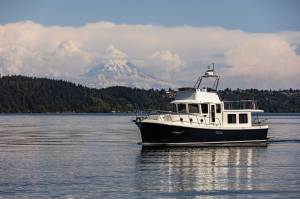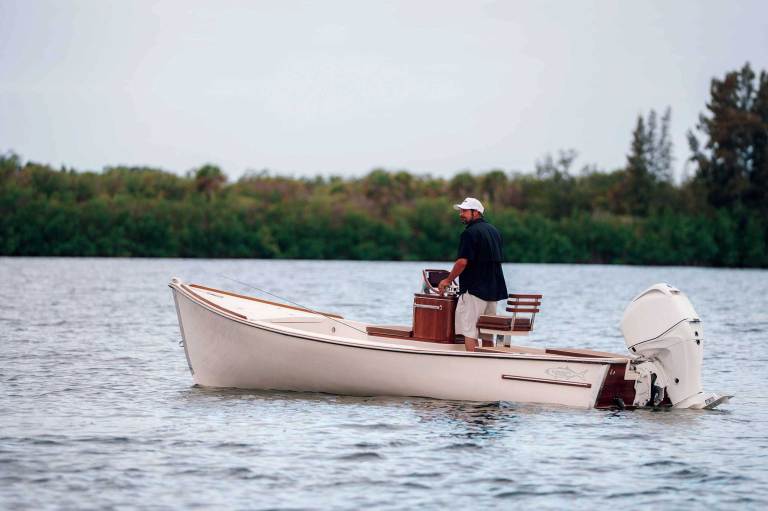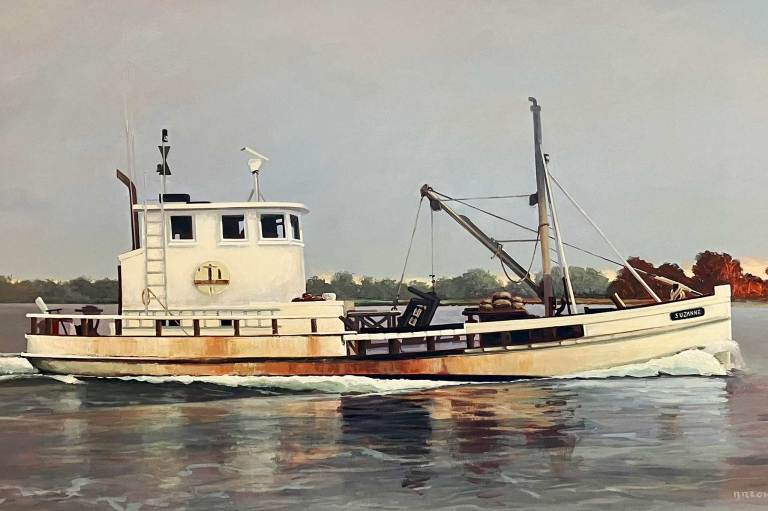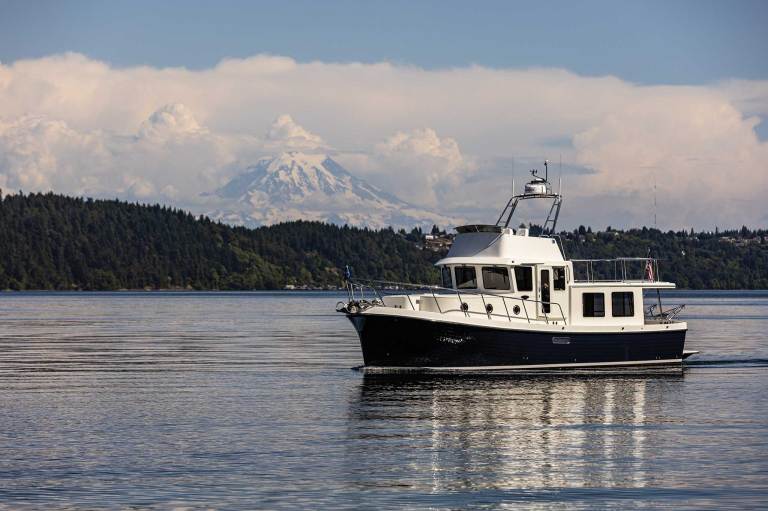
November 12 marked one year since Andy Tyska bought Huckins Yachts in Jacksonville, Florida. There’s a Legacy Club now for owners of these boats, with Huckins preparing to celebrate its 100th anniversary in 2028. If ever there were a fleet of aging boats whose owners were guaranteed to need some kind of refit services based purely on age, the Huckins fleet is it, and Tyska says these owners are pretty uniform in how they approach the refit process.
Owners of other boat brands will refit their vessels to gain speed through performance-enhancing modifications like repowering with a new engine, improving the power-to-weight ratio, or changing the prop, among other methods. “I can’t say that we’ve ever had someone who came to us and said they want to go faster,” Tyska says. “Usually, it’s part of a more holistic conversation about speed, efficiency and seaworthiness. Usually, when you get more speed, you give up some efficiency or you’re pounding into the waves more. It’s a give and take.”
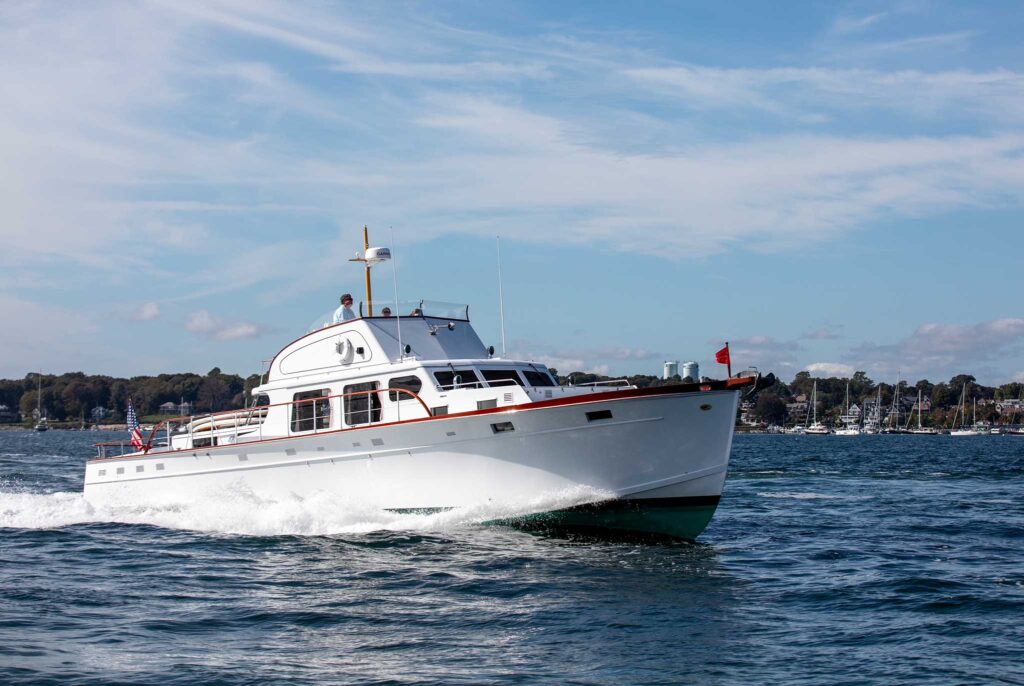
Tyska is far from alone. In refit yards up and down the East Coast, powerboat owners are requesting refits not just for increased speed, but also for improved efficiency and better ease of handling.
JB Turner, president of Front Street Shipyard in Belfast, Maine, says he sees this combination in refit requests day after day. “People don’t just say they want speed anymore. They want speed, and they want to make the boat easier to handle.”
Scott Bryant, general manager at The Hinckley Company in Portsmouth, Rhode Island, also sees this same desire to upgrade more than just the power plants. “People do repowers because the engines are old. They care about reliability and the modern engines that give you better performance and better efficiency. And then if you’re dealing with Hinckley, we have made some pretty big strides in the past two years relative to control. This is just for Hinckleys only, our JetStick system.”
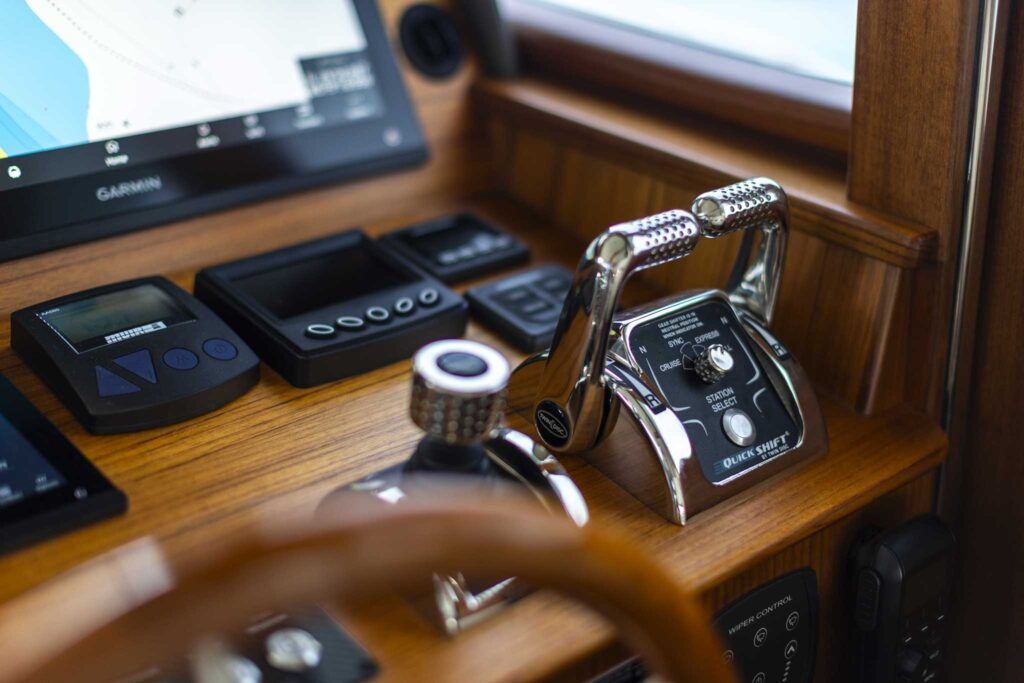
The JetStick is, indeed, only for Hinckley owners on refits, but Turner says the same principle applies to all kinds of powerboat owners.
“Everybody’s got to have a JetStick or a joystick these days,” Turner says. “They make the boat more maneuverable and easier for people to handle.”
What’s happening is different from repower-focused refits of decades past, he adds. Powerboat owners did used to come in looking to gain speed. But with all the technology options that are available today, that attitude doesn’t seem to make sense to a lot of owners anymore.
“Twenty years ago, nobody did it,” Turner says. “People are doing it now, though—especially changing over drive systems for total maneuverability. But along the way, if you’re changing out an engine, you might put in a pod drive. Going from a drive to a pod system is not a cheap endeavor by any stretch of the imagination, but going to a more advanced sterndrive system or outboard system, that’s certainly within the reach of many people.”
And switching out the wheel for a joystick system, he says, is also an upgrade that a lot of owners decide is worth the spend. “If you have an Intrepid 32 with old 300-hp engines and you’re driving with a wheel and an old bow thruster up forward, you can put on 350s or 400s with a joystick” he says. “That’s a much more maneuverable boat, and it’s a much faster boat. Then you start talking about lifting strakes and chines, and you gain more speed.”
Adding lifting strakes and chines can be relatively easy or relatively complicated, says Craig Picard, Front Street’s in-house designer. “It all depends on the size of the project,” he says. “It can add a little complexity or a lot. We did a set of lifting strakes on a Down East boat, and it was a weeklong process. The owner wanted to go faster than the boat was designed to do, so we actually made it an outboard boat instead of an inboard boat. The outboards are bigger and faster, so that’s a way to get more speed.” But other strake-and-chine refits, he says, are a whole other level of complexity. “Some projects, you get into fitting foam and glassing it on,” he says. “That takes months.”
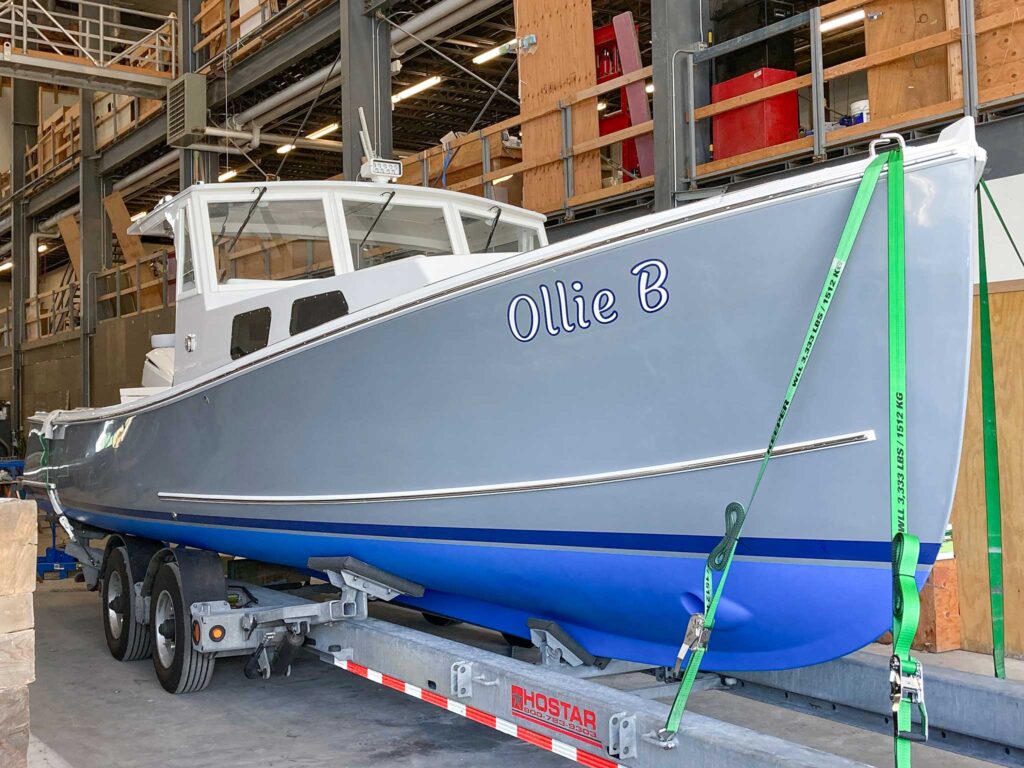
Still other owners, Tyska says, want every ounce of benefit they can gain, which can lead to an intense focus on reducing weight while adding interior upgrades. “We have a customer at Huckins doing a multiyear refit to bring the boat back to originality,” he says. “It had some not new, but not vintage dome lights in cast bronze with chrome plating. It’s hard to find vintage replacements for those that are made out of aluminum, so we scanned in the bronze ones and made patterns to cast the aluminum ones. We’re reusing the vintage reflector that’s inside it, but it’s a pound and three quarters savings for each dome. Will it affect the performance? Not on its own, but all of these things happen in increments. We look at things like that to be weight-conscious.”
Bryant says Hinckley also recently had a refit customer who wanted significant changes aboard his vintage 62-foot Vicem. That 90,000-pound boat, which now has an open layout and brighter interior, can also hit 37 to 40 knots post-refit. “This was a substantial refit down at our Savannah yard,” Bryant says. “Not only did we completely rebuild the interior, but we put bigger motors in the boat, got more speed and were able to increase the efficiency as well—and that’s what the client was looking to do with the modern diesels.”
Tyska says that with any kind of refit, including the ones he does for customers at Bristol Marine, where he’s founder and CEO, important questions are always in the mix about how much weight is being added and whether whatever might be gained could damage the boating experience in other ways. “If you’re doing systems upgrades, you want to put weight where it was,” he says. “If you’re moving it, don’t move it in a way that causes speed or comfort issues with the boat’s motion.”
Helping boat owners understand what is and isn’t possible should be a conversation that happens with every refit, Picard says, because a lot of people have big ideas that are simply not feasible. “It’s people who want to do something that doesn’t fit in the platform they have,” he says. “That’s where we come in and steer them in the right direction. I had a customer who wanted to make his boat go faster and faster, and we couldn’t fit a bigger engine in the boat. In time, we ended up with him building a boat that suits his needs better.”

The Ultimate Refit for Speed
They’re not saying how much speed they gained. Or precisely how they gained it. But the team at Palm Beach Motor Yachts recently announced details about their refit of the 20-year-old Palm Beach XI, formerly known as Wild Oats XI, one of the most famous racing sailboats in the world.
What we know is that the boat will have a new, deeper keel fin and bulb that are designed to reduce drag and maximize righting moment. There also are going to be advanced upwind daggerboards for sharper pointing ability, and reduced drag and leeway in all conditions. In addition, the builder says that radical C-foils are in the mix, engineered to optimize lift, minimize drag, and enhance righting moment for reaching and downwind sailing angles.
Palm Beach’s team is undertaking all of this in collaboration with Juan Kouyoumdjian of Juan-K Naval Architects in Spain; McConaghy Boats, a composite race-yacht specialist in Australia; the folks at North Sails, headquartered in Connecticut; and Palm Beach XI’s yacht manager, Paul Magee.
“Palm Beach XI is the ultimate team effort,” says Mark Richards, the founder of Palm Beach Motor Yachts. “We have worked collaboratively to bring this vision to life in a very short time frame. This project embodies everything Palm Beach Motor Yacht stands for—our relentless passion for innovation, powered by a team culture that thrives on discipline, precision and shared purpose.”
And importantly for powerboat owners, he adds: “Every lesson we learn here will flow directly into our range of motoryachts, ensuring that our owners benefit from technology that’s proven at the cutting edge of the sport and our industry.”
This article was originally published in the January 2026 issue