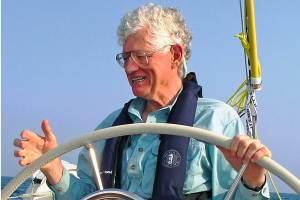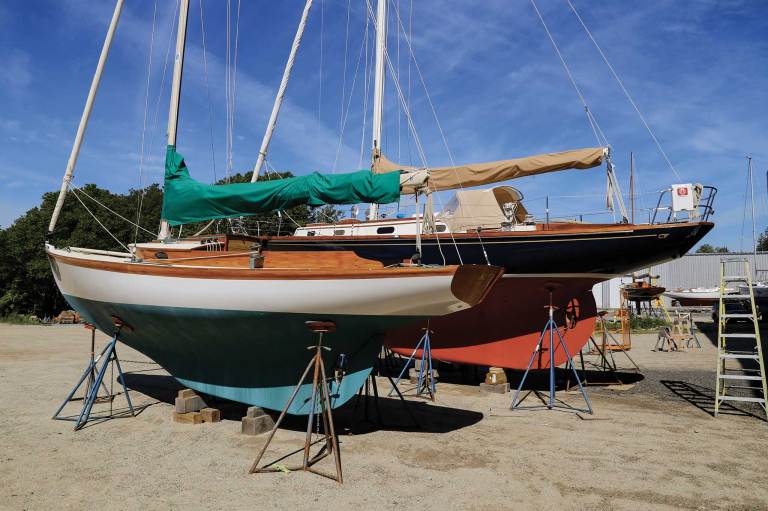
He grew up on Martha’s Vineyard, spending summers working the docks and learning to rig. By 15, he was racing his own sailboat. As he grew older, the horizon stretched: seven Bermuda Races, two trans-Atlantic races, the TransPac and nearly every major ocean race in the Northeast. Even when he became steward of the Concordia yawl Nefertiti and carefully restored her, preservation was only part of the calling. A boat, to John “Jock” Williams, was always a promise of somewhere yet to go.
It was powerboats that would make his name, in a career devoted to giving others a way onto the water. After charting the South China Sea in the Navy, Williams settled in Maine, building production boats and mastering composites. There he met Lyford Stanley, a lobster boat designer who conceived vessels first in miniature — perfect half-hulls holding the promise of boats they might become, like acorns carrying whole oaks within them. Their friendship set Williams’ life on a new course when, in 1973, he gave those half-hulls room to grow, and the John Williams Boat Company took root in Hall Quarry, Maine.
For half a century, Williams built Stanleys, first as working boats for fishermen, then — after boaters discovered the grace and efficiency in the hulls —as finely finished lobster yachts. By his passing at age 87 Aug. 9, Williams had built more than 200 boats, sending them to waters he was often too busy to explore himself. One, a 2000-built Stanley 36, eventually found her way home almost two decades later when he bought her back, renamed her Hokulani — Hawaiian for “heavenly star” — and stepped back from the yard to chase some long-awaited horizons, including the Great Loop.
In time, Hawaii became Jock’s winter home, where his wife’s native roots dug deep and the community folded him into its family. But even a continent away, Williams could not leave boatbuilding behind. In Honolulu, his path crossed that of Hōkūle’a, a Polynesian double-hulled voyaging canoe that has carried its educational mission across oceans by celestial navigation since the 1970s. When she needed new crossbeams, he enlisted Maine’s university to engineer them, then lent his hands to their making. Two years later, Hōkūle’a sailed up Somes Sound into John Williams Boat Company — as if the sea itself had drawn a line between the two shores Williams called home.
Mainers would say Williams was “from away,” but he earned a place in Maine’s maritime history as one of its great builders of Down East boats — an honor bestowed neither often nor lightly. His last boat, a Williams 29 launched last year, seems a fitting expression of a lifetime refining the form: a centerconsole dayboat with warm wood, a graceful sweep of tumblehome and the quiet elegance Williams brought to many boats before it. A boat built by Williams is rooted in tradition without being bound by it, treating those who take to sea aboard her kindly — much like the man who built her.
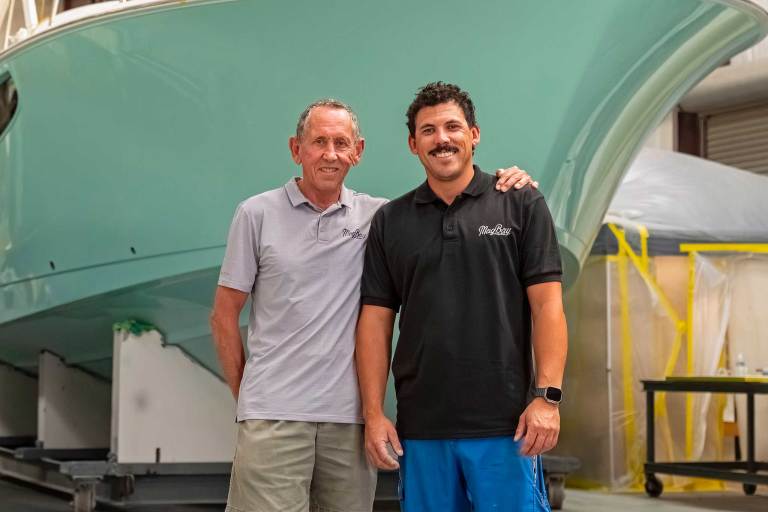
By all accounts, the legacy Williams treasured most was measured not in boats but in people. His family extended beyond his wife and three daughters to the crew at the yard. He might gather them for an impromptu boat ride or turn a workday into a celebratory lunch simply because the moment seemed to call for one. When a new boat slipped into the water, the launch belonged as much to the hands that built her as to the owner who would take her to sea.
Until his passing, Williams was still dreaming of the next stretch of water, with plans to ship Hokulani to Europe and wander its locks and canals. One lifetime could never have been enough to explore every body of water aboard every kind of boat that captured his imagination. And yet the wake Williams leaves behind reaches farther than any horizon he chased.
This article was originally published in the November 2026 issue.