
Mario Vittone
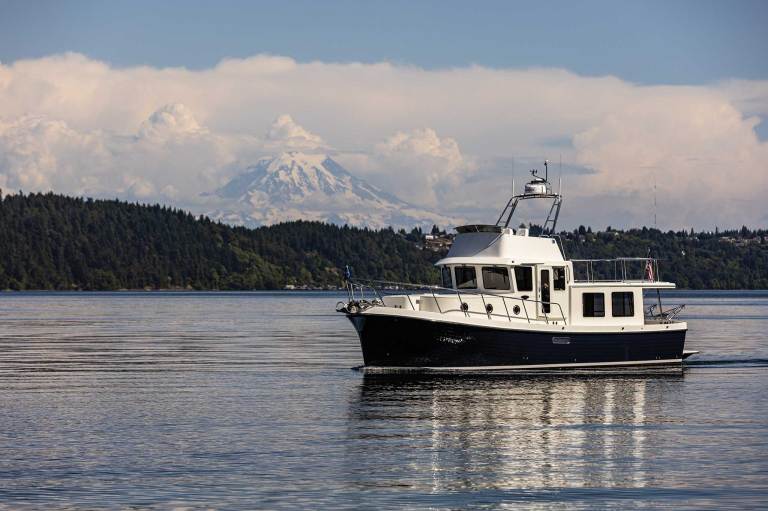
“Throttle back!” yelled Scott Evangelista, the owner and captain of Sarah-Sarah. He was abaft the helm of the Circa Marine FPB-64, near the settee, where white smoke billowed from the deck hatch.
We can’t be on fire, I thought as I pulled back the throttle. But the truth is, I was certain that we were.
Out of nowhere, there had been high-pitched screeching from the engine. Then the white smoke. It was a fine weather day on the Inside Passage in Alaska, where our situation had gone from a perfect afternoon on flat-calm waters to a real emergency.
Any confidence I had acquired during the previous 70 days at sea was gone. I was the one on watch. And I’m supposed to be an expert at avoiding at-sea emergencies. Smoke was pouring from the engine room. My girlfriend, Julie, was terrified. I was wondering if a mayday call was in our future.
We soon discovered that what we had seen was not smoke. It was steam, with the distinct odor of glycol about it. We had overheated.
Our crew was relieved, but I felt worse because I was responsible. Who was supposed to be monitoring the gauges? Oh, that’s right, I was. Yet for the life of me, I could not remember the last time I had looked. It could have been 20 minutes earlier. Or not.

I had learned so much on this trip from Maine through the Northwest Passage to Washington, and as it turns out, a reminder about complacency was on that list. I had committed the mistake that leads to most mishaps: I forgot where I was in the world.
Being on the water, especially cold water, means being surrounded by something that will kill you if you get in it. That doesn’t mean boating is unsafe, but forgetting to monitor the engine temperature makes it less safe.

Once we understood what we were dealing with, I went to work ventilating the engine room while Scott rigged the dinghy to side-tow us into our anchorage a few miles away. After the engine cooled, Scott identified the problem.
The raw-water pump had failed. A small screw that held the cam in place had sheared off, rendering the pump useless. The screeching was likely steam escaping from the pressure cap on the coolant reservoir as the temperatures pushed past 240 degrees and the pressure built to uncontrollable levels. Even if I had been monitoring the temperatures like a hawk, that wouldn’t have saved the pump. The engine still would have been hard down. However, it would have been hard down without the massive overpressures that had built up, and without the glycol haze and moisture all over Scott’s engine room. And without that look of terror in Julie’s eyes.
That’s what almost derailed me. As a rescue swimmer for the Coast Guard, I saw people who were afraid, but I wasn’t accustomed to being the one who made them feel that way.
After we replaced the pump the engine ran fine again. We cleaned the space, then spent an extra day at anchor. Scott checked the engine under power to make sure we were safe to move on. I tried to act normal while I kicked myself.
Everything works before it breaks. How many times had I said that to boaters as a warning not to take a working system for granted? You can’t worry about everything all the time, but you can try to avoid complacency, which is likely to cause problems. On Sarah-Sarah, Scott found the alarm setting in the Maretron that was not previously set. He dialed it to 195. Had it been set earlier, it could have changed the outcome. More important, the system has an alarm feature for a reason.
The thing to understand about complacency is that it’s part of how we operate as human beings. If boating required the same constant vigilance as, say, performing surgery, none of us could do it for very long without becoming exhausted. On board, 100 percent vigilance means a lot less fun, and that’s not how most of us work.
We learn, over time, what to keep an eye on and what to move to the background. Most of the time, we are right. I missed the mark in this circumstance. Engine gauges are no longer something I can ignore for too long.
On your boat, you may never be laissez-faire about your position in a narrow channel, but have you set your depth gauge alarm? If you have radar, have you set the closest-point-of-approach alarms, or are you all too sure you’ll never look away from the screen for that long? How often do you investigate the engine compartment underway? I’m a fan of “at the top of every odd hour” for physical engine-room checks. Now I know to check the gauges, too.
Before that emergency on the Inside Passage, we had experienced two engine failures. And yet I still got lulled into a complacent state. Granted, it was a beautiful day, and because Julie was with me, I was happy. There were whales off the port bow, and I was focused on staying in the channel.The raw-water pump did not care. It had no idea how easy this part of the trip was compared with the previous two months.
After years of being “that guy,” that annoying person who is always advising other boaters never to let down their guard, I had done just that. Fortunately, no one got hurt. Regardless of how graciously Scott told me not to worry about it, I’m not going to downplay the situation. We got lucky.
I missed a change in engine temperature, something I knew to be important. What if Scott had been checking the engine room, the door closed behind him, when the steam rushed out at 240-plus degrees and filled the space? He had been back there twice that day. I could have killed him.
Years ago, I wrote a piece about how to choose a safe charter captain. In it, I suggested asking each candidate to talk about a mistake they had made that almost got them and their crew in real trouble.
I now know what my story will be if anyone asks me that same question.
This article was originally published in the April 2026 issue.