In the mid-1980s, there was a rapidly growing interest in midrange offshore sportfishing designs, particularly among those who wanted to tackle species found only in deeper waters. C. Raymond Hunt & Associates developed a hull design with the pedigree to handle big seas and changeable winds, as well as the trolling and handling needs of experienced anglers.
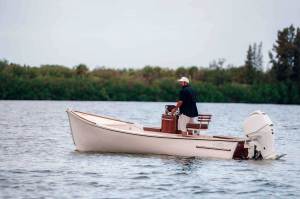
The Black Watch 33 had that deep-V hull, with a well-flared bow that offered plenty of reserve buoyancy in tall waves. The boat’s helm was well protected behind a sturdy raked windshield, and the cockpit was spacious enough for a pair of anglers to fight fish. Thanks to this cockpit and a generous 11-foot beam, the boat was a fast success.
It was prized for its ability to handle all kinds of water conditions safely, while offering the features and equipment necessary for landing large gamefish on their own grounds. And while the Black Watch is usually thought of as a semi-custom design built by Ted Hood’s yard in Portsmouth, New Hampshire, its origins were a bit farther south in the Bristol, Rhode Island, yard of C.E. Ryder.
“I started Black Watch while doing interior layout design for Clarke Ryder, who was known for building Sea Sprite and Southern Cross cruising sailboats,” said Peter Van Lancker, who served as president of Black Watch in the 1980s. “Clarke had this Hunt 30 mold in the storage yard, something I’d never seen before. The industry segment for offshore fishing was getting very popular. So, we decided to build one, took it to a boat show, and it simply took off in popularity. I think we built over 100 Black Watch 30s over several years.”
They were balsa-cored, lighter in weight than many competitors, and faster and more fuel efficient. Early on, Van Lancker established a relationship with Cummins and was given some preference for its 300-hp diesels, which gave the 30 cruising speeds in the high-20-knot range. Most competitors were running 240-hp diesels.
“Ted Hood, having just bought a property in Portsmouth, Rhode Island, approached us about buying the Black Watch company,” Van Lancker said. “He hired me, and I brought 20 experienced builders along.”
Hood went forward with plans to develop Black Watch as a high-end, semi-custom boat line. One of his first moves was to take the 30 tooling and stretch it to 33 feet, to create a larger cockpit. For the same reason, Hood eventually stretched it to 36 feet. In both instances, the shape of the hull forward of the engine boxes remained virtually identical to the Black Watch 30.
November 2025