When Kim Holman joined forces with Don Pye in 1964 to create the design firm Holman and Pye, they could hardly have known that their talents would give birth to some of the most beautiful yachts ever built, including the Oyster 61. Both had backgrounds in traditional wooden vessels. Holman penned good-looking, seaworthy sailboats, while Pye led the company in the transition to fiberglass construction.
Their design for the Oyster 61 was first built in 1995 under the watchful eye of Richard Matthews, founder of Oyster Marine. It was the sixth Holman and Pye design built by the yard; the collaboration began in 1978. During the 5 years the design was in production, 14 yachts were built and equipped to be handled by owner-operators with family as crew or with up to two professionals.
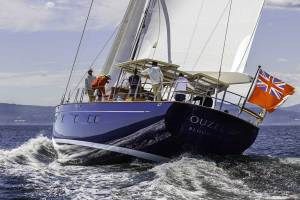
Over the years, Oyster became well known for its “deck saloon cruisers” that were purpose-made for offshore cruising. The 61 is one of those models. Its deckhouse is kept aerodynamically low, to offer unobstructed views from the slightly raised cockpit, which is perched above, rather than recessed into, the main deck. Large wraparound windows on three sides add light and visibility in the main cabin directly below.
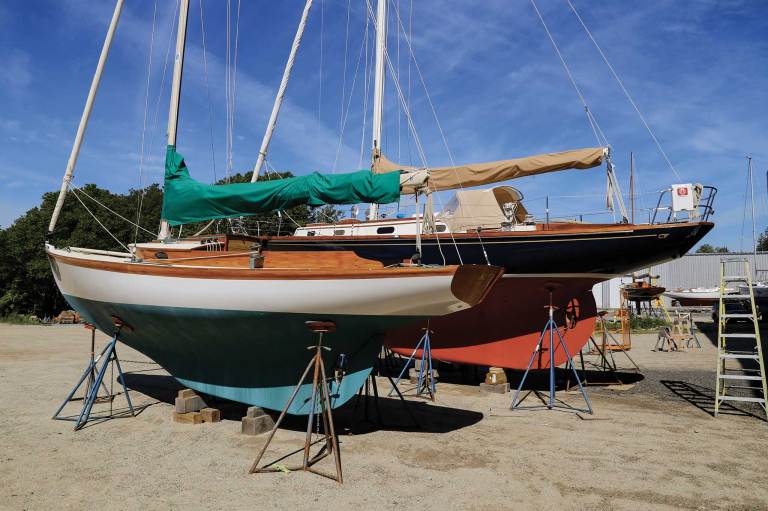
The classic look of the Oyster 61 is emphasized by the modestly sprung, lightly crowned deck. With an LOA of 61 feet, the boat features beautiful overhangs at the stem and stern. The waterline length (LWL) is just over 49 feet and promises an increase in speed and stability when heeling underway. The near 17-foot beam offers wide side decks. Below the waterline, there’s 8 feet, 2 inches of draft, a fin keel housing, 21,500 pounds of ballast, and a spade rudder protected by a substantial skeg. Displacement is approximately 62,000 pounds. Theoretical hull speed is 8.7 knots.
The Oyster 61 is rigged as a cutter, with a staysail halving the area of the 100 percent foretriangle. An overlapping genoa headsail is the primary power generator. Both are hydraulically roller-furled, but the mainsail is conventionally battened with reefing slabs. Some Oysters are equipped with in-mast roller furling.
Layout for the interior includes a companionway ladder for access from the cockpit down to the main cabin. Two curved settees with tables flank centerline, while the nav station is located to starboard. Behind the nav station is access to the engine room. Forward and to port, a guest cabin with double berth has private access to the portside head. It sits across the walkway from another cabin with two Pullman berths. A third cabin forward also features two Pullmans and access to the starboard-side day head. The galley is abaft the main cabin, and the walkway through it provides access to the owner’s cabin.