Transformational change doesn’t happen out of the blue. Groundwork needs to be laid, sometimes for years in advance. Think of a marina being built or a boat model being launched. The big reveal is a public moment of celebration, but behind the scenes, people have toiled tirelessly to make the change real.
That kind of moment just happened with the BoatUS Foundation, which announced in late July that a groundbreaking partnership with the National Oceanic and Atmospheric Administration will fund the removal of more than 300 abandoned derelict boats in five states, one reservation and two territories.
“It’s a really big deal,” says Alanna Keating, BoatUS Foundation director of outreach. “We’ve been working on this with NOAA for 12 years, but its program was only small, individual projects or state-level bids. We were awarded this grant in 2023, and we’ve been working hard to get this to where we can offer this funding opportunity.”
What’s new is that the BoatUS Foundation is going to start handing out the grant money, after reviewing and whittling down nearly 100 proposals it received from across the country about abandoned derelict vessels the need for those craft to be removed.
The requests for help totaled more than $44 million, Keating says, adding: “We have $7.4 million. We had to makea lot of choices. We could have easily funded three times this and they all would have been worthy efforts, but we had to bring this down to 10 proposals that were the highest-scoring of those we received and that we felt would have the biggest impact.”
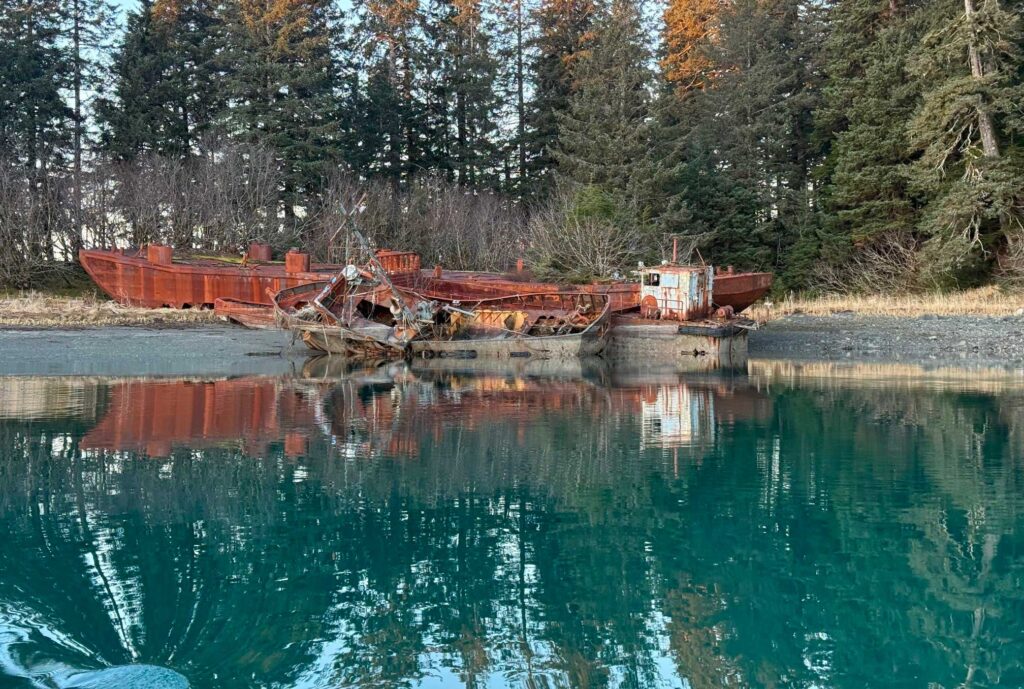
Top: Lulu is one of the abandoned boats slated for removal. On the hard in Alaska, it is an environmental hazard, with oils and metals that leak into soil. Above: The cost to remove this commercial vessel from the city and borough of Yakutat in Alaska will be covered by a grant from the BoatUS Foundation. Photo by Martha Indreland
Keating also says some of the winning projects had additional sources of cash, so they won’t be relying on just the grant money alone to complete the planned work. Many of these projects are coming with their own funding, which wasn’t a requirement but it helps to realize an even bigger impact,” she says.
The 10 winning proposals will be handled in the next two years, with that $7.4 million being used to remove more than 300 abandoned derelict vessels. The hope is for the first vessel removals to start before the end of this year, with the caveat that permitting and environmental compliance have the potential to cause delays.
The $7.4 million being put toward vessel removal is part of a $10 million total grant, with the remainder being used for public education, to hold an in-person summit about the overall issue, and to create a first-of-its-kind national database where people can add locations of vessels that need removal. That database, which is expected to launch online this autumn, will also track which vessels get removed.
The existence of such a database that the public can access is a big step forward in trying to make sense of the overall problem and solve it, Keating says. For instance, having real data coordinated nationwide should make it easier for people leading this effort to speak with lawmakers about why the problem deserves serious attention and more funding.
“There are only small pockets of tracking and location information, and it’s not something the public can usually add to, or that a large number of stakeholders can understand the scope of the problem,” she says. “We’re going to quantify the problem.”
Similarly, some of the remaining funds will go toward an educational campaign to help spread the word about on the progress of each grant-winning project. That kind of information sharing will also be new on a national scale, with the intent of supercharging ideas to solve the problem that exists in many places.
“It’s not a single state or region having these issues. It’s all across the country,” she says. “If Washington state is working on X, they don’t always know who else is doing it and how to share that information. We want to position ourselves as that resource on a national level. Everybody can build off the lessons already learned. If we can move faster and smarter and more efficiently toward solutions, it will benefit everybody.”
The in-person summit that will be funded from the remaining grant money, an event called Turning the Tide, is scheduled to take place in December 2026 in New Orleans. This gathering follows a digital-only summit that drew more than 200 attendees this year, with participants talking about numerous topics. They included what the recreational marine industry might learn from other industries when it comes to a vessel’s end-of-life options.
“When you need to get rid of a car, there’s almost always somebody who is willing to take it for free or pay you for it. The same can’t be said for boats,” Keating says. “Typically, boats don’t have any value toward the end of their life, and typically, they cost more to dispose of than the last owners paid for them.”
The goal, she says, is to create a shift in thinking that leads to the realization that a boat can have value at the end of its life. That way, a boat can be taken without the process becoming a hardship. If that goal is achieved, people may not abandon boats and allow them to become derelict in the first place.
It would be a tremendous shift compared to where things stand today, but Keating says she and others involved in this project—even after all the effort they’ve made so far—are undeterred about the significant work that’s yet to come.
“We’ve moved some pretty big mountains already,” she says. “And we have big dreams.”
Work on the ADV removal projects is expected to mobilize salvage crews across each of the announced grant areas later this year as local environmental reviews are completed. Both recreational and commercial ADVs are targeted for removal. The awarded states, communities, organizations and programs include:
Metlakatla Indian Community, Alaska
City & Borough of Yakutat, Alaska
Sitka Conservation Society, Alaska
Terrebonne Parish Consolidated Government, Louisiana
Makah Indian Tribe of the Makah Indian Reservation, Washington
State of Maine
U.S. Virgin Islands Department of Planning and Natural Resources
North Carolina Coastal Federation
Oregon Department of State Lands
Port Authority of Guam
October 2025