In an old book on speedboats, I found a chapter on marinizing aircraft engines for use on boats. Sounds crazy, but after World War I the process of marinizing war-surplus V-12 Liberty aircraft engines really took off. They were lightweight and powerful—400 to 500 hp, depending on who did the marinization, which was a lot of power back then—ideal for Roaring Twenties boaters with the need for speed. The principles of aircraft engine design were soon adapted for marine engines, leading to the Packards that powered PT boats in World War II and the light, strong engines we enjoy in our boats today.
Marinizing terrestrial engines began almost as soon as engines were invented, as early as the mid-1880s according to some sources. The basics of marinization back then weren’t much different than today: The cooling system was modified to replace the radiator with a heat exchanger or keel cooling; the exhaust manifold was water-jacketed to prevent fires; the fuel system was made safer for use in enclosed engine compartments, especially important with gasoline engines; and the drive train was re-engineered to include a reduction/reverse gear.
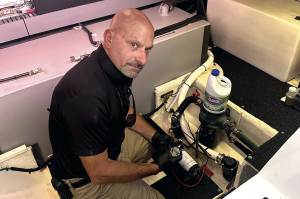
Sounds straightforward, but there’s a lot more to marinizing an engine than just those few steps. To learn more, I spoke with Bas Eerden, global sales manager of Yanmar Marine. His “brief” outline of the steps Yanmar takes to create its popular 4LV series of diesel engines, which starts from a Toyota 2.8-liter common-rail turbo diesel, ran to 18 items.
Eerden stressed that Yanmar builds most of its engines, but the same engine might be used across a range of industries; only a small percentage end up in marine service. Yanmar Marine purchases the engines from Yanmar and marinizes them. However, if Marine has a need but Yanmar doesn’t have a suitable block, “We’ll source from reliable providers,” Eerden says. One is Toyota. Its 1GD-FTV diesel, in use for more than a decade, is Toyota’s primary small truck and SUV diesel, and has been proven in very tough service. There are millions of them in use all over the world. When marinized to Yanmar Marine standards, the Toyota truck diesel becomes the 4LV, available in five models from 150 to 250 hp.
“We do a lot to it,” Eerden says.
First, he says, boats use a different ECU mapping than trucks. Common-rail diesels like the 4LV rely on an engine control unit (ECU) to regulate fuel delivery—timing, pressure, duration and frequency. Rather than a single injection for each combustion stroke, there are frequently several smaller injections to maximize efficiency and power, and reduce emissions. The ECU takes input from many sensors on the engine to determine how to control fuel injection. Cars and trucks run at a low percentage of load, but boats often run at higher loads, and for long periods. But they are also used many fewer total hours per year than a typical car engine. Yanmar Marine engineers have to remap the Toyota ECU to match that different usage.
Because a marine engine is used fewer hours than a car engine, it can be tuned to produce more horsepower, Eerden says. The 4LV is rated up to 250 hp, while the Toyota diesel in the Hi-Lux truck produces 201 hp. Yanmar Marine replaces the Toyota injectors with bigger injectors that can deliver more fuel to get the increased power. Yanmar also changes the turbocharger, not only so it can be intercooled by water—truck turbos are air-cooled—but so it matches the load patterns of marine use.
Yanmar Marine moves the low-pressure fuel pump onto the engine; in a truck it’s mounted in the fuel tank. A new air filter is added to allow the engine to breathe easier, along with a custom-engineered oil cooler and a diesel cooler. Diesel engines pump much more fuel than is burned; the excess both cools and lubricates fuel system components and is returned to the fuel tank. Eerden explains that when the fuel level is low, the hot returned fuel will heat the diesel in the tank. Hot diesel not only has less power than cold, but it also provides less lubrication, allowing increased wear in the injectors, fuel pump and other components. A diesel cooler prevents this.
Yanmar designs and casts a new oil pan, one that’s strong enough that the engine can sit on it without damage. But the main reason is to reshape the pan, so the oil pickup won’t be starved when the boat pitches, rolls, yaws and otherwise gyrates. Trucks are usually on an even keel, Eerden says, but boats often are not, especially since some sailboat owners motorsail, running the engine while the boat’s heeled. A standard design pan could starve the engine of lube oil even under normal boating conditions. More rugged engine mounts are cast, too, redesigned to match a boat’s engine beds.
Yanmar diesels are known for their unique silver-grey finish, but the paint’s important for more than just cosmetic value. Marine engines, like everything on the water (especially salt water), fight a never-ending battle against corrosion. The parts used in marinization are chosen not only for maximum corrosion-resistance, but once complete, the entire engine is sprayed with Yanmar Marine’s super-corrosion-resistant paint. Special care is given to the oil pan and other areas that meet bilge water. Marine engines rarely wear out. They’re more likely to corrode; a healthy coat of paint helps them live out their allotted lifespan.
Finally, Eerden says, there are some options available with the marinization package. One is a protective top cover for the engine, made of aluminum thick enough to stand on, convenient for folks who climb down into the engine room to service their diesels. But maybe more useful is a second alternator, providing extra charging power to match today’s tendency to pack in high-capacity lithium battery banks. The optional alternator can generate 12, 24 or even 48 volts. Higher voltage means smaller gauge wires, which can then make for easier and less expensive connections between high-draw appliances of similar voltage—such as bow thrusters, windlasses and electric cockpit grills. Finish the marinization package with a guard to keep clothing, and maybe hair, from getting caught in the belts when the engine’s running.
Seagoing engines have come a long way since the Roaring Twenties. While today’s gas and diesel engines might not be able to fly, they can make modern boats leap across the waves, and with proper marinization, they can keep doing so for years and years.
This article was originally published in the August 2026 issue.