Great boats rarely die. Often, they morph into even greater boats. A case in point is the Sabre 51 Salon
Express, a serious cruiser designed to displace the builder’s beloved 48.
The 48 debuted in 2011, combining reliable seakeeping and performance with classic lines that aged well. Layouts were handsome and livable. In short, the 48 delivered on Sabre’s mantra to build boats for people who really use them.
“We’re not destroying the molds or anything like that,” said Kevin Burns, vice president of design and product development. “But they’ve come to the end of their useful life. We built more than 200 of the 48. It’s had a good, long run. And the beauty of that is we were able to glean insights from all those owners before going to the drawing board to create the 51.”
During a sea trial off West Palm Beach, Florida, Burns explained how instead of simply adding to things that worked on the 48, Sabre began the 51 with a blank sheet. “Every feature had to earn its way onto it,” Burns said.
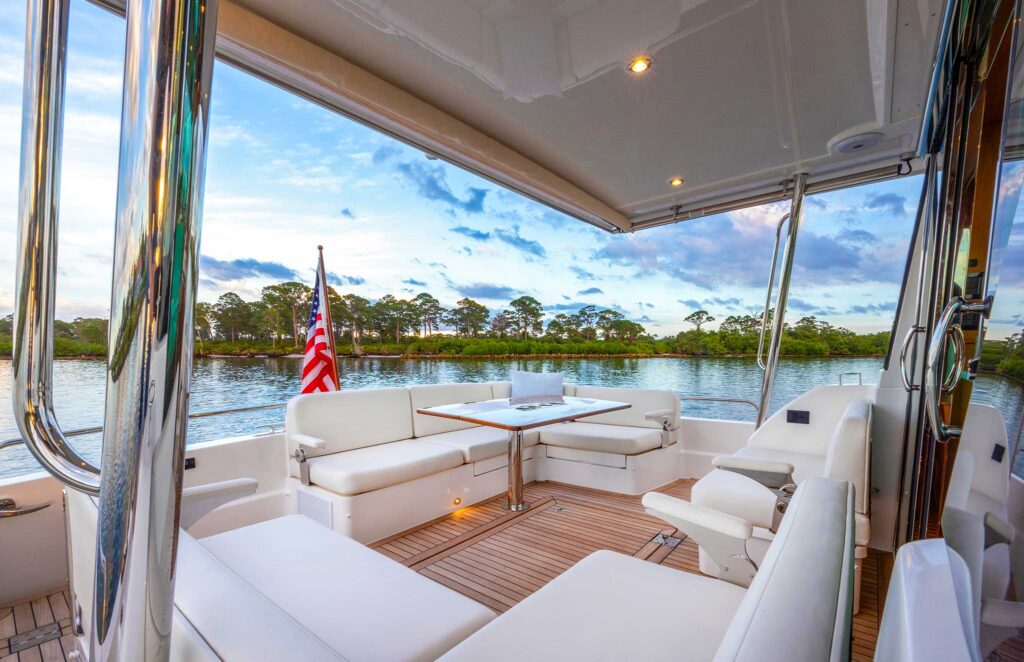
There are big differences between the two boats, and similarities, too. The cockpit is just one area with what Burns called “evolutionary changes.” The scale is impressive, and the seating is arranged to maximize comfort, movement and socializing—you can see and hear the person you’re having a conversation with across the teak-covered deck. And then there’s the hardtop, which is elongated to protect passengers in the aft-facing seats, but not so big as to make the space feel too enclosed.
“We wanted to create a real alfresco space, so we engineered a full-scale mockup of the cockpit in the factory to measure everything,” Burns said. “We wanted to nail all the dimensions, big and small.”
The 51 showcases a few firsts for Sabre, including a convertible foredeck lounge with twin seats. “Owners have been asking for a proper place to watch fireworks from the bow,” Burns said. “They don’t want to sit on the cabin trunk.” The engineering team designed the seat to fold flat when not in use, meaning the 51’s silhouette is uninterrupted. Like its siblings, the 51 has moderate sheer and a low-profile superstructure, with no exaggerated angles. She looks cohesive, classic and seaworthy.
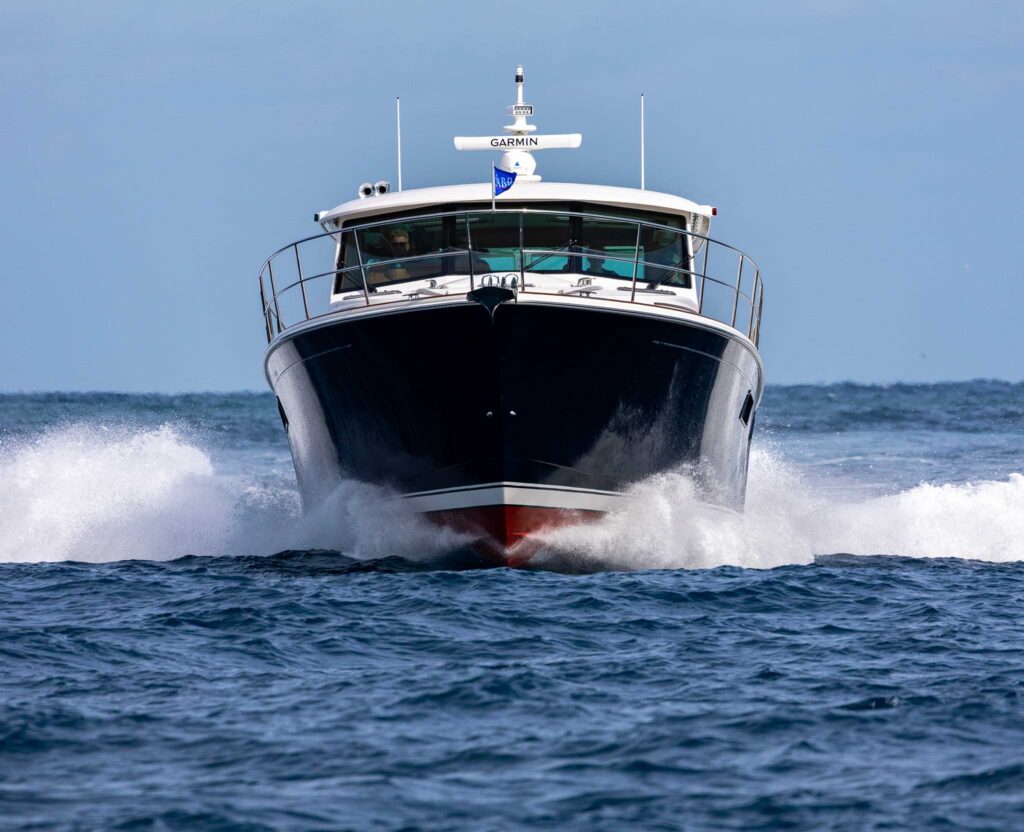
Burns was behind the wheel when we took the boat offshore. Twin 600-hp Volvo Penta D8-IPS800s with joystick control powered the modified-vee hull that he called “the grand sum of everything we’ve learned as an engineering organization.” That includes efficiencies, ride quality, the capacity to deal with varying conditions, and the fact that this boat is extremely fun to drive. “It’s taken a lot of institutional knowledge to get to where we are today,” he said.
Like other Sabres, the 51 has a flared bow that does more than look good. It creates reserve buoyancy to dampen longitudinal motion. And the boat is built on the heavier side (45,300-pound displacement) for a solid ride.
Top-end speed during our run was 32.4 knots at about 3,100 rpm, but the more critical number was 2,800 rpm, which Sabre recommends for maximum continuous cruise. Our speed at that pace was 28.2 knots, with a range of 299 nautical miles, burning 51 gallons of fuel per hour.
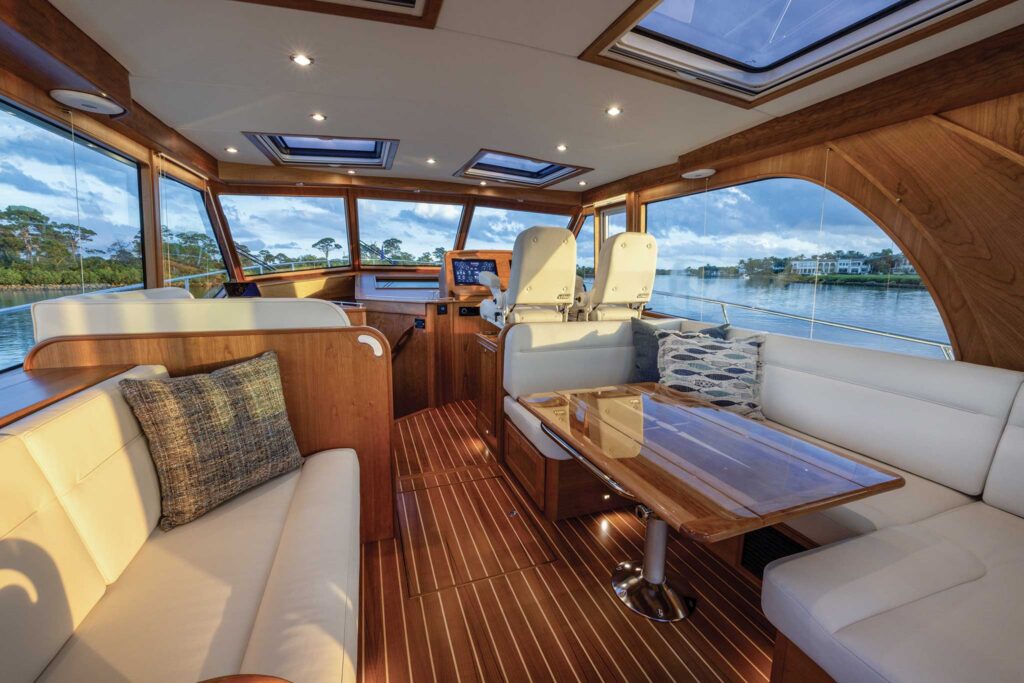
Another first for Sabre is the power-actuated step at the helm that can be raised or lowered for captains of different heights. When retracted, the step stows under the module that supports the Stidd helm seats. It’s one way the builder improves visibility. “We spend a lot of time focused on where the eyeballs are going,” Burns said.
The windshield is constructed with frameless glazing and smaller mullions for fewer visual distractions. In addition, its position relative to the bow is farther forward than on other Sabre models, broadening the skipper’s view and creating more volume in the salon. Advancements in composite tooling made it possible.
Sabre also eliminated the dash that I expected to see to port. As a result, there’s a wide entry at the companionway that leads belowdecks, and it provides an atrium effect, drawing lots of natural light to the accommodations level.
Design evolutions like this say something about Sabre owners. The company reports that all its customers operate their own boats, even the flagship 58 Salon Express, with a length of 66 feet. They tend to cruise long distances, too. “They’re not looking for a waterfront condo,” Burns said. “So we bring an authentic, nautical sensibility to everything we do. It’s been that way since Roger Hewson founded the company in 1970.”
That sensibility also surfaces in features like Sabre Connect, a digital networking system that centralizes control and monitoring of AC and DC power, along with key systems. It allows for remote access with an iPad or the Sabre Connect app. Owners can spool up the Seakeeper from home before heading to the dock, or use traditional physical switches at the helm for basic functions such as running lights, engine room blowers and bilge pumps.
While Burns was at the wheel, Allie Alsup, Sabre’s marketing and social media manager, pointed out the cabin’s thoughtful and practical layout. The aesthetic is polished. Domestic cherry wood warms all the living areas, and the quality of the joinery is what you’d expect in a boat built by expert craftsmen in Raymond, Maine. On the main level, the salon has a U-shaped settee, folding high-gloss table and wet bar aft to serve the cockpit.
Below, the master stateroom with en-suite head is amidships; a guest stateroom with its own head is forward. The layout is like the 48’s because the location of these staterooms is the same, but there’s a lot more space, along with new fixtures and finishes that are elevated and easier to maintain.
“We had tiles in the shower for years, but now we’ve gone to a solid surface, which is a lot easier to clean without the grout,” Alsup said. “We keep things fresh.”
In the guest room, Alsup opened all the drawers, cabinetry and hanging lockers to emphasize how much stowage is on board. “Our owners need it,” she said. “Some live on their boats or use them as second homes, spending months on board.”
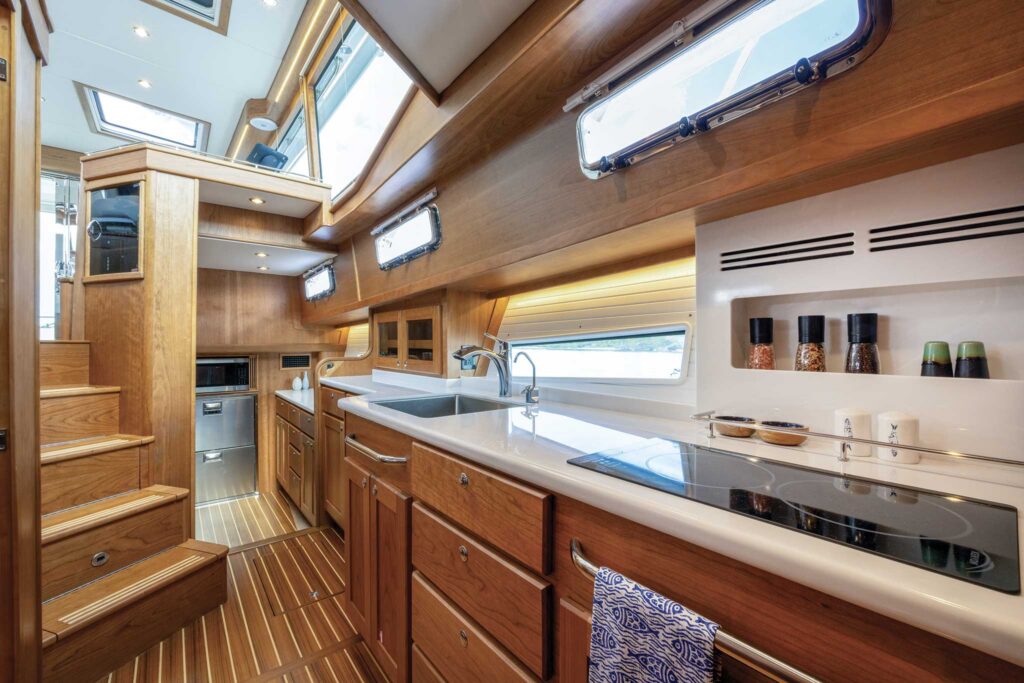
In the galley to port, there’s a sink, induction cooktop, microwave, refrigerator and more storage. The variety of drawers, shelves, cabinets and cutlery holders is intended to satisfy owners who like everything in its place. A nice surprise is the extension of the galley aft. Sabre carved out space for a coffee station and storage for appliances such as espresso makers and air fryers that people can’t seem to cruise without these days.
“I think of this space as one of those renovated areas you see on HGTV,” Alsup said. “It’s like we knocked out a wall and opened it all up.”
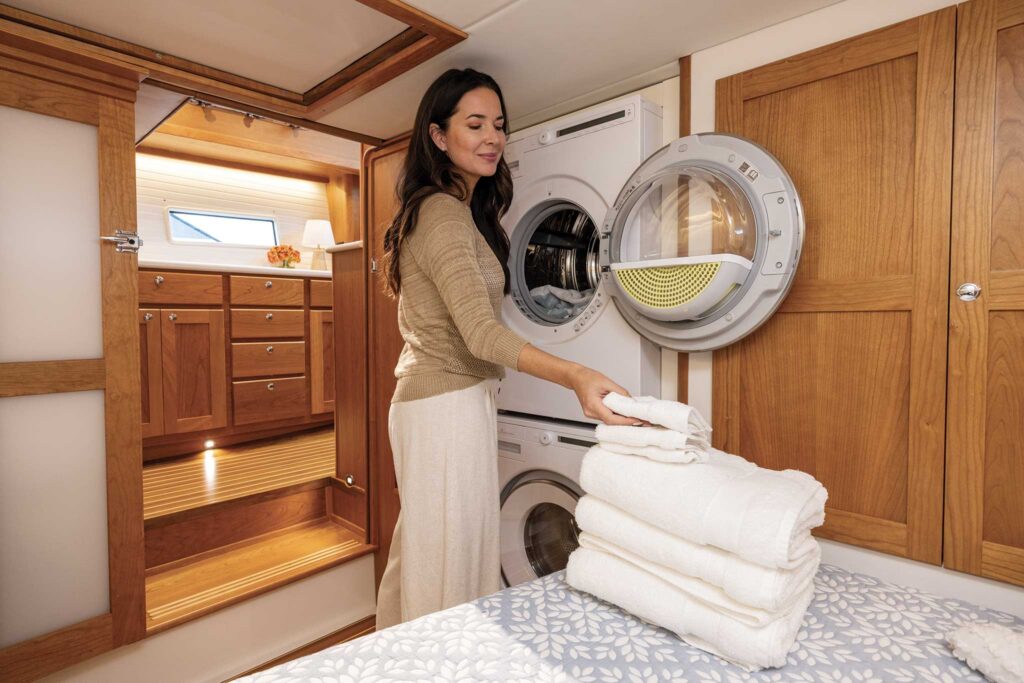
Just past the coffee station is a utility room that can be optioned with a berth for extra guests, a desk for a remote office, a workbench for the DIYer or an oversized laundry space with a washer and dryer. The 48 has this utility area, too, but it’s not as easy to access, as it requires walking up to the salon and then down a few steps abaft a seat in the salon.
“It’s another example of evolutionary design,” Burns said. “We’re trying to keep the things that are good and rethink those that can be better.”
LOA: 57’5”
Beam: 15’11”
Draft: 4’1”
Displ.: 45,300 lbs.
Fuel: 600 gals.
Water: 160 gals.
Power: (2) 600-hp Volvo Penta IPS800s
This article was originally published in the April 2026 issue.