Courtesy Boston Whaler
And yet that’s the reality with today’s center- and dual-console boats. Whether you call these models hybrid, crossover or multipurpose, the trend is the same: Designers are aiming to make fishing boats more cruiser-friendly, and cruising boats more fishing-friendly, with whatever special touches they think will grab the attention of people who want a single ride for the whole family to enjoy.
“Depending on what brand you are, that affects how you’re trying to achieve that goal,” says Grady-White senior product designer Christian Carraway, who worked on the builder’s new 321 Coastal Explorer. “If you look at a Tiara, they were always a great cruising boat, and they now offer a fishing package. Or if you look at a Regal, it’s the same sort of thing. They always made fantastic cruising boats, but now they’re starting to build center consoles with outriggers and live wells. You’re seeing these extremely luxurious, extremely comfortable boats that are also capable. And in many cases, there’s also fishability. It’s unique to see companies that have never been in the category before trying to get their foot in the door.”
At the same time, Carraway says, teams like his own at Grady-White are working toward the same do-it-all goal from the opposite angle of approach. “Back in the ’80s and ’90s, we were the hard-core, well-built fishing machine,” he says. “And what we realized back then is that to continue to be the top-tier premium brand that people thought of us as, we had to incorporate more comfort and versatility. We also had to build boats that you could take to the sandbar or out to dinner.”
Mark Taiclet, director of brand management for Pursuit, says this trend also impacted his brand’s thinking when conceiving the new 286 DC, but from an opposite viewpoint. “A lot of brands out there have done a lot of hard-core fishing boats, and that’s kind of what their niche is, but they’re actually trying to chase down what we’re doing,” Taiclet says. “They’re adding little pieces to make the boats more comfortable, adding a seat here or there. But we’re actually designing all of that seating, and the luxury and the entertainment centers.”
At Boston Whaler, designer Kristin McGinnis says working on the new 330 Outrage also involved this kind of thinking, only from her brand’s standpoint. “Comfort features, social features—these were some of the additions to the new 330, like the forward bow lounge layout,” McGinnis says. “Not only do people want to be able to go 70 miles offshore and score some tuna, but they also want to be able to take their families cocktail cruising or dock dining at restaurants.”
It’s a different mentality from the one skippers had years ago, when some kept a fleet for whatever type of boating was on tap for a given day. “When I first started [in this business], people just had the expectation of having their adult cocktail cruise boat, a wakesurf boat for the kids, and then a pontoon if they’re bringing the dogs,” McGinnis says. “Now people are looking for something that does a little bit of everything.”
Wellcraft 243 Fisherman
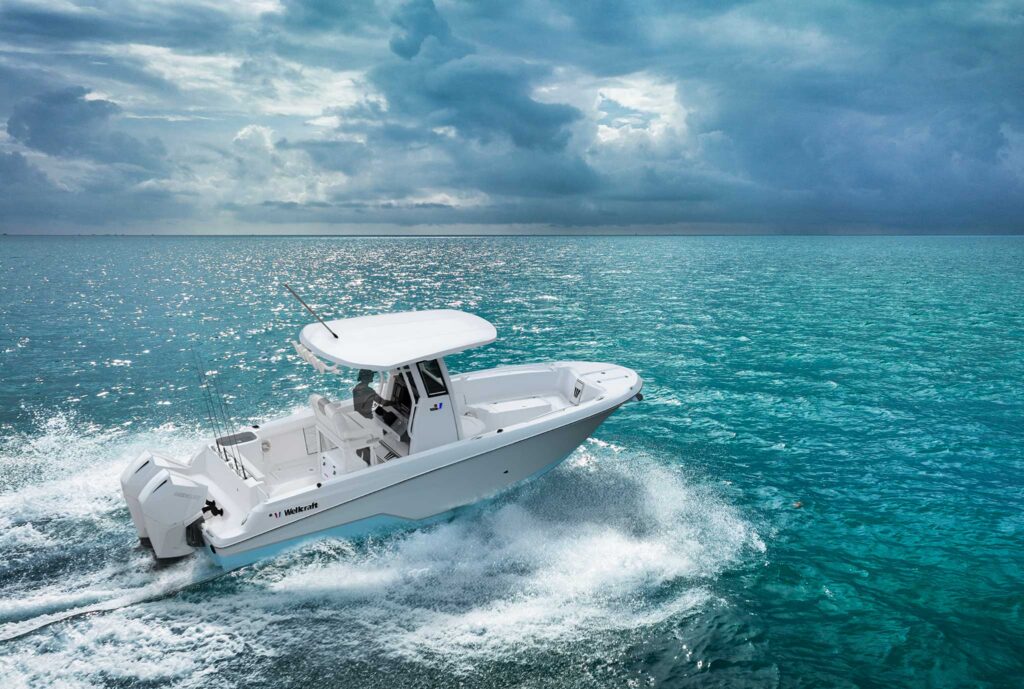
Wellcraft CEO Ken Clinton says that after being with Intrepid Powerboats for more than three decades, the first thing he did at Wellcraft was an evaluation to make sure the 243 Fisherman could compete with today’s do-it-all fishboats. “I stepped on that boat the way it was designed prior to me, and the first thing I noticed is the motor. Where the engines went, it looked way too deep,” he says.
His team repositioned the engines in a way that, when combined with moving the console 4 inches forward, gained an entire foot of space in the cockpit of the 24-footer. Updates then included adding a larger bait well, moving the transom door over 8 inches to widen the aft seat, and moving a bulkhead to gain an extra 37 gallons of fuel. Numerous changes of that nature, plus the inclusion of more creature comforts, are what he hopes will make the Wellcraft 243 a serious contender in the competitive trailerable fish/cruise niche.
“It’s got this beautiful forward seating with a backrest facing forward so you can lounge,” Clinton says. “You can put in a table insert to create a sunpad to lay out, or remove it to fish. There’s room for the kids, and there’s a nice head down below in the console, so the boat gives you all of that. There’s a ski pylon that you can put in if you want to tow the kids on the tube behind the boat. Let’s be honest: Boats take up space. When you have to put them someplace, it costs money for storage. So if you can have one boat instead of three that does all the things that you need to do, then that’s what you do.”
WELLCRAFT 243
LOA: 24’4”
Beam: 8’6”
Draft: 2’1”
Weight (dry): 4,900 lbs.
Power (max): 400 hp
Boston Whaler 330 Outrage
Courtesy Boston Whaler
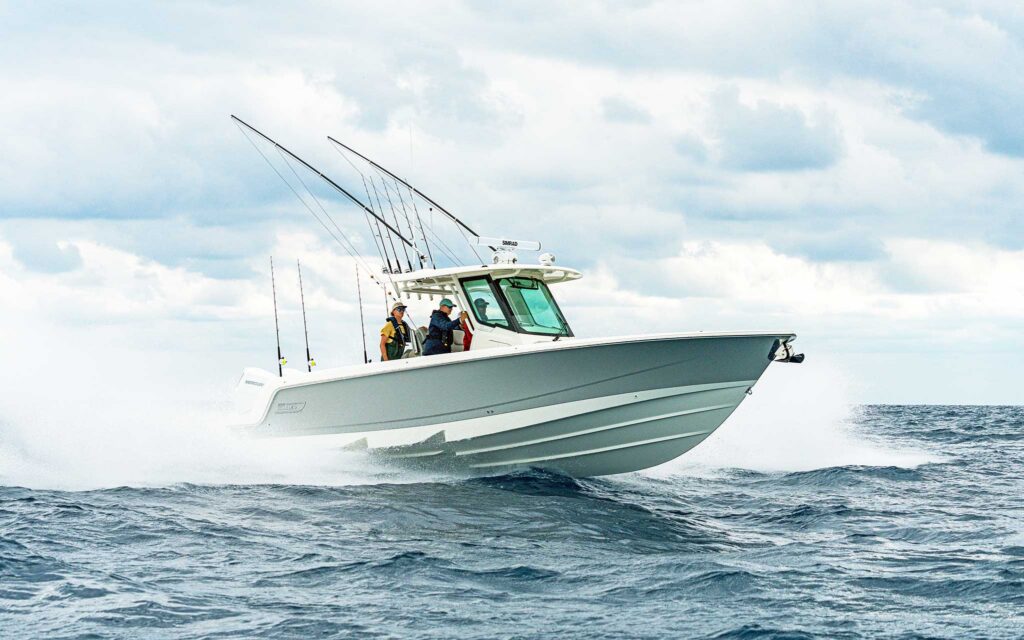
McGinnis says the journey to this first Whaler with a stepped hull began more than 13 years ago. “We patented the basic idea of the T-step hull, but it didn’t necessarily capture all the little tweaks the naval architects had to do for production,” she says.
And what a difference all those tweaks make, she adds. McGinnis, after more than a decade in the recreational marine industry, has done her fair share of offshore sea trials. “Usually you’re out for eight or nine hours, and you get back and you’re beat up and exhausted,” she says. “We’re trying to hit waves as hard as we can out there. We want to find where the boat is going to break and preemptively fix it to make it stronger. Well, when I went offshore in this 33, I didn’t need any aspirin. I felt fine. It ran so much softer than even a traditional V-bottom boat.”
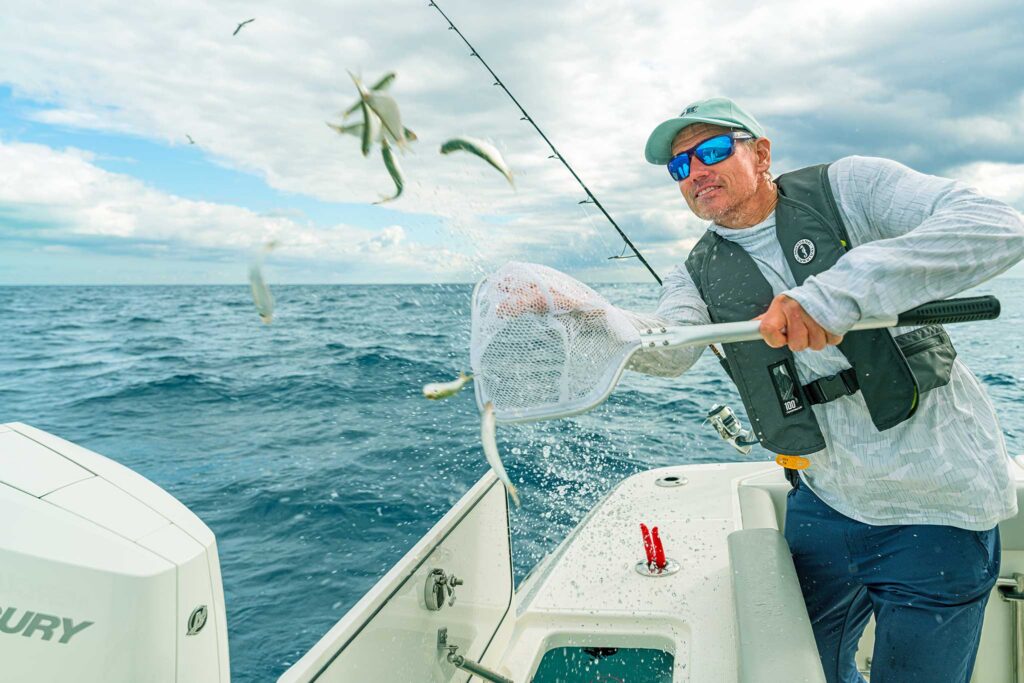
Boston Whaler also was able to achieve a 5 to 7 percent performance improvement, especially across longer cruising distances, she says. And the team hit their desired retail price by simplifying onboard systems to what boaters in this size range actually need. “It doesn’t have digital switching systems. It doesn’t have air conditioning,” she says. “It’s a large-ish boat, but you can just jump in it and go. You don’t have to prep all your systems. We were very cognizant of keeping the 33 as the distillation of what the experience should be.”
BOSTON WHALER 330
LOA: 33’0”
Beam: 10’2”
Draft: 2’1”
Weight (dry): 9,800 lbs.
Power (max): 850 hp
Grady-White 321 Coastal Explorer
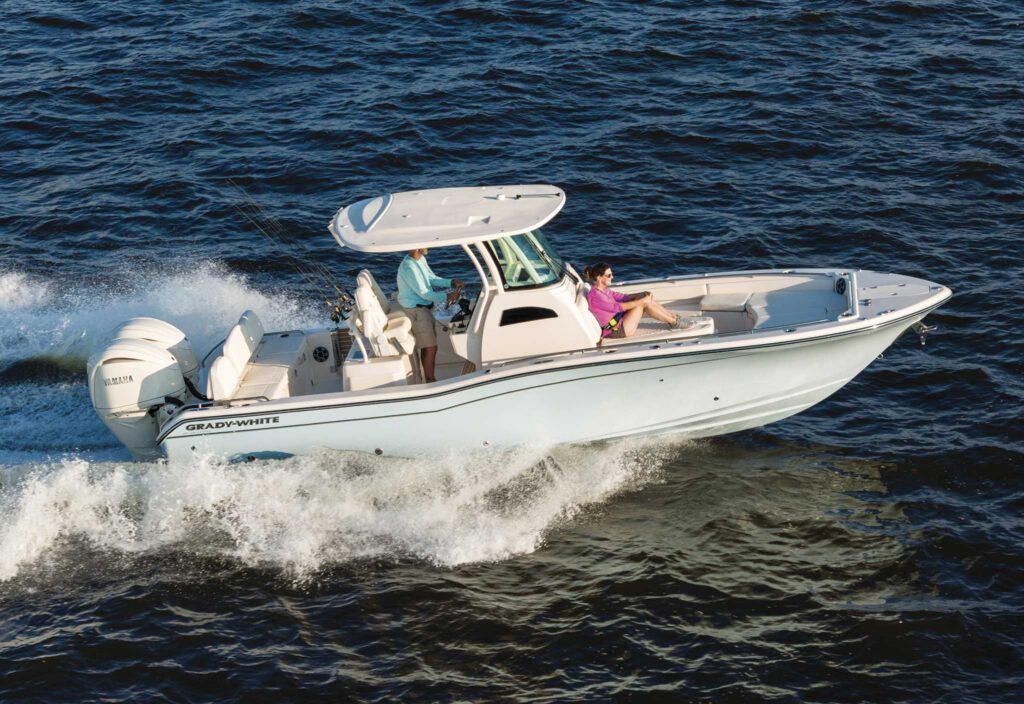
Carraway says a focus on what boaters want shaped the design of the 321 Coastal Explorer, which debuted in February. And these days, more owners want a boat that can be flexible in terms of where it can be used for fishing and cruising.
Grady-White uses the descriptor “all-shore” when talking about the 321 CE. Essentially, it’s a hybrid design that can be used for inshore or offshore fishing and cruising. The key to that versatility is the deadrise aft: Coastal Explorers have less of it than other Grady-White models. On the 321, for instance, transom deadrise is just 16 degrees.
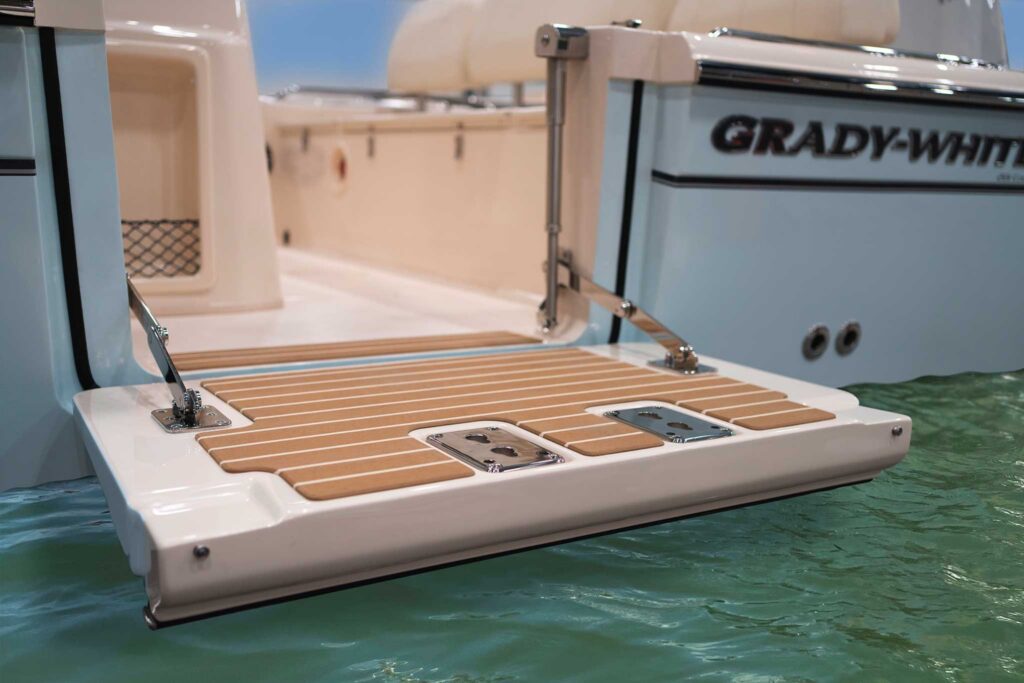
“You get a lot of the same running characteristics that people like on our boats—the stability at slow speeds, getting on plane with less bow rise, the wave-cutting ability—and in addition to that, you can go into shallower water,” Carraway says. “That gives you the versatility to go into skinnier fishing holes or to the sandbar.”
Creature comforts, too, are part of the 321’s brief. “We have comfortable, adult-size seats for 15,” he says. “If you look at other brands’ seats, they’ll sculpt them to look like a three-seater, but it’s maybe three kids. Our seats are all big enough for adult males.”
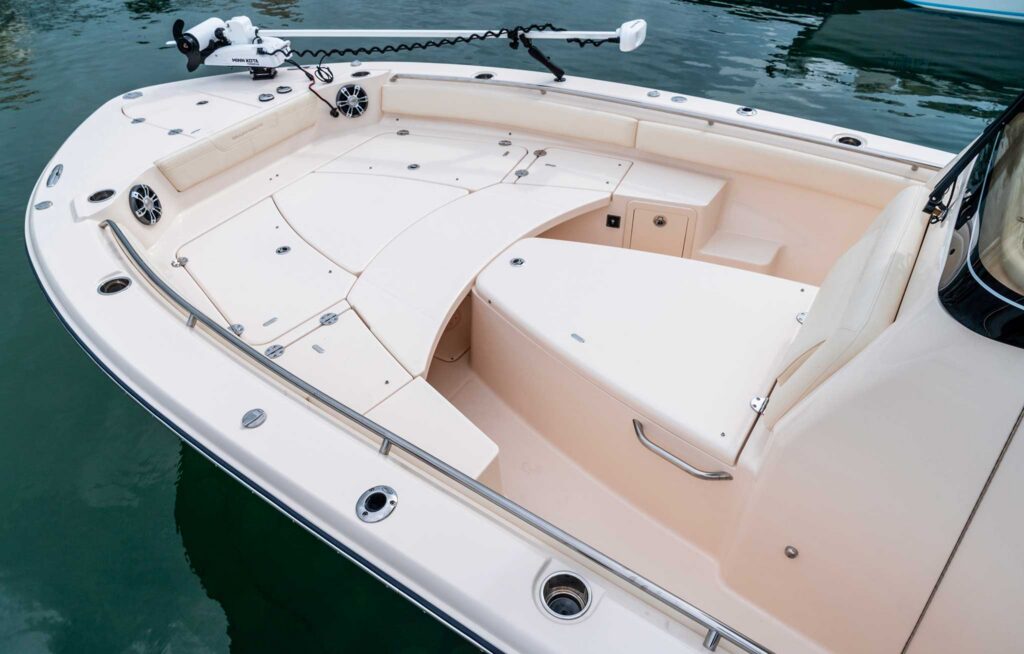
Such details are differentiators, he adds. “Our seats are at the right height with thick, plush cushions and backrests that are inclined appropriately. Fishability might be tit-for-tat, but our competitors aren’t at the level of comfort that we’ve been able to achieve.”
GRADY-WHITE 321
Centerline length: 31’7”
Beam: 10’6”
Draft: 1’10”
Weight (dry): 9,800 lbs.
Power (max): 700 hp
Pursuit 286 DC
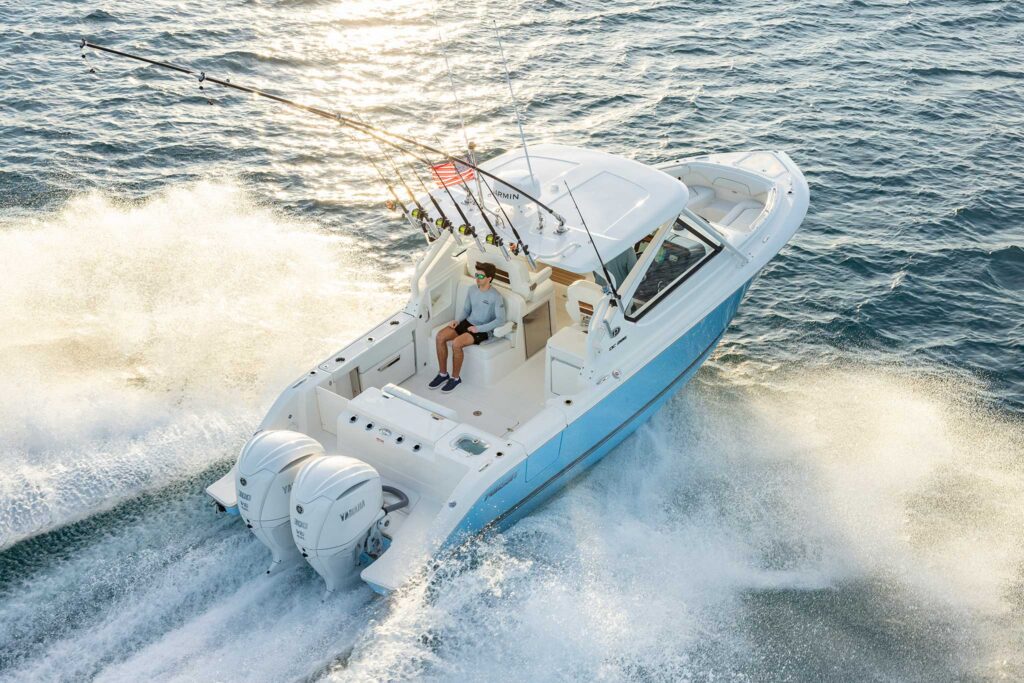
Taiclet says this new dual console is the result of Pursuit learning more about how customers really use their boats. One feature he calls out is the ladder that attaches to the bow. “It’s a simple thing. When you pull up to the beach bow-first, you can get off and on the boat from that ladder, rather than having to get in the water and swim around to a hull-side door or the transom,” he says. “The first company I saw do a bow ladder like that, you couldn’t get a windlass if you ordered it. When we did our first boat with the bow ladder, we made sure you can get the windlass, too.”
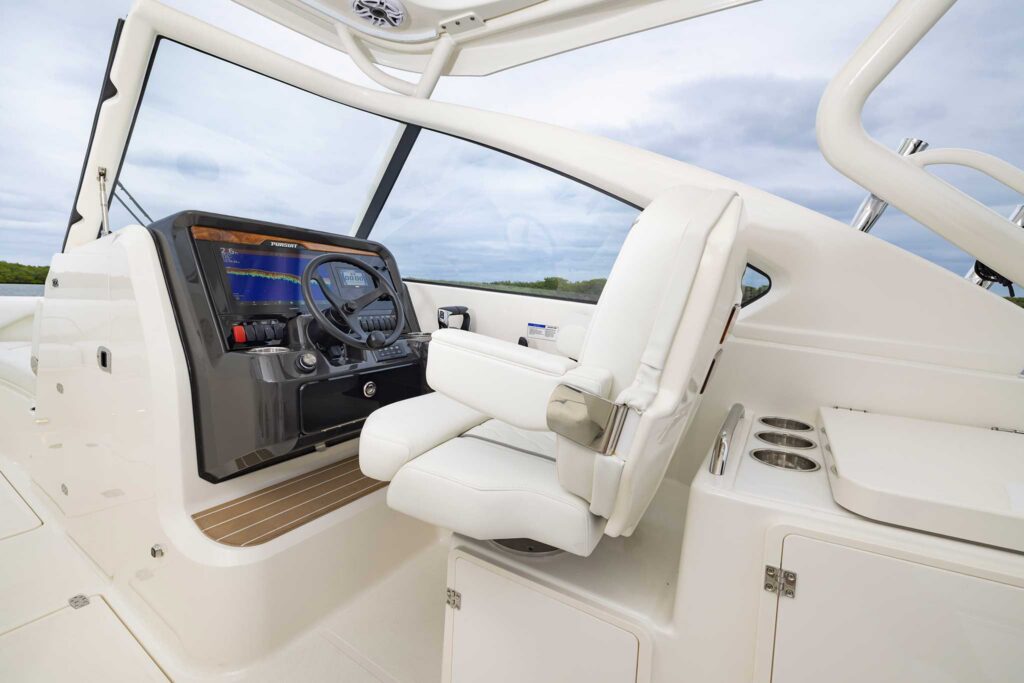
The Pursuit 286 DC, he says, has everything anglers need—from rod holders to prerigged wiring for electric reels—plus essential creature comforts such as a wet bar, ergonomically designed seats and drink holders in easy-to-reach spots. “We’ve been putting more focus on that recently, making sure that there are plenty of drink holders while being more selective with where they are located,” he says.
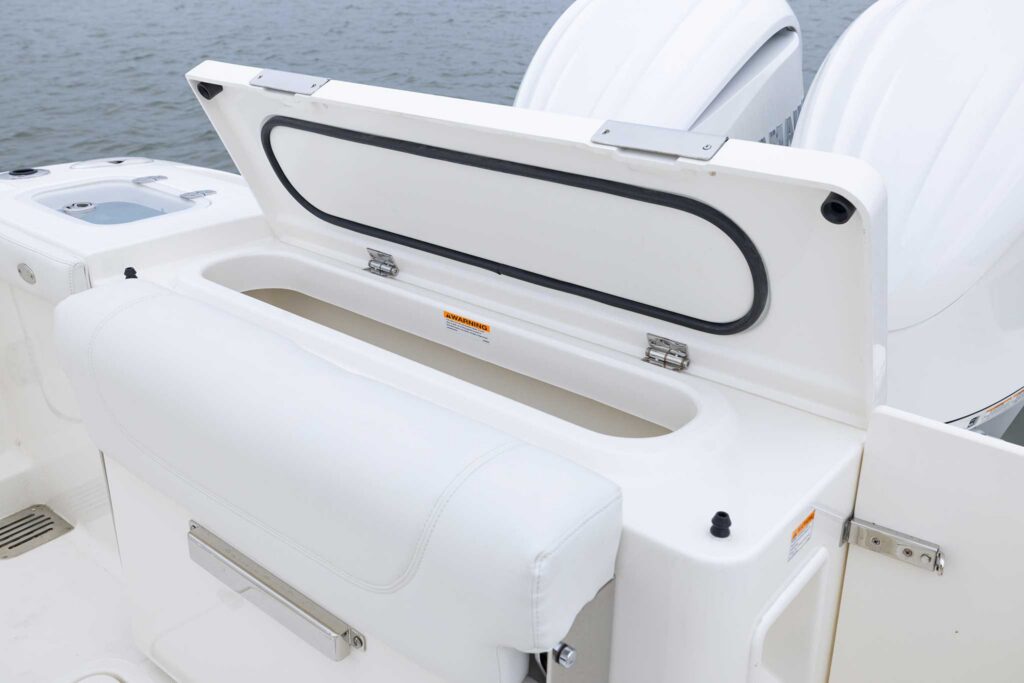
The builder also put an emphasis on stowage. “And we have so much storage in the boat that I don’t see why anybody would ever have to use the head compartment as a place to tuck away their gear,” he adds.
PURSUIT 286
LOA: 30’0”
Beam: 9’6”
Draft: 2’0”
Weight (dry): 9,340 lbs.
Power (max): 600 hp
This article was originally published in the May 2026 issue.